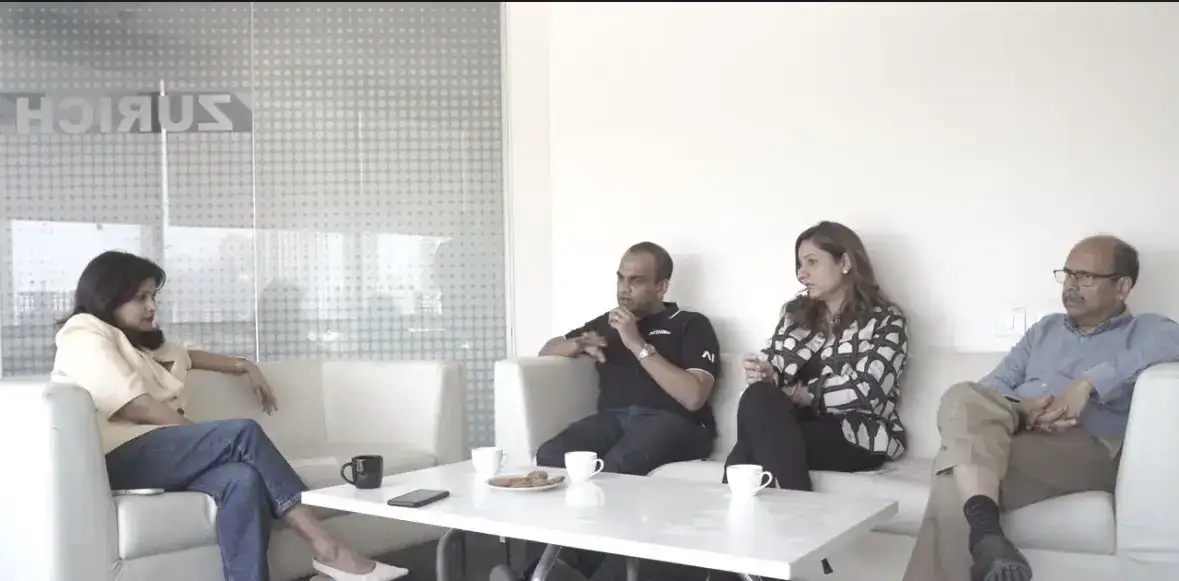
On the eve of Mumbai Tech Week, Sharad Sanghi of Neysa AI, Aakrit Vaish of Activate, and Naiyya Saggi of EDT spoke with ETtech editor Samidha Sharma about data centres, India’s AI investment gap, and building a startup ecosystem in the city.
What has TEAM been able to accomplish since 2022?
Vaish: The idea came together when Harsh Jain reached out about losing talent to other cities. We called a group together, brainstormed, and TEAM launched in November 2022. Membership will cross 100 this year — effectively close to 100 unicorns and soonicorns from Mumbai. People are often surprised. They ask, where are all these companies? But they are here, across a wide range of sectors. Over the past year we held close to 100 events, run YPO-style peer forums, and have become a coordination point when global tech leaders visit.
What is Mumbai’s specific claim in the AI story?
Sanghi: Mumbai is the data centre capital of India — 50% of the country’s capacity is here. Power quality is the best in the country, we have the highest undersea cable connectivity, and virtually all major banking, financial services and enterprise headquarters are based here. Data centres are the foundational layer of the AI stack, so the maximum concentration of AI infrastructure in India is in Mumbai.
Saggi: If you are looking at real-world, at-scale AI application — BFSI, consumer, healthcare, media — it is all Mumbai-based. Last year’s Mumbai Tech Week was Asia’s largest AI-focused event. This year we expect more than 10,000 attendees. A job fair we seeded last year received over 30,000 applications for AI roles in Mumbai. It has become one of the largest meeting points for AI job seekers in the country.
Where does India stand in the global AI race?
Vaish: The problem is not that India has no AI story. The problem is that the benchmark has moved so far ahead. I track 103 Indian AI startups I consider strong — built for India, not pivoting to the US. But those companies don’t need more than a few million dollars each to get off the ground. Total investment becomes a few hundred million dollars. That is an angel cheque for a big lab today. India has one model company and two data centre companies. That is the challenge.
Sanghi: Risk appetite for deep AI infrastructure investment remains limited here. Just recently, Base 10 and Fireworks — broadly in the space Neysa is building in — announced raises of $8 billion and $11 billion respectively. Our Rs 1.2 billion raise feels reasonable for India, but in the global scheme it is nothing. Enterprise adoption is also tempered by the low cost of labour. In the US, companies outsourced to India for labour arbitrage. Now AI delivers that arbitrage, so adoption there is much faster. In India, enterprises are more careful about demonstrating ROI — but that is changing. We are seeing significant AI use cases in production now.
What can policy do to help, how has TEAM been able to facilitate these conversations?
Vaish: Two structural constraints hold India back — time and talent. Nearly all core AI research talent globally is concentrated in a tiny geography. That makes building foundational technology harder everywhere else. On the market side, even frontier labs derive most revenues from B2B enterprise — a segment where India’s depth is limited by GDP per capita. Where government support has come, it has mattered. Sarvam’s model does not get built without India AI Mission support. My prescription: policymakers should seed private AI companies that can then attract broader capital.
Saggi: There are two imperatives — promoting India-centric founders and solutions, as governments have done in manufacturing through PLI-style incentives, and treating AI as a matter of national sovereignty. Whether it is hardware, defence, robotics or how our data is used, this needs to be localised and held on national turf.
What are TEAM’s priorities over the next two years?
Vaish: Making Mumbai the default choice for founders returning to India to build. Increasing the role of women in the city’s tech narrative. And broadening what we mean by tech — hardware startups, BFSI, second-time founders are already part of the fold. The hackathon we held was the largest generative AI hackathon in the world. We have a Guinness World Record for it. That is the energy here.