While it sometimes feels as if there is as much chance of the pope giving mass in ripped jeans and a backwards baseball cap as there is of football’s governors changing the laws of the game, now and again the sport’s powers-on-earth do enact radical departures from the norm. Who among us can say that football has not been uplifted by, for example, the introduction of the offside law or the ban on the back-pass? So the people who run the game do know that there is a difference between conservation and complacency even if it takes a long time to convince them that the most popular sports on earth needs to be improved. This weekend, then, they are meeting to discuss, and possibly introduce, significant changes.
The International Football Association Board, whose continued existence is a cause and effect of the conservatism around the game’s laws, is gathering in Belfast to consider – and in some cases make rulings on – a variety of amendments to the laws, including the abolition of so-called “triple punishment”, the introduction of sin-bins, video replays and a fourth substitute in extra time, and the institution of transparent timekeeping.
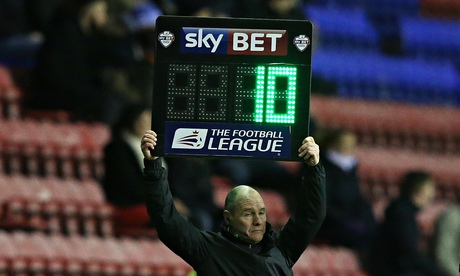
Let us start with the last of those because it is, surely, the easiest to agree on. Following a proposal by US Soccer, Ifab will consider whether to take time-keeping out of the referees’ hands and stop a visible central clock when there are breaks in play so that everyone knows precisely how long there is left to run in a match. That would foil time-wasters and eliminate murkiness and conspiracy theories, and, by the by, allow fans to amuse themselves with triumphant countdowns and deprive broadcasters of easy shots of managers of trailing teams swiping in the air in outrage when the fourth official indicates a minimum of just two minutes of time added on.
It would also raise the tantalising possibility of football introducing rugby-style hooters to signal the end of the game, possibly with each team given the authority to decide what sound they want to use at their home ground, paving the way for an array of chimes to rival the buzzers on the QI quiz show. Not only would this give football fresh appeal to the ringtone generation but it would also enable Arsenal, for example, to signal the end of another European tie with a loud whoopee cushion parp, Aston Villa to announce the conclusion of games with an alarm clock wake-up call, and West Ham to mark the completion of 90 minutes by airing a recording of supporters calling for the manager to be sacked, win, lose or draw. Actually, they’ve introduced that already, haven’t they?
Unfortunately this particular proposal is only up for discussion – as opposed to decision – this weekend, so it will not become law just yet even if Ifab indicate approval by ringing wedding bells. The same goes for sin-bins and video technology, as the suggestion is for them to be applied in small-sided recreational games, rather than the professional game, if Ifab rules in favour. Which brings us on to what could actually be passed pronto into law, namely a fourth substitution in extra time and the abandonment of triple punishment.
The notion of permitting teams to make an additional substitute in extra time is intended to enable teams to replace a player who suffers from cramp or fatigue when play goes beyond the standard term, so that the chances of the result being determined by a team’s performance rather than injuries remain high. It is a reasonable point. Gregg Bakowski has argued here that the proposed change would give big teams yet another advantage over less well-endowed ones. That, too, is a reasonable point. Perhaps, then, a better approach would be not to allow another replacement in extra time, but to start removing players. If every, say, five minutes after the 90 both teams had to withdraw one player – a jaded one, if need be, or any other one of their choosing – then the dynamics of the match could be changed in entertaining ways, with every five minutes bringing a fascinating enforced tactical adjustment until either a decisive result or a penalty shootout is reached.
The triple punishment issue is more tricky. It refers to the ruling that a player who prevents a clear goalscoring opportunity in the penalty area concedes a spot-kick, is sent off and incurs a suspension. Uefa insists that this is too severe and that a penalty should suffice as it restores the goalscoring opportunity – sending a player off on top of that, it argues, distorts the game too much. Manchester City’s Champions League meeting with Barcelona last season has been cited as a case in point, with the Premier League side never looking like getting back into the tie once Martín Demichelis was sent off early in the first leg for a foul that gave the Catalans a penalty from which they took the lead.
The first thing to say is that in one way the existing law is not severe enough because, as explained here, penalties should be awarded for fouls that prevent clear goalscoring chances even if they do not take place in the area.
But you can also see Uefa’s point. However, if a player risked only the conceding of a penalty for illegally thwarting a goal, then it will often be a risk worth taking, as in many cases a spot-kick would be a more difficult opportunity than a chance from open play. A striker has an open goal? Chop him down and give the keeper a chance to make a save.
A measure has been introduced in the Bundesliga in attempt to mitigate the triple punishment slightly. If a player is sent off and the ensuing penalty is scored, the player is banned for only one match; if the penalty is missed, his ban is extended to two matches. Critics say this suffers from an anomaly, as it could encourage goalkeepers not to try to save spot-kicks. “What happens if my team is winning by a comfortable margin?” asked the Borussia Mönchengladbach keeper Yann Sommer. “What should I do? Deliberately let the opposition penalty go in, so my red-carded team-mate serves a smaller suspension? That would be the logical thing for me to do.” Manuel Neuer of Bayern Munich says: “The rule should be stopped immediately. It makes no sense.”
Some have suggested that in the event of a foul denying a clear goalscoring chance, a penalty goal should be awarded, like a penalty try in rugby. That would remove all motive from committing the foul, aside from sheer nastiness (except where players think they can foul so subtly that they will not be caught). But it would feel anticlimactic, denying spectators the money shot.
The triple punishment system, then, has the merit of imposing a strong deterrent, which is vital. The downside, however, is that the strength of this deterrent may not be as powerful as the incentive it gives players to dive: not only does a successful simulator get a spot-kick, but he also depletes the opposition. The only way to balance things up, then, is to use video technology to detect and deter divers. But the use of video technology to help referees reach the right decision is still a long way off. It will only be debated this weekend, with a view to introducing it at underage level. Where’s a boo button when you need it?