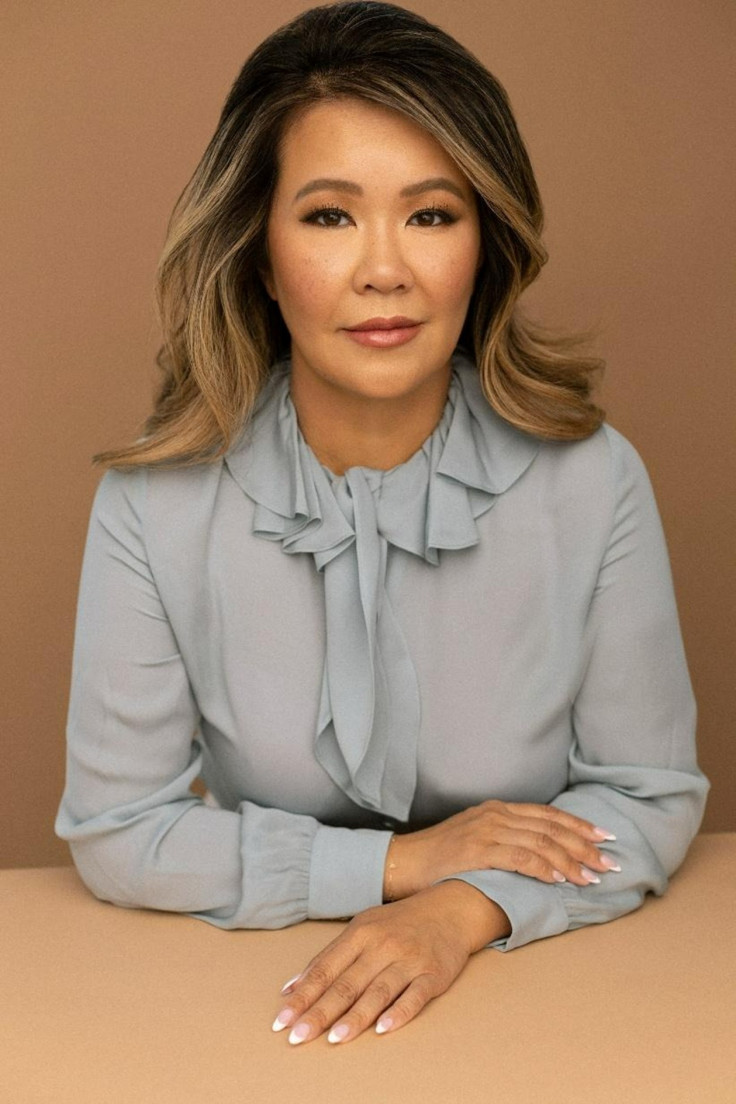
When Lisa Cheng walked onto the wooded grounds in rural Virginia, ready to start a week-long retreat about consciousness, she wasn't looking for a startup idea. She was looking for a reset.
Days were structured around guided meditations, science-based consciousness exploration, and carefully engineered audio frequencies. Nights were quieter where a group of curious people traded notes about what they'd just experienced.
For Cheng, a veteran of early Bitcoin, distributed systems, and Ethereum, one idea kept surfacing:
"If consciousness is trainable and has structure," she recalls, "then we can study it, model it, and build systems that support it."
In another cabin was a software veteran and AI leader who would later become her co-founder. Their hallway conversations would unknowingly turn into whiteboard sessions about world models, memory, and ethics in AI. Without realizing it at the time, they were not talking in abstractions. They were diagramming architectures.
Those sketches became the seeds of Loosh AI, a cognition system, memory fabric, and deontological framework designed to plug into world models, agents, and humanoid robots.
An Early Builder in Crypto and Distributed Systems
Long before Loosh, Cheng was already operating at the edges of emerging technology.
She entered Bitcoin in 2013, drawn to the idea of decentralized systems and cryptographic signatures used as a chain for verification. From there, she moved into one of the ecosystem's first token launches, helping to define playbooks that much of the industry would later follow.
Her trajectory took her to the Ethereum Foundation, where she contributed during the formative years of smart contracts and programmable money.
But Cheng did not just sit in the technical trenches. She had a knack for translating complex systems to broader audiences. That talent led her into the cultural side of markets.
She was an early operator in the WallStreetBets company, overseeing partner projects that would lead her into the Metaverse, NFTs, and Decentralized Finance.
She signed an iHeartRadio deal for a WallStreetBets show that blended trading culture, crypto, and market education. The experiment paused when her co-host fell ill, but it confirmed something important. Cheng could move comfortably between deep infrastructure work and mainstream conversation.
These experiences left her with a unique vantage point. Part engineer. Part storyteller. Part systems thinker.
A Quiet Pivot and a Personal Loss
For years, Cheng built and ran a previous company in the blockchain space, working long nights and weekends, often putting the team first. She and her small team collectively managed more than 40 early crypto initiatives, helping projects like Coinkite, Tether, Tron, Enjin, and Spells of Genesis. When new leadership and investors took over operational and financial control in 2017, she transitioned into a public speaking role and eventually left the organization.
At the same time, life pulled her in a different direction. Home.
Her mother had been diagnosed with pancreatic cancer. Rather than moving abroad like her early bitcoin peers, Cheng chose to stay in Vancouver, Canada, to be with her mother. Boardrooms and conferences were traded for hospital visits, family time, and long conversations that suddenly felt finite.
Her mother ultimately passed away in July 2025.
It was a profound loss that also sharpened Cheng's focus on what truly mattered to her. Continuity. Meaning. How identity persists beyond roles, companies, or titles.
"Losing my mom made everything very clear," she says. "If I was going to build again, it had to be something aligned with who I actually am and where the technology is truly going."
Discovering Monroe and the Blueprint for Loosh
That is when what she learned at the Monroe Institute finally took shape, not as a business opportunity, but as part of Cheng's personal search.
She had already spent that week in Virginia learning about consciousness as something more structured than people often assume. Monroe's approach treated subjective experience as data. There were repeatable protocols, measurable states, and decades of research on how human awareness can shift, stabilize, and expand.
For someone with a background in distributed systems, this was familiar territory in a new form. States could be mapped. Signals could be tracked. Patterns could be measured over time.
After her mother's passing, those ideas stopped being abstract. The frameworks she had encountered at Monroe gave her language for continuity and identity that did not depend on a title or a cap table. They also resurfaced a simple, powerful question.
If consciousness has structure, what would it mean to build AI systems that take that seriously?
The answer would emerge through the same partnership that started in that hallway at Monroe.
From Bittensor Subnets to Loosh AI
Back from Virginia, Cheng and her future co-founder stayed in touch. They began experimenting with Bittensor, a decentralized network for AI where models compete and collaborate for rewards. Together, they started mining Bittensor subnets, using their own hardware to participate in an ecosystem that treats intelligence as a network resource rather than a centralized asset.
Bittensor answered one part of the puzzle. It showed how incentives and distributed compute could coordinate many separate models into something more powerful. But Cheng and her co-founder were interested in another layer.
- How do you give those systems a memory that persists over time
- How do you help them reason about cause and effect instead of reacting only to the last input
- How do you embed values, context, and ethics into the way they interpret the world
Those questions circled back to Monroe. The idea that consciousness is measurable and trainable was no longer just a personal insight. It became part of the design brief.
Loosh AI was created to sit between raw models and the real world. It is inspired by what Cheng learned about states of awareness and by her career working with distributed ledgers, open networks, and systems that must be trusted.
What Loosh AI Is Building
Today, Cheng describes Loosh AI as a cognition system, memory fabric, and deontological framework that plugs directly into world models, agents, and robotic platforms.
Rather than trying to replace the large models that already exist, Loosh focuses on everything that happens around them.
Context. Memory. Interpretation.
The platform is designed around a few core ideas.
First, Loosh builds a living, temporal knowledge graph from the streams of data an agent encounters. Interactions with users, events in the environment, changes in configuration, and important decisions are all treated as structured memories, not just logs. This allows agents to reason over how things evolved, not just what is true right now.
Second, Loosh maintains a persistent, semantically searchable memory fabric. Agents can retrieve the right moment, decision, or pattern when they need it. They no longer start from zero every time a new session begins. They learn and adapt.
Third, Loosh is designed with alignment and nuance in mind. Inspired in part by Monroe, it focuses on emotional context and ethical constraints. The goal is not to create artificial mysticism. The goal is to help agents perceive when a situation requires sensitivity, transparency, or restraint, and to give them the tools to respond in a way that builds trust.
Finally, Loosh is built for the frontier where this all matters most. Robotic systems and advanced agents that will operate alongside people. In hospitals. In homes. In factories. In front-line customer environments.
For these use cases, intelligence alone is not enough. Continuity, memory, and context become essential.
Looking Ahead
For Lisa Cheng, Loosh AI is both a continuation and a new chapter.
It draws on her early work in Bitcoin and Ethereum, where decentralization and shared state were everything. It carries forward her experience working with dozens of early crypto projects, where new systems had to earn trust from the ground up. It also reflects the inner work she did at Monroe and the clarity that followed her time with her mother.
She is not interested in building novelty for its own sake. She is interested in building infrastructure that lets AI systems remember what matters, understand the humans they serve, and operate with more care in complex environments.
"Loosh exists because of all of it," she says. "Bitcoin, Ethereum, Monroe, even the hard chapters. They all pointed to the same question. How do we build systems that are powerful and also aware of context and of the people who rely on them?"
As world models grow more capable and robots move from labs into everyday life, Cheng believes the differentiator will not only be raw intelligence. It will be how that intelligence remembers, relates, and responds over time.
Loosh AI is her way of answering that challenge.