Was Barry McKenzie the greatest comedy trailblazer in the history of Australian cinema? The film that bears his name, director Bruce Beresford’s vulgar 1972 classic The Adventures of Barry McKenzie, didn’t so much pave the way as – to paraphrase Marge Simpson – throw up on it.
Accompanied by his beloved Aunt Edna (Barry Humphries), the beer-guzzling yahoo (played by Barry Crocker) travelled to England and tested cinema patrons with unprecedented gross-outs, like hot beef curry as an aphrodisiac and songs about one-eyed trouser snakes. Audiences responded with two thumbs up and Bazza became one of Australian film’s most notorious comedy heroes. He was also at the forefront of the 1970s ocker film movement.
Breaking new ground in comedy tends to be linked to breaking taboos, thus a tendency for creators to cringe at their work decades later. Perhaps this is why Beresford eventually called his irreverent debut feature a “colossal mistake”. But The Adventures of Barry McKenzie pioneered an Australian comedy hero trope that would be passed along and skewered through numerous on-screen outings.
The first and second Alvin Purple films arrived not long after Barry McKenzie (1973 and 1974), combining a bitta ocker with a lotta raunch. The unlikely exploits of an average looking guy (Graeme Blundell) who couldn’t avoid sex if he tried – and he certainly did – had a big impact.
Alvin was the embodiment of the ultimate heterosexual male fantasy: that the opposite sex can look upon someone with utter and inexplicable lust neither earned (gym, diet, etc) nor genetic or even personality-driven. Everything about Alvin is average; everything about the way women are drawn to him – as if by a magic spell – extraordinary.
Alvin Purple also offered audiences something they hadn’t seen before. Director Tim Burstall and screenwriter Alan Hopgood exploited changes to censorship laws made in 1971 by then federal minister for customs, Don Chipp, who introduced an R rating and thus paved the way for all sorts of locally sourced wobbly and curvy bits to grace our cinema screens for the first time. In addition to the initial sequel, the mop-haired protagonist’s virile energy spawned a 13-episode TV show and later a third big screen instalment: 1984’s Melvin, Son of Alvin.
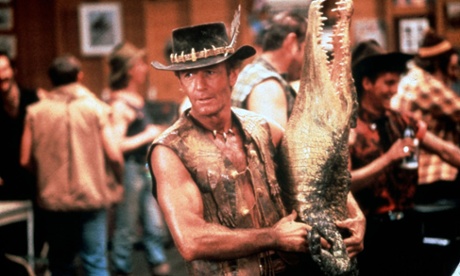
Among the most successful to continue the ocker bloke abroad shtick was Paul Hogan and his Akubra hat-wearing bogan Mick Dundee. Director Peter Faiman’s “call that a knife?” crowd-pleaser wasn’t ground-breaking – and the passage of time hasn’t been kind – but audiences sure dug it. Released in 1986, Crocodile Dundee is still the highest performing Australian film of all time at the Australian box office, a record it maintains with a cool $10m lead.
If the film were released nowadays, it would arguably be described as satire. But Dundee isn’t a work of irony, sarcasm or ridicule: Australian men enjoyed seeing a comical projection of what audiences abroad believed them to be, while international audiences thought they were more or less seeing the real thing – aided no doubt by Hogan’s unmissable presence in the Tourism Australia advertising campaigns of the time.

Notions of national character were once more exploited when Yahoo Serious burst on to the scene in 1988 as the star, co-writer, co-producer and director of Young Einstein, recasting the inventor as a young Tasmanian musician with a thirst for beer. Serious rocketed to international stardom, his high-powered rubbery mug appearing on the cover of both Mad and Time magazines in 1989.
His shtick was a more cosmopolitan-style Mick Dundee. Although Serious’ characters in Young Einstein and later Reckless Kelly (1993) lived in remote communities away from latte–sipping city slickers, many things about him – from that troll doll-like shock of hair to his affinity with popular music – told us he was a modern metro creation.
Discussion of Australian film in the 90s tends to be synonymous with “quirk”. On the darkest side of it, a mentally unwell man-child murdered his pet and family by smothering them with clingwrap. . His name was Bubby and he was a very bad boy; anybody who saw writer/director Rolf de Heer’s jet black comedy Bad Boy Bubby would not forget it in a hurry.
A tragicomic portrait of a woman with serious self-esteem issues was just as dark, albeit in more subtle ways. When we remember writer-director PJ Hogan’s Muriel’s Wedding, the film that introduced us to Toni Collette and Rachel Griffiths, it’s easy to conjure up images of Abba renditions or Collette’s smiling face showered with confetti. But the film is startlingly mean-spirited and the titular wedding a bitter joke; it represents a low point for the protagonist, who is among Australian comedy’s most memorable.

Collette made Muriel resonate so well as an endearing dork that, when she embraces the mean girls who for so long taunted her and turns on the one person (Griffiths) who liked her for being herself, audiences really feel the sting of it. And yet we cannot help but feel empathy for this pathetic figure, acknowledging her virtues might outweigh her vices.
Another classic film to integrate performances of Abba can be summarised pithily: cocks, frocks and a rock. The principal characters of Stephan Elliott’s The Adventures of Priscilla, Queen of the Desert – two drag queens and a trans-woman – stole audience affections and the 1994 film became enormously popular. Released during the height of the Aids crisis, it also shone a light on prejudices from bigoted parts of the population looking sceptically on alternative definitions of masculinity.
In any of the backwater pubs the Priscilla girls stop off at, it’s easy to imagine Mick Dundee or Barry McKenzie among the sweaty beer-swilling men in singlets looking on disapprovingly – and was a sign of how far we’d come. Other 90s comedy heroes, such as the noble-hearted Darryl Kerrigan (Michael Caton, from 1997’s The Castle) would presumably be happy to sit back and enjoy fabulous renditions of Dancing Queen. Or at least appreciate the serenity.
The turn of the century saw an increase in talent approaching film comedies tangentially, often from careers in television or standup (including Jimeon, Nick Giannopoulos, Paul Fenech and the Kath and Kim team). One of the most memorable revolved around a likeable rascal on a mission to save a bowls club.
Actor and co-writer Mick Molloy fronted the greens in requisite white uniform as Jack in 2002’s Crackerjack. His character is the familiar Aussie larrikin, infused with the performer’s distinctively couch potato vibe and armed with a healthy amount of zingers.
Another fair dinkum Aussie bloke arrived in cinemas in 2006, with stench-proof nostrils and dunny brush in hand. Kenny was on a mission to combat smells that outlast religion and never before had so much heart and soul been associated with so much toilet humour. Kenny encouraged us all not to put on airs; he is nothing if not an inspiringly genuine creation.
With Australian films in 2015 heading towards a 10-year high at the box office, funny movies are curiously absent from a list of current heavy hitters that include Mad Max: Fury Road, Paper Planes, The Water Diviner and Last Cab to Darwin. But local audiences love to laugh, and our next comedy hero – with or without body fluid jokes – can’t be far behind.
- Guardian Australia film club’s screening of Kenny and a panel discussion about Australian comedy on screen takes place on 23 August at Cinema Nova in Melbourne. Click here to book your place