My big brother gave me a copy of Michael Lewis's Liar's Poker for my 18th birthday. I read it, was hooked and read it again. It was the early 1990s, and this racy account of the excesses of the financial world lit a fire. From then on, all I wanted to be was an investment banker. Somehow though, 20 years later, I've become an artist.
A summer internship at the investment management firm Barings in 1994 should, perhaps, have been a warning, coming just months before Nick Leeson blew the house up. But I ploughed on, got a respectable degree in economics and, within months, had my feet firmly under the desk as a fresh young graduate at Barclays Capital.
Corporate finance became the only career I knew. Ironically, I was helping my employer pursue a path which, industry wide, would bring about the circumstances where I could actually become an artist. I could not have imagined that 12 years later I would be taking my first steps into a new life as a professional painter.
I wasn't even that good at art at secondary school. But I liked it enough that, on a whim, I bought a watercolour set on holiday in San Francisco. I was 22. Perhaps it was there that, unbeknown to me, my nascent creative career also sprung its first, but dormant, root.
Meanwhile, the City treated me quite well (though I'll admit, I didn't think that at the time). After a couple of promotions and a year out to do an MBA in Dublin, I made a long-planned move into the hallowed world of private equity. Now part of the fast-growing, newly listed Australian finance house Babcock & Brown, I was not looking back. And though I'd started sketching again by this stage, I was far more sharp-dressed art collector than paint-spattered artist.
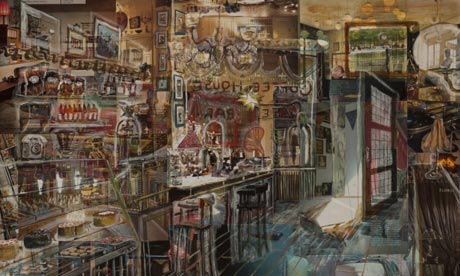
If I had to pick one moment where I felt I'd become an artist, it would be my last official day working in the City. It was May last year, and my 37th birthday. But more importantly, it was the day I sold my first painting – of Westminster Abbey. The four-figure sum I made, modest though it was by comparison to my regular salary, felt like the only money I'd properly earned since a student job at the local abattoir.
The painting was a substantial view of the interior of the abbey. My third attempt, it was based on a postcard on my fridge of the same view. And how did I come to have so much time on my hands to paint it? Well, this is not the place to describe how Babcock & Brown met its downfall. Suffice to say that within 18 months of the credit crunch, the company went from being worth some $12bn to being broken up, overwhelmed by debt. I was busy; many weren't and lost their jobs.
The empire was broken up in 2009. I was one of the lucky ones, and hung on to a piece of it for another two years, working for my old boss. As the banking sector refused to recover, I began to feel less secure and more worried; the threat of redundancies was becoming real.
And then the redundancies came. Long days stretched ahead, waiting for interviews. The meetings were alluring but proved infrequent – and the results disappointing. Painting proved a thoroughly absorbing, inexpensive, and profitable way to pass the time. And when people saw my work, loved it – and I believed them – it felt fantastic.
At the time I wasn't considering art as a potential career. It seemed too off the wall to be a serious option. Certain members of my family were becoming worried and would vainly ask "When will William get a proper job?" or suggest "Why don't you go into teaching?".
As summer went on, things gathered pace and started to feel really exciting. My young nephew built me a website. Friends introduced me to the Pepper Gallery in London, which now represents me. The Chisholm Gallery in New York got to hear of me, too, and it promotes my art. In November, two of my paintings were selected for the Westminster Arts Exhibition. How many art school graduates are in a similar position – even years after graduating?
The moment when I felt like I was really taking the plunge was signing the licence for my wonderful new studio space. On hearing of a vacancy in a large shared room at the Clockwork Studios near me in Camberwell, I jumped at it. Used to the early start of a City job, I'm often first at my desk. And being among other established artists and craftspeople working hard day-to-day is fantastic. Each of us inspires the others, and being so diverse, no one competes. There's also always someone to have lunch with.
It's now 10 months since my first painting sold. It's still early days, and other work – home tutoring south London children in maths some afternoons, and the odd cooking job – provides day-to-day income. But this year is already looking exciting, with three exhibitions in the pipeline and a programme of competitions to enter.
Finally, some advice for anyone inspired to do something similar.
• First, set aside plenty of creative time. Be disciplined, work quickly and turn your phone off when you are at your art.
• Second, experiment, try things out you've seen other do and recognise that you will go down blind alleys from time to time.
• Finally, and most important, create a community around your art: go to exhibition openings, tell people that you are an artist (not an "aspiring artist"), explain your ideas clearly and simply: tell and show a story that will keep people interested. Even if you don't feel ready, start the story and follow up on opportunities to exhibit, so people in the art world can see for themselves what you can do."
So am I really becoming a professional artist mid-career without the normal training? Well, so far so good. I can now confirm: art is far more fun than banking; and being at the centre of contemporary art, there is no doubt London is the city in which to do it.
To see more of William's work, visit his website or Facebook page. You can also find him on Twitter: @WilliamSavageLN
• This article was amended on 12 April 2012. The original used the phrase "cooking up investments" instead of "corporate finance". An inaccurate sentence has also been removed. These items have been corrected.
This content is brought to you by Guardian Professional. To get more content and advice like this direct to your inbox, sign up for our weekly Careers update.