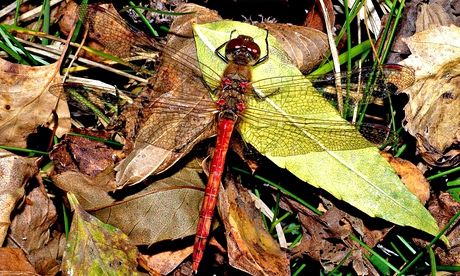
If the temptation presented by the pile of autumn leaves hadn’t awoken my inner child, I perhaps would never have seen it. Just as my swinging boot was about to send the leaves in all directions, a male common darter rose and flew away: it was the last dragonfly of summer.
This footpath, between the railway line and the river, flanked by trees on one side and a verge of wild flowers on the other, has been prime dragonfly territory all summer.
At first we paused to watch as they caught prey in mid-air or snatched flies from hogweed umbels, hunting with breathtaking speed and agility.
But after that initial delight of re-acquaintance in July the novelty wore off and by August we were often passing them by without a second glance.
Now, with the first hard frosts of winter just days away, seeing one of these aerial predators took on a special significance for us. It could be eight months before we might see another.
It came back. Flying low, perhaps to escape the worst of the gusting wind that sent the leaves tumbling along the path, it hovered within a few inches of my outstretched hand.
Then it settled back on to the ground near my feet, so menacing in flight but so easily lost from sight among the detritus of autumn.
The lure of this spot was the swath of ivy nearby. It was covered in flowers that oozed nectar and it was still attracting flies and even a few wasps, enough to provide the final feeding opportunities of autumn.
This was as close as we had been to a darter all year, a welcome opportunity to observe details; those ruby red all-seeing eyes, the intricacy of its wings and even the pterostigmas – those single red panes in the tracery of veins near the wing tips.
But the exhilaration of dragonfly-watching really lies in watching their mastery of flight. An air of melancholy surrounded this grounded individual, which was seeing out its last days among the fallen leaves – making us wish that we had spent more time watching them in summer.
@seymourdaily