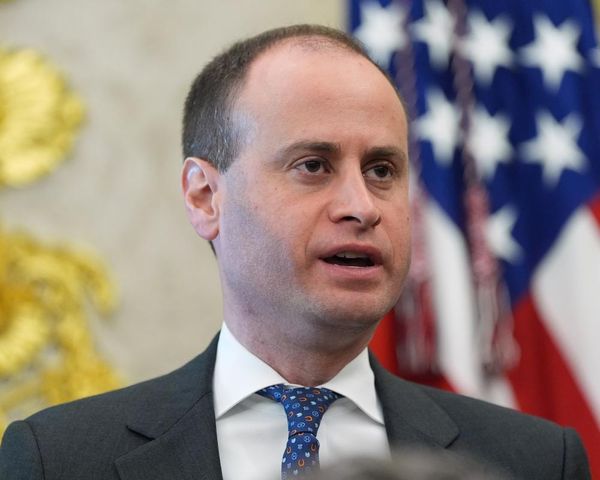
Five years after walking into an organisation engulfed in crisis, Chris Fechner leads the federal government's chief digital agency with time he never thought he would get.
Taking charge of the Digital Transformation Agency (DTA) in October 2021, Mr Fechner inherited a bleeding staff crisis, immature processes and the threat of an impending review of its procurement culture.
When the audit dropped, it laid bare an agency where information and communications technology buying practices were non-compliant, poorly recorded and falling short of basic ethical standards.
Reflecting on those early months of crisis management, Mr Fechner recalled telling himself to look past the immediate storm.

"Chris, you'll last more than three months in the DTA. So think about what happens next, not what's happening right in the middle of this audit crisis," he said.
As his five-year term nears conclusion in late 2026, Mr Fechner has overseen a fundamental reshaping of the agency.
It stripped away Malcolm Turnbull's original 2015 vision of the Digital Transformation Office as an all-encompassing disruptor and instead refocused it on artificial intelligence (AI), sourcing and investment assurance.
The pivot was driven by a long history of costly information technology failures.
Megaprojects like GovERP, the Welfare Payment Infrastructure Transformation program and Modernising Business Registers suffered massive blowouts or fell short of expectations.
To prevent future disasters, the DTA built an Investment Oversight Framework to monitor about 150 digital projects of various sizes across government.
Mr Fechner said all of its highest-value and most critical digital projects now maintained independent delivery confidence assessments rated medium or higher.
That level of portfolio oversight was achieved without statutory authority, relying instead on collaboration and relationship building.
"There's no DTA Act," Mr Fechner said. "We've become a collaboration entity, not a mandatory function. We've had to work really hard at building and sustaining relationships."
The discipline appears to have paid off internationally, with Australia recently placing second in the Organisation for Economic Co-operation and Development (OECD) and ranking first overall for digital government maturity for the first time in the index's 10-year history.
A practical test of that collaborative soft power played out as more than 100 federal agencies prepared to modernise their enterprise resource planning systems over a three-year window.
Following the demise of GovERP, Mr Fechner said the DTA stepped in to cluster and sequence agency rollouts to prevent a chaotic rush on the private market.
"Can you imagine what the impact to the market would be if all of them tried to do it at once?" Mr Fechner said.
"So the DTA set up panels, we're providing advice and we're looking at how we can cluster agencies together to deliver on those outcomes, rather than just let everybody go their own way."
As the agency steadied its investment framework, it was thrust onto the front lines of AI governance, where adoption across the public service remained inconsistent.
Although data-heavy hubs like the Australian Taxation Office had used predictive analytics for a decade, front-line service delivery agencies remained cautious in the shadow of Robodebt.
"Anybody that was even remotely connected to Robodebt is absolutely limiting where they're doing it," Mr Fechner said.
"So its application in front-line services is really, really very immature, and it's really restricted to things like chatbots."
Although basic generative AI tools were routinely used for administrative drafting, Mr Fechner said autonomous agentic AI presented a far riskier challenge.
By executing multistep workflows in milliseconds, autonomous software stripped away the natural checking pauses created by human handoffs, prompting the DTA to mandate human-in-the-loop controls.
"This change in the environment is going to be one of those really tricky things for us to manage because it breaks the chain of process," Mr Fechner said.
Yet Mr Fechner said that cutting-edge technology remained only as good as the administrative foundations beneath it.
Quoting an Organisation for Economic Co-operation and Development (OECD) counterpart, the DTA chief said departments could not skip the unglamorous work of data clean-up.
"You can't have your AI dessert without eating your data vegetables," Mr Fechner said.
Looking back across his tenure, his overarching ambition was elevating digital from an expense line-item to a core capability on par with any major portfolio.
"Digital is as important as any other investment category anywhere in the Commonwealth," he said.
He also offered a final piece of advice for surviving senior digital leadership.
"Occasionally stop and have more fun because it is a really demanding job," Mr Fechner said. "All its people also need to be able to take a break."