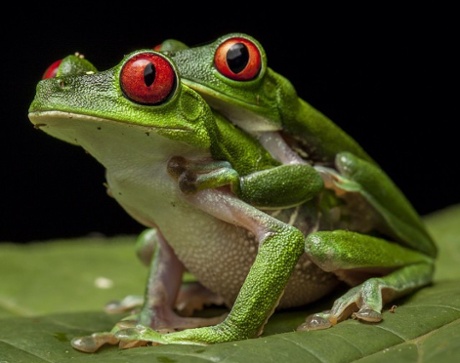
While it’s true that bulging eyes and sleek long limbs have enchanted children and adults alike, the Rainforest Alliance didn’t choose its little green mascot for its good looks alone. With their semipermeable skin, unprotected eggs and reliance on external temperatures to regulate their own, frogs are among the first animals to die off when an ecosystem loses its delicate balance, making them what scientists call an “indicator group”.
No one knows this better than author-photographer Dr Robin Moore. In 2010, Moore, who is also the conservation director of the Amphibian Survival Alliance, spearheaded a massive search across the globe for frogs, salamanders and caecilians not seen in decades. Over the course of six months, 33 teams in 21 countries slashed through thick jungle, waded up rushing rivers and hiked remote mountain passes in search of “lost frog” species. Their quest revealed much about what scientists are calling “the sixth mass extinction” – the greatest loss to biodiversity since humans appeared on the Earth – as well as some happy surprises.
The Rainforest Alliance talked to Moore about his expeditions and his findings, and how a boy from Edinburgh came to love amphibians so much that he devoted his life to them.
What inspired you to mount such an intensive search expedition for lost frogs?
For me the idea was planted when I went on a trip in search of two lost harlequin frogs in Ecuador. One was black, as if in mourning, and it was named after the local word for sadness. It seemed to symbolise all the frogs that had been lost in South America over the years. Although I didn’t find it, other scientists did the following year. That came right after the variable harlequin frog of Costa Rica and Panama, believed to have gone extinct, resurfaced in Costa Rica in 2003. Encouraged, I put out a call to scientists to see if anyone would be interested in searching for other lost frogs, and the response was overwhelming.
What did you hope to find?
The extinctions of these amphibians was happening so fast in the 1980s and 1990s that we didn’t have time to find out what was killing them. So we wanted to see what set the survivors apart from the victims and what – if anything – we could do to prevent future extinctions.
What was your most memorable experience on one of these search expeditions?
It was probably in Colombia, on my first expedition for the campaign. We invited a journalist to come along so I felt this huge pressure to find a frog for the story. And when you’re searching for a frog that hasn’t been seen in 100 years, you start imagining finding it – or at least I do. So I went from being giddy with excitement to crushing disappointment as it became clear we weren’t going to find it. So we decided to change tacks and venture into unexplored forests, where we discovered a new species – now that was a jolt of adrenaline! After I off-handedly remarked that it looked like The Simpsons’ character Monty Burns, the name stuck, and the Monty Burns toad went on to win Time magazine’s No 1 new species of 2010.
What was the saddest moment on an expedition?
It had to be in Ecuador, when we found a black and yellow harlequin male trying to mate with a dead female splayed in the stream. The futility of it was one of the saddest things I’d ever seen, especially knowing that these two frogs could join the ranks of other species that had gone extinct. We took the male into a lab in Quito for observation. But he died weeks later from a fungus that’s been wiping out populations all over the world.
The fungus is just part of the story. Amphibians are really experiencing death by a thousand cuts, succumbing to a lethal cocktail of factors that includes disease, climate change, pollution, and habitat loss and degradation. All of these factors can weaken the immune system of amphibians; the fungus is dealing the final blow.
How did your passion for amphibians start?
When I was a boy, we’d go on holiday every year to the northwest of Scotland where I’d spend entire days looking for newts in the vast moors and peat bogs. They were extremely exotic to me because I lived in the city, in Edinburgh. I’d collect tadpoles and take them home and watch them develop into froglets. It was like watching evolution on speed. Because I was able to do this in my bedroom, it allowed me to develop a more intimate relationship with amphibians than I could have with, say, birds or mammals. It also opened my mind to scientific inquiry and curiosity.
The mass extinctions of amphibians is quite depressing. How do you stay optimistic enough to do this work?
We need to be aware of the extreme challenges we face. But it’s dangerous to become overwhelmed; that’s when you start thinking, what’s the point? I enjoy being in the field, telling the story of frogs and capturing these images. And I enjoy talking to other people in the field who are also looking for lost frogs. Their commitment and passion is infectious – it rubs off.
See more of Robin Moore’s photos and stories from his journey.
Content on this page is brought to you by the Rainforest Alliance, supporter of the Vital Signs platform.