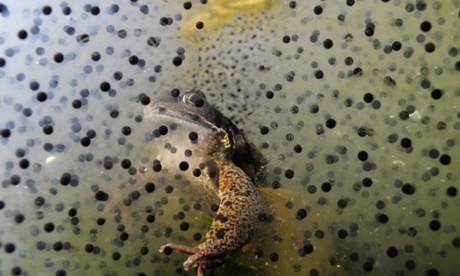
Mild autumn weather has led to frogs breeding five months early, with frogspawn sighted in Cornwall this week. It is the earliest frogspawn recorded in nearly a decade.
The Woodland Trust was alerted to the frogspawn by a National Trust ranger, who had spotted the common frog’s spawn at the North Predannack Downs nature reserve on the Lizard Peninsula.
“This year I first saw frog spawn on 21 November, which is early, but not unheard of in a Cornish context,” said Rachel Holder, the ranger who first spotted the frogspawn. “The gamble of getting ahead in the breeding game must be worth taking, and the risk of a severe cold snap which could freeze the spawn is worth braving,” she said.
Early frogspawn at Predannack, Lizard. Frogs here often breed Oct/Nov. https://t.co/U3jtqtaQIY @froglifers pic.twitter.com/1Peu3QleKg
— NT Lizard Rangers (@LizardRangers) November 20, 2014
Frogspawn usually seen in March across the UK, with the earliest occurrence in recent history being on 26 October, in 2005.
Dr Kate Lewthwaite, project manager for Woodland Trust’s Nature’s Calendar , said: “Although spring is generally arriving earlier, to receive a frogspawn sighting before winter has properly begun is highly unusual.
“Given the reasonably mild weather we have been enjoying recently, it is possible for frogs to be fooled into spawning early, but sadly it is unlikely the spawn will now survive the frosts we are experiencing,” she said.
November has been mild and very wet so far, according to the Met Office, with average temperatures nearly 2C above the long-term average, and 93.1mm of rainfall.
Frogspawn, which has the appearance of a thick translucent jelly with dark specks, often contains 5,000 eggs and is laid at one time. Tadpoles begin to emerge after a month, although early spawn is vulnerable to freezing during the winter months while it floats on the top of the pond. As frogs mate once per season, their breeding effort for the year may be wasted if spawn is laid when the conditions are not right.
Chris Hickman, from the Woodland Trust, told the Guardian that the early UK sightings of frogspawn, “highlights the wider issue that frogs are looking at spawning early, or having to adapt, because climate change is changing the natural environment in England.”
He added, “it’s not something that we’ve had for a long time and we have to establish whether this will be a one off, or maybe there are other frogspawn sightings out there that perhaps people haven’t yet reported.”
Matthew Oates, a naturalist at the National Trust, saidhe had noticed how climatic changes have affected the seasonal behaviour of species, such as the purple emperor caterpillar not hibernating, and this autumn he has heard the evening chorus of song-thrush and robins singing. The naturalist said that he expects hazel catkins, which traditionally appear mid-January, to bloom before Christmas.
There have been early first sightings of other species in recent years. According to the Woodland Trust, snowdrops which are traditionally out in spring have been sighted early in November and December since 2001. Ladybirds, which historically hibernate during the winter months, were spotted in December every year between 2002 and 2008 and also in 2011.