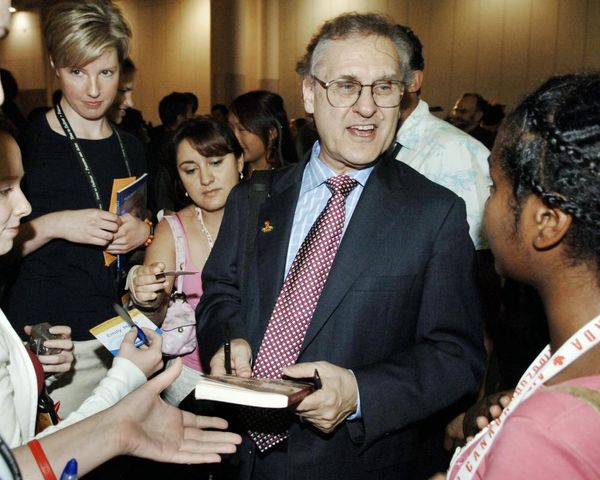
Outside his native Austria, Friedrich Cerha seems destined to be remembered as the man who finished Lulu, making the third act of Alban Berg’s opera dramatically and musically complete. For the past 30 years, his painstaking work on one of the musical landmarks of the 20th century has overshadowed Cerha’s own music, an output that includes three operas and a wide range of orchestral and chamber works. But the Wigmore Hall’s Cerha day put that music in the spotlight, with three concerts given in the presence of the composer, who will be 90 next year.
The emphasis was on Cerha’s recent chamber music, and the final concert, given by Ensemble Modern, included the world premiere of a piece commissioned for the occasion. Piccola Commèdia evokes the spirit and brittle wit of the commedia dell’arte in an instrumental suite that takes the form of a comic opera – overture, five acts and an intermezzo – with music that is effervescent, wonderfully clear, and larded with quotations. But the piece that Ensemble Modern played before it, Konzertante Tafelmusik, with its echoes of neoclassical Stravinsky and Hindemith, composed in the late 1940s, and revised two years ago, reinforced the idea that, stylistically, Cerha’s music has gone full circle, and that his more radical music of the 1950s and 60s is very definitely in the past.

Yet something much more personal and striking emerged in the work from the 1980s, which occupied the second half of the final concert. 1 Keintate is a setting for voice and ensemble of brief, Viennese-dialect poems by Cerha’s friend Ernest Kein. They are sometimes sardonic, sometimes affectionate snapshots of life in the Austrian capital, on to which Cerha has layered memories of the Austrian folk music he played in pre-war Vienna. Delivered by the inimitable HK Gruber in that half-sung, half-spoken style somewhere between Lotte Lenya and Tom Waits, accompanied with astonishing panache by the ensemble, and counterpointed with projections showing old images of the city and translations of the texts by Ernst Krenek, it placed Cerha in his cultural context more winningly than any number of purely instrumental pieces could have done.