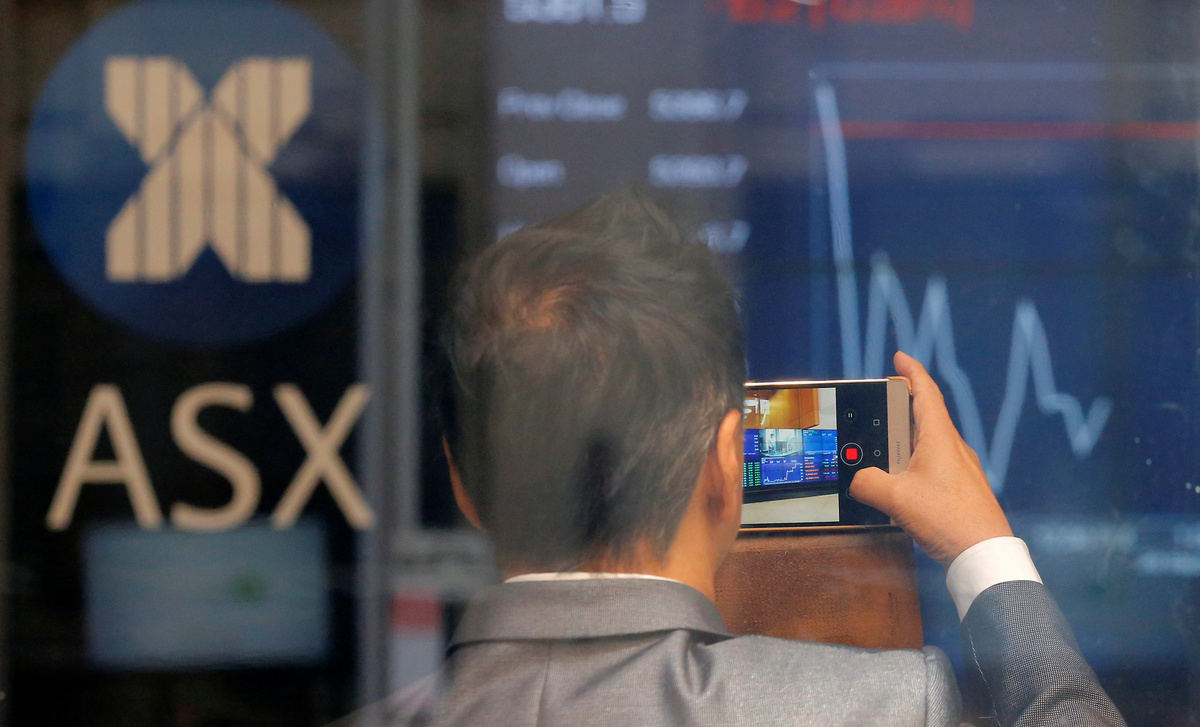
August 5 (Reuters) - Mining stocks led Australian shares to their worst session in over seven months on Monday, with investors slashing riskier positions as the growing trade war between the United States and China revived worries about weaker global growth.
The S&P/ASX 200 index <.AXJO closed 1.9%, or 128.3 points, lower at 6,640.3, its fourth session in the red and the largest one-day decline since last December.
Resource stocks, Australia's biggest export sector, bore the brunt of the benchmark's <.AXJO> A$37.77 billion ($25.58 billion) loss in market value since Friday's close. (Calculations based on Refinitiv Eikon data)
Investors have dumped riskier assets since U.S. President Donald Trump abruptly declared late last week that he would slap 10% tariffs on $300 billion in Chinese imports, snuffing a month-long trade truce and prompting China to warn of retaliation. [MKTS/GLOB]
China is the biggest buyer of Australian exports. On Monday, the world's no. 2 economy let its currency slide past the key 7-per-dollar level for the first time in more than a decade.
"PBOC (People's Bank of China) weaponizes the renminbi...the boost to China's export sector from currency depreciation is worth attracting the ire of the Trump," said Capital Economics in a note.
The world's biggest miner BHP Group <BHP.AX> shed 3.6% to close at a near two-month low, while smaller peer Fortescue Metals Group <FMG.AX> tumbled 7.2%.
Heavyweight banking units <.AXFJ> lost 1.5%, with the "big four" banks giving up between 0.8% and 1.7%.
Australian oil and gas companies <.AXEJ> also declined, with Santos <STO.AX> giving up 2.4%. However, Oil Search <OSH.AX> closed 2.9% higher after the Papua New Guinea government signalled its backing for a liquefied natural gas deal in which the company is a partner.
Domestic technology stocks <.AXIJ> saw their worst session since February 2016, and data solutions provider Appen <APX.AX> was the top loser on the main index. Declines followed sharp losses for U.S. peers on Friday as the trade war escalated.
On the economic front, focus will be on the central bank policy reviews in Australia and New Zealand this week, and on Chinese trade and inflation data.
In New Zealand, the benchmark S&P/NZX 50 index <.NZ50> finished 0.9% lower at 10,766.03.
Dairy products makers A2 Milk Co <ATM.NZ> and Synlait Milk <SML.NZ> led losses, giving up 3.3% and 3.7%, respectively.
(Reporting by Devika Syamnath in Bengaluru, additional reporting by Gaurav Dogra; Editing by Kim Coghill)