Parishioners in the small town of Saint-Laurent-sur-Sèvre in western France are paying homage to Father Olivier Maire, murdered on Monday. The main suspect, a failed asylum-seeker from Rwanda whom the priest welcomed, is in psychiatric care. While the tragedy has fuelled controversy over immigration, many Catholics are grieving and trying to understand what went wrong.
Locals gathered at the Basilica of Saint Louis-Marie Grignion de Montfort on Monday evening to pray for Father Olivier Maire. The 60-year-old Roman Catholic priest was the provincial superior of the Montfortian Missionaries, a religious order founded some 305 years ago. His death has left a deep hole in the community.
“I feel empty,” says Nicolas who worked with Father Maire for 17 years. “He was the pillar of the congregation, the one you could easily turn to,” he tells RFI’s Matthieu Bonhoure.
Nicolas says he feels “lucky” to have attended Father Maire’s final Mass. “I would even say it was like receiving grace, quite overwhelming,” he adds.
Bertrand, a bookseller, knew Father Maire for 30 years and attended Mass every morning.
“We liked him a lot, he came and blessed our apartment. He was a very humble man, and very deep,” he says. “I’m devastated but still full of hope. He knew this wasn’t the end, that there was something more.”
Others, like Thibault, are still in shock, overwhelmed by “enormous sadness” and utter incomprehension.
“We can’t see what could have led to this. This is the second one. After Saint-Etienne-du-Rouvray, now it’s Saint-Laurent. What will be next? Us? Our children?”
Saint-Etienne-du-Rouvray is the village in Normandy where two French-born followers of Islamic State killed 85-year-old Father Jacques Hamel in his church in July 2016.
The murder of Father Maire, while no less tragic, is different. His presumed killer had no apparent links to terrorism, Interior Minister Gérald Darmanin told reporters in Saint-Laurent on Monday.

‘Wrong side’ of the genocide
The chief suspect is 40-year old Emmanuel Abayisenga, an asylum seeker from Rwanda who had been staying with Father Maire for the last two months.
Abayisenga handed himself over to the police on Monday morning announcing he had “killed a clergyman”. He was arrested but rapidly transferred to a psychiatric hospital due to his fragile mental state.
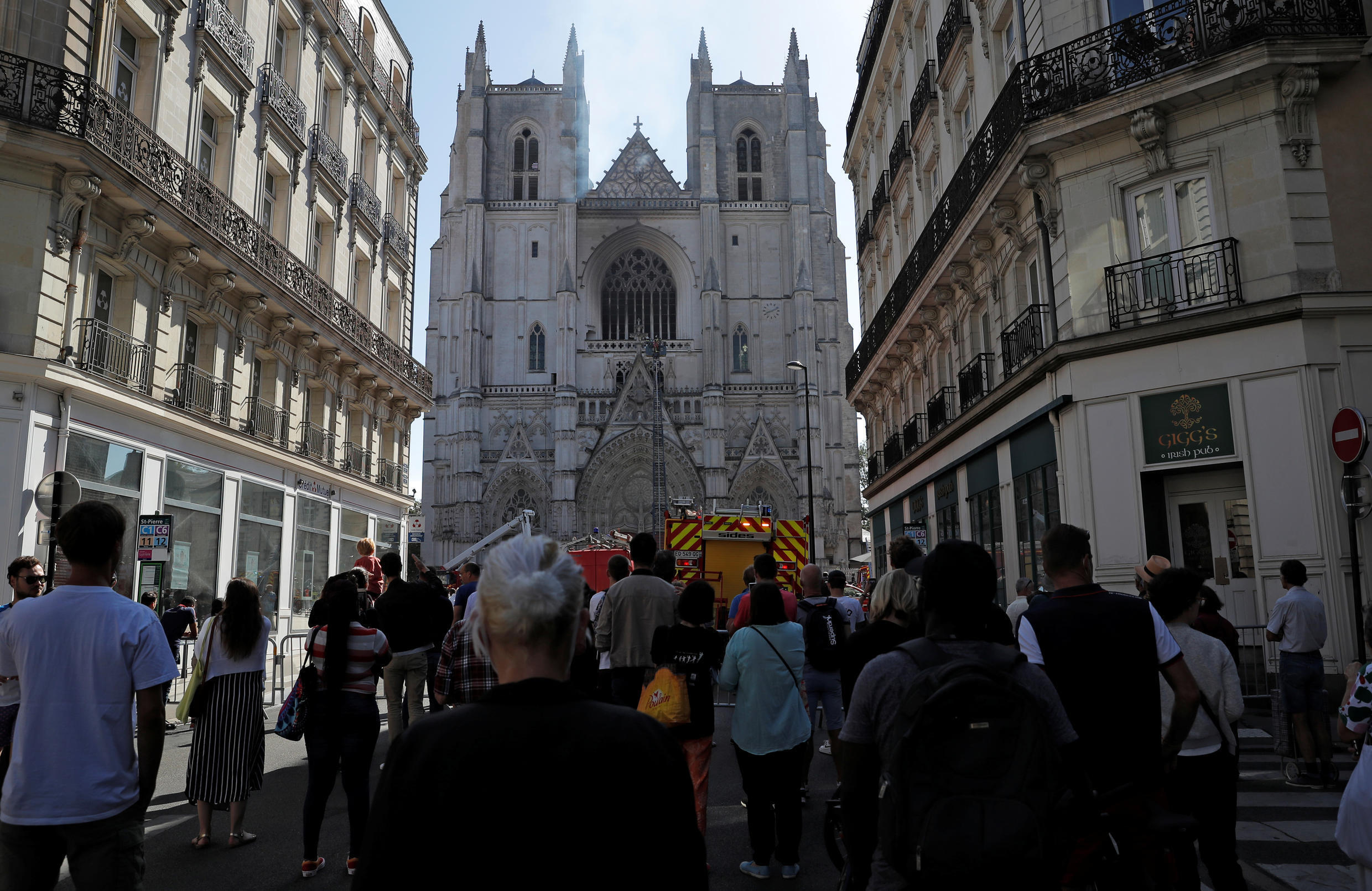
Heloise de Neuville, a journalist with Catholic daily La Croix, did research on Abayisenga after he admitted deliberately setting fire to Nantes Cathedral in July 2020.
Speaking to French public radio on Tuesday she said she was “surprised” to hear he had murdered Father Maire.
“He’s a fragile man and was described to me as pacifistic, someone who was more likely to turn any violence against himself.”
She said he was suffering from “multiple traumas”, which began with the 1994 genocide in Rwanda.
Abayisenga was one of 12 children born into a Hutu family and was just 13 at the time of the genocide.
“His father was executed for taking part in the genocide and his uncle is serving a life sentence,” de Neuville told France Inter. “He was raised in an extremely violent environment […] with a family implicated in the wrong side of the genocide history.”
He found work as a low level police officer but left after three years or so and fled to France as an illegal immigrant where he’s lived for the last eight years.
In his asylum request in Nantes, the Rwandan argued he had left the police “because he refused to take part in executions or ignoble acts against Hutus”. But the authorities didn’t believe him and rejected his claim.
A devout Catholic, Abayisenga found solace in the Church and became a volunteer warden at Nantes Cathedral.
“His first reflex on arriving in France was to put himself under the protection of the Catholic community,” said de Neuville.
Sheltered by the Montfort Missionaries
Abayisenga received three expulsion orders, two of which were overruled by the administrative court in Nantes. A third, in 2019, was pending another court decision but in July 2020 he was arrested over the fire in Nantes cathedral and spent the next 10 months behind bars.
"It was obvious he was suffering hugely, psychologically, and this was exacerbated by being in prison," a chaplain who visited Abayisenga each week told La Croix. To make matters worse, "conversation was complicated as Emmanuel had a severe hearing problem".
In May this year he was released on bail under a number of release conditions and was not allowed to leave France - or be deported - while awaiting trial.
He had nowhere to go, until the Montfort Missionaries, with Father Maire at the helm, opened their doors.
De Neuville doesn’t believe Abayisenga set out to hurt the Catholic community who’d shown such unfailing support. But the multiple traumas, including being assaulted in Nantes Cathedral in 2018, left their mark.
“On the eve of the fire he sent an email to 300 people saying he had to drive out evil from the cathedral because he had been assaulted in front of the sacristy in 2018. He had already fallen into a form of paranoia, and it got worse.”
While the aggression stirred up deep souvenirs of violence, de Neuville regrets Abayisenga received no psychological support. “Everyone close to him confirms that was a tipping point.”
Pushing charity to the extreme
Shortly after the murder, Interior Minister Darmanin praised the “charity and welcoming spirit which guides the Church and which guided this congregation” but he added that “when you attack a man of the cloth, you attack the soul of France”.
De Neuville doesn’t believe Abayisenga sought to attack France but rather “we’re dealing with a man who is ill”.
Among Father Maire's many memorable Masses, the National Catholic Register quotes from one in October 2020 which reflected his vocation as a priest.
“Live a life of sharing with others, don’t waste your life by living it alone, isolated, protected from the world, protected from others – you have to protect yourself from the virus but not from others,” he told the congregation.
“Let us dare to sit down for a time of fraternal sharing. Let us dare to sit down with the poorest, the excluded, and the rejects of humanity.”
Father Maire dared to do just that and he paid a heavy price.
But de Neuville likes to quote from one of the Montfort Missionaries who said they ‘didn’t regret anything’.
“They pushed charity to the extreme,” she concluded.