France is moving closer to imposing strict limits on children’s access to social media, as the government pushes ahead with legislation aimed at curbing screen time and protecting young people’s mental health.
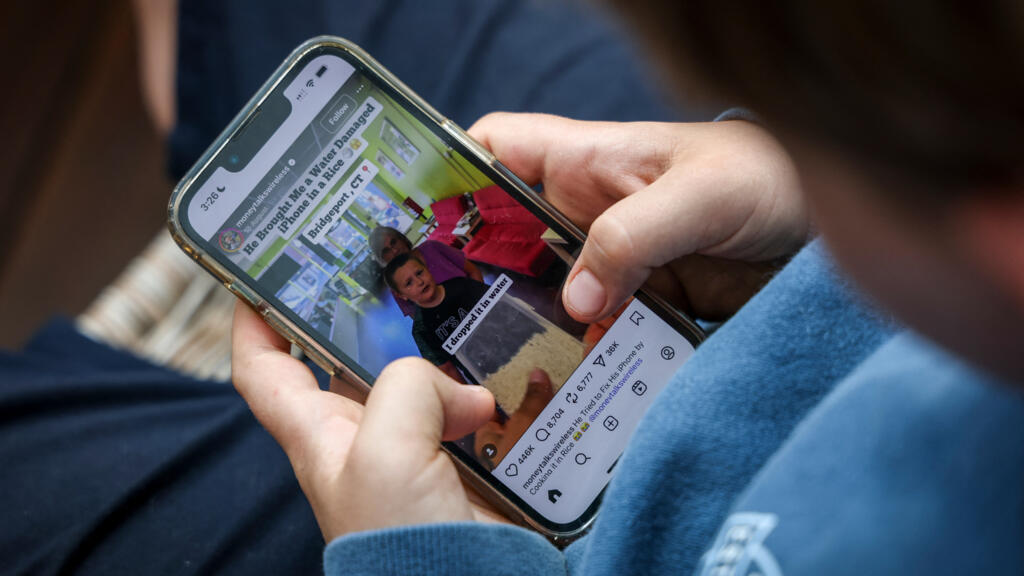
French lawmakers have taken a decisive step towards reshaping children’s digital lives, approving a bill that would ban under-15s from using social media and restrict mobile phone use in high schools.
Championed by President Emmanuel Macron, the measure is framed as a way to shield young people from excessive screen time and its potential impact on mental health.
The lower house of parliament, the National Assembly, adopted the bill by a comfortable margin of 130 votes to 21 after a lengthy overnight session running from Monday into Tuesday.
The legislation now heads to the Senate, where it must be approved before becoming law.
Macron welcomed the vote enthusiastically, calling it a “major step” to protect children and teenagers in a post on X.
"We do not want an anxious generation but a generation that believes in France, the Republic, and its values," he added.
In a video broadcast over the weekend, he struck a firm tone, saying the emotions of young people should not be “for sale or manipulated, either by American platforms or Chinese algorithms”.
Macron pushes fast-track ban on social media for under-15s ahead of MPs debate
Push to curb screen time
If passed in its current form, the legislation would make France only the second country to impose such a sweeping age-based restriction on social media, following Australia’s decision in December to ban under-16s from major platforms.
Supporters argue the move reflects growing concern worldwide that heavy social media use is harming child development and contributing to rising anxiety and depression among adolescents.
Authorities hope the new rules will begin to apply from the start of the 2026 school year, initially covering new accounts.
Gabriel Attal, the former prime minister who now leads Macron’s Renaissance party in the National Assembly, said he was aiming for Senate approval by mid-February so the ban could come into force on 1 September.
Platforms would then have until the end of the year to deactivate existing accounts that fail to meet the age requirement.
Attal presented the bill as both a public health measure and a matter of national independence. Beyond addressing the mental health effects of screens, he argued it would help counter “a number of powers that, through social media platforms, want to colonise minds”.
France, he said, could become a European pioneer, improving family life and even shaping the country’s future autonomy.
EU countries push for stricter rules to keep children off social media
Health concerns and political resistance
Concerns about the impact of social media were echoed this month by France’s public health watchdog, ANSES.
It warned that platforms such as TikTok, Snapchat and Instagram can have several detrimental effects on adolescents, particularly girls, even if they are not the sole cause of declining mental health.
Risks highlighted include cyberbullying and exposure to violent or disturbing content.
The bill itself states clearly that access to online social networking services would be prohibited for children under 15.
Online encyclopaedias and educational platforms are excluded, underlining the government’s effort to draw a line between learning tools and social media feeds.
A robust age verification system would be essential for the ban to work, and officials say work on such technology is already under way at European level.
However, not everyone is convinced. Arnaud Saint-Martin of the hard-left France Unbowed party criticised the proposal as a form of digital paternalism, calling it an overly simplistic answer to complex technological problems.
Nine child protection associations also urged lawmakers to focus on holding platforms accountable, rather than banning children outright.
The social media ban is part of a broader push by Macron to limit phone use in schools. France already banned mobile phones in lower secondary schools in 2018, and the new bill extends the principle to high schools.
Former prime minister Elisabeth Borne, however, urged caution, saying enforcement remains a challenge even under existing rules.
(With newswires)