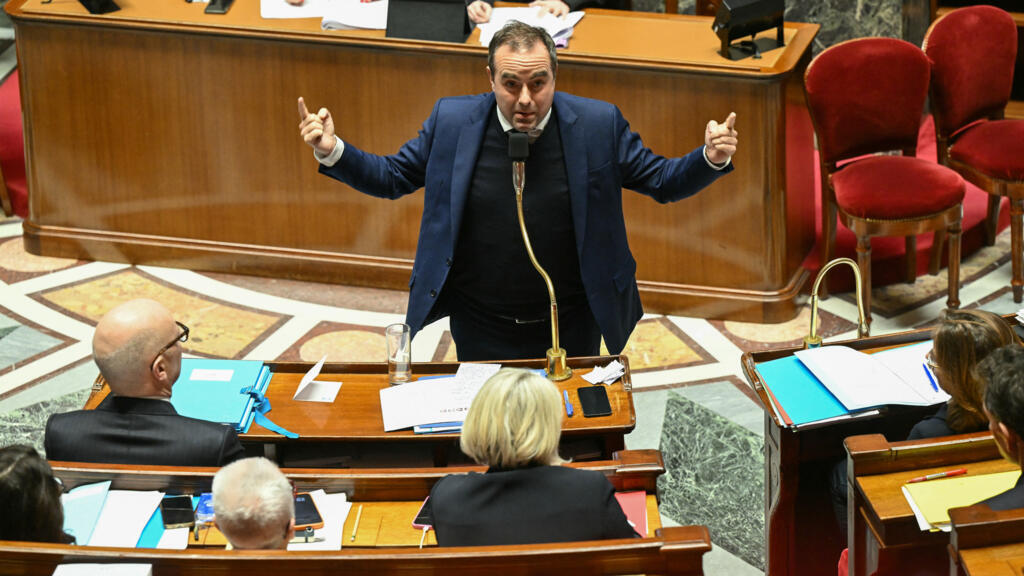
France has finally locked-in its 2026 budget, bringing an end to months of political wrangling after Prime Minister Sebastien Lecornu once again survived no-confidence motions in parliament.
On Monday, French lawmakers rejected two attempts by hard-left and far-right parties to bring down the government, clearing the way for final approval of the 2026 budget spending plan.
The votes followed Lecornu’s decision on Friday to force the budget through parliament without a vote for the third and final time – a move that proved controversial, but ultimately decisive.
“France finally has a budget,” Lecornu wrote on X, welcoming what he called a “parliamentary compromise” that curbs public spending while avoiding tax hikes for households and businesses.
The outcome ends a four-month stalemate that had paralysed decision-making on government finances.
The prime minister had previously acknowledged a “partial failure” when he reversed an earlier pledge not to rely on the constitutional fast-track mechanism known as Article 49.3.
Yet the 39-year-old managed to navigate the impasse by making concessions to the Socialists, a key swing group in the fractured National Assembly.
He had already weathered two earlier rounds of no-confidence votes triggered by the same procedure. Speaking ahead of Monday’s ballots, Lecornu criticised those seeking to “reject everything”, singling out the far-right National Rally and the hard-left France Unbowed.
Motions tabled by France Unbowed, the Greens and other left-wing parties drew 260 votes – just short of the 289 needed to oust the government – while a separate far-right motion secured only 135.
French PM faces new no-confidence votes as budget faces final hurdle
Deficit-cutting effort
At the heart of the budget is a renewed push to rein in the public finances.
The plan aims to reduce France’s deficit to five percent of gross domestic product in 2026, down from an expected 5.4 percent in 2025.
That target is less ambitious than an earlier goal of 4.7 percent, reflecting the political compromises required to get the package over the line.
The budget includes higher taxes on some businesses, expected to raise around €7.3 billion in 2026.
However, the Socialists were unable to secure backing for a proposed wealth tax on the super-rich. They did, however, win several high-profile concessions, including a one-euro meal for students and an increase in top-up payments for low-income workers.
Defence is another clear priority, with military spending set to rise by €6.5 billion, a boost Lecornu described last week as the “heart” of the budget – underscoring France’s strategic ambitions at a time of heightened international uncertainty.
After PM forces through finance bill, what's next in France's budget battle?
State spending row
The broader spending plan has been shaped by months of tense negotiations.
In December, lawmakers narrowly adopted the social security budget, postponing an unpopular pensions reform until January 2028 – after President Emmanuel Macron leaves office.
Talks on state expenditure proved even more divisive, pitting a right-leaning Senate pushing for savings against a lower house where no bloc holds a majority and the left has pressed for higher tax revenues.
All this is unfolding under pressure from the European Union, which has urged France to bring down its debt-to-GDP ratio – the bloc’s third-highest after Greece and Italy and close to twice the EU’s 60 percent ceiling.
France has been mired in political instability since Macron called a snap election in 2024 that cost him his parliamentary majority.
Lecornu was appointed prime minister in September, briefly stepped aside, and then returned to the post a month later after two predecessors were toppled over cost-cutting plans.
(with newswires)