“Either these participative tools will help to save democracy, or they will actually accelerate the collapse of liberal democracies,” says Quentin Sauzay, co-president of Democratie Ouverte, a group advocating for more citizen involvement in France.
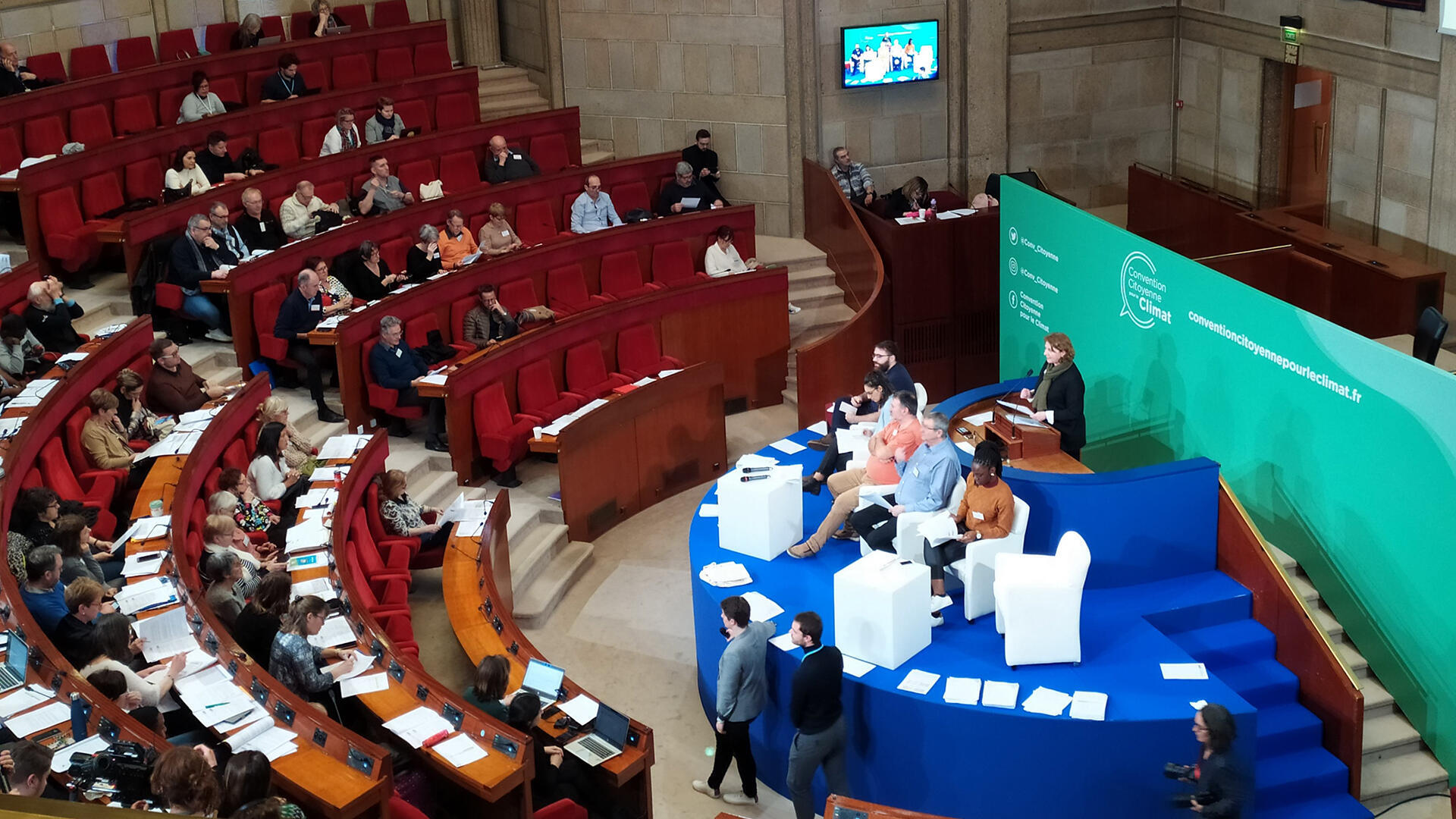
The group helped organise France’s biggest experiment with participative democracy so far: the Citizen’s convention on climate, which convened 150 citizens to come up with policy ideas to reduce France’s carbon emissions by 40 per cent by 2030. (France has since upped the ambition).
This story is part of the Spotlight on France podcast:

Sauzay traces a direct line between the covention and the Yellow Vest protests, which started in November 2018 against fuel taxes, but grew into a more general movement of discontent against the French government and what many saw as a lack of representation.
Many Yellow Vest protesters rallied around the idea of a Citizen’s Initiative Referendum (RIC), where people can propose laws, without having them being proposed by parliament or the government.
France's vertical power structure
Sauzay says the way the current French governing system is set up is very top-down: “I would say that the last version of the Fifth Republic is terrible in that it is highly vertical. The executive body has way too much power, compared to the parliament. It is not balanced anymore.”
And the way that Macron wields this power makes it even more concentrated at the top: “He thinks that he's gaining time by deciding quickly, but he's actually losing a lot of time because if you don't take the time to actually deliberate with the population, your decisions will be questioned. Especially in France where people love political debate, and they want to be part of the decisions.”
Macron acknowledged the discontent of the Yellow Vest movement, and in January 2019 introduced the Great National Debate, a months-long series of debates and meetings all over France to gather citizen input on issues like taxation, the ecological transition, and democracy.
'Without filter'
Out of these debates was born the idea of convening a Citizen’s assembly on the climate. When Macron announced it in April 2019, he said that he would present what came out of the convention “without filter” to a vote in parliament, or a referendum.
The Citizen’s convention met for six sessions between October 2018 and June 2019, and presented 149 proposals on a range of issues, from transportation, housing, development and food.
Macron immediately rejected three of them, but the others are being examined by parliament, ministries and other branches of government, to be put into law.
But the communication became muddled in December, as convention members and activists started asking for results.
In an interview with the online media Brut, Macron lashed out at a question about why the process was not going faster.
“I respect the 150 citizens like MPs,” he said. “But I will not say that just because 150 citizens wrote something, it is the Bible or the Coran.”
This was taken as a direct contradiction to his promise to accept the proposals “without filter”, though Sauzay says the situation is more nuanced. He points to industry groups rushing to lobby lawmakers against implementing the Convention’s proposals as proof that they are being put into action.
“You cannot imagine how the lobbies are battling to destroy the measures,” he says. One measure, a tax on heavy vehicles, has already been quashed by the car industry, though Sauzay says that the issue will still be debated.
“It will still be discussed in the parliament. It is in the political debate, and that was I think a very important part of it. It is not over yet.”
Accountability from the people
The convention will meet for a final session in January or February of this year to assess what has actually come of its proposals.
For Sauzay, this is a crucial last step, "because the government could have easily said ‘OK, look guys, we’ll try to do some of these things, but the context has changed, we’re in the middle of a huge economic crisis, with Covid, so thank you very much for your participation, and that's all’,” he says. Instead, there will be accountability.
As for the vaccine panel, the 35 members will be announced this weekend and they will start work on 16 January, through the end of the vaccination campaign. The expectation is that they will help allay scepticism of the vaccine.
But ultimately it is still not clear how much such a panel, or a citizen’s convention can help the lack of representation in France.
“These participatory tools are like a Dr Jekyll and Mr Hyde,” says Sauzay. “They are intended to help representative democracy to survive.”
But they can also be used “in a very–we say in French–'gadget' way: as toys that you give to people so that they think that they are participating, but actually power remains very vertical.”
Citizen participation creates hope for more representation, he says, “and if you destroy [this hope] it will definitely take democracy with it in its destruction.”
This story first appeared in the Spotlight on France podcast. Click here to listen.