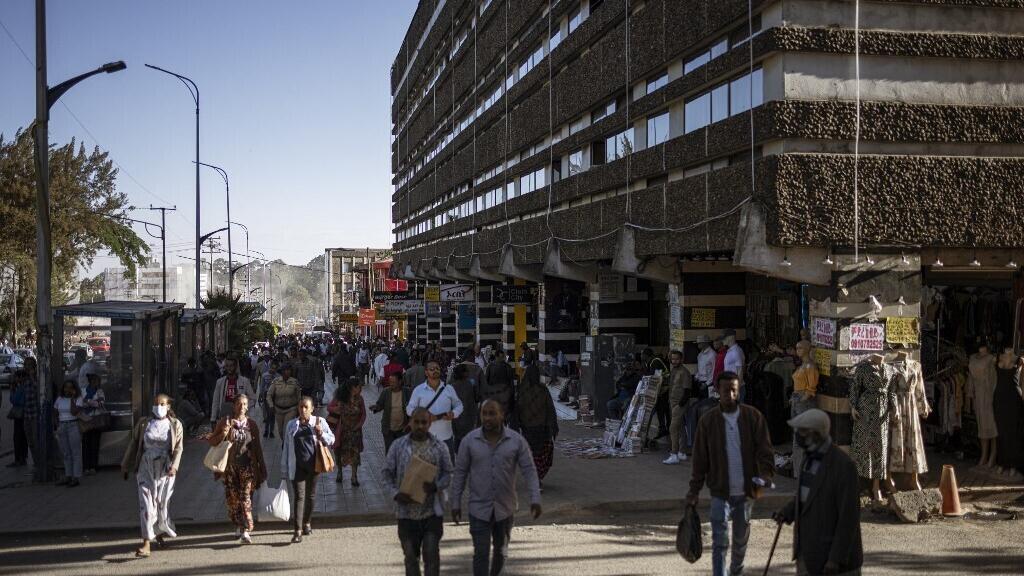
The Africa Forward summit, currently under way in the Kenyan capital Nairobi, reflects France’s efforts to reposition itself on the continent. An increasing number of French companies are choosing to set up operations in neighbouring Ethiopia – attracted by a market of more than 120 million people, despite a deteriorating security situation.
On Sunday morning, customers crowded around the counter at Hanit Bakery in the Ethiopian capital Addis Ababa. The shop is a client of French food group Lesaffre, which produces ingredients such as yeast. The company set up operations in Ethiopia in 2021.
“Lesaffre chose to open a factory in Ethiopia because it's the second most populous country in Africa," says its country director, Marine Durot. "It's also a country where we noticed people are eating more and more bread instead of injera [traditional sourdough flatbread]," she told RFI.
"For us, it was a key market where we wanted to establish a presence. We see strong prospects and solid growth potential."
In December last year, the company launched Lesaffre and Me – a new digital platform designed to support bakers and pastry professionals across the country.
Opening up markets
Lesaffre is just one of a growing number of French firms turning to Ethiopia.
France is the third-largest European investor in the country after the United Kingdom and the Netherlands, with an estimated foreign direct investment (FDI) stock of €485 million, according to the French foreign office.
While still limited in scale, the French economic presence is multi-sectoral – notably seen in energy, infrastructure, agri-food, logistics and the digital sector.
In recent years, Ethiopia has been opening up parts of its economy, particularly in those areas, to attract foreign investors.
“Countries such as Ethiopia have launched reforms to open up markets, liberalise various sectors and encourage investors to put money into their economies," says Getachew Teklemariam Alemu, an economist with the African Union.
"Thanks to these reforms, the main macroeconomic obstacles to investment have now been removed."
In mid-April, around 15 French companies visited the country at the initiative of Medef International – the overseas arm of the French business federation.
Poet, trader, explorer: following Rimbaud's footsteps in Ethiopia
Escalating tensions
Ethiopia's security situation, however, remains volatile. While the country's civil war ended in 2022, escalating tensions between Addis Ababa and the northern Tigray region are threatening to reignite conflict between Ethiopia and Eritrea.
There is also conflict in the Amhara and Oromia regions.
Tigray party restores pre-war parliament, jeopardising northern Ethiopia peace
Despite this, Gérard Wolf, president of Medef International, insists investors should not be put off.
“Conflicts like the one in Tigray exist all over the world. In difficult places, but where the intensity of conflict is not extremely high, we're not going to wait until everything is over before getting involved," he said. "We don't rule out going into a country simply because it is in conflict."
In January 2026, French retail giant Carrefour announced it would launch in Ethiopia by partnering with Queens Supermarket – an Ethiopian company and a subsidiary of the Midroc Investment Group owned by Ethiopian-born Saudi billionaire Sheikh Mohammed Hussein Al Amoudi.
The firms are set to roll out the Carrefour franchise across Queens’ existing stores, with the first of those expected to be rebranded by the end of June, according to African Business online.
“Carrefour’s expansion to Ethiopia, if executed well, will create brand new jobs, transfer skills and integrate local agricultural products into global markets, enhancing export opportunities for farmers while linking local production to Carrefour’s extensive network,” Bernard Laurendeau, managing partner at consultancy firm Laurendeau & Associates, told African Business.
“If local entrepreneurs are included in the value chains, this will also help mature the budding entrepreneurship ecosystem.”
This article was partly adapted from the original version in French by Marlène Panara.