Free night schools are a key part of efforts to help foreign residents and others in Japan learn to read and write Japanese, with some teachers continuing to hold in-person lessons even amid the pandemic.
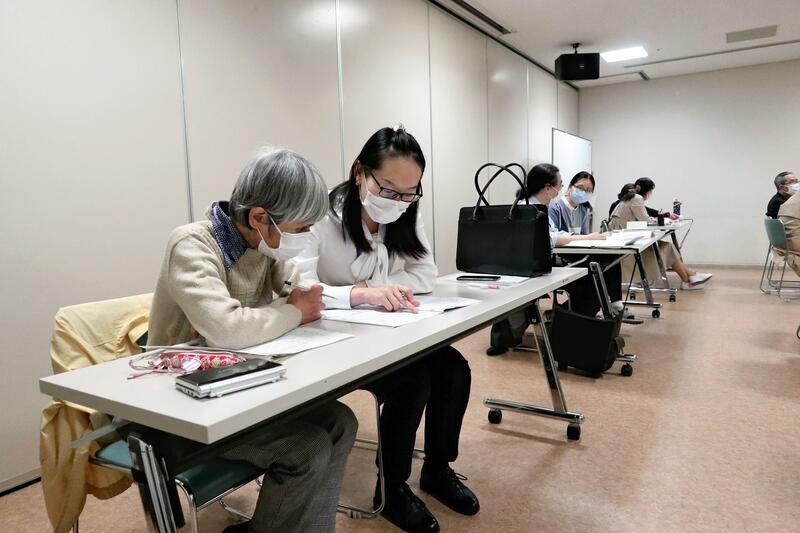
One evening in late April, about 20 people from China, Nepal and Vietnam wearing masks gathered at a free night school called "Kawaguchi Jishu Yakan Chugaku," located in a multipurpose facility in Kawaguchi, Saitama Prefecture.
"Someday I want to go to graduate school in Japan," said a 30-year-old woman from China who is working for a Japanese company. She was trying to read and understand a book on economics in Japanese, and asked a Japanese lecturer for help with words that she could not read.
The teacher gently instructed her, saying wryly, "I don't know much about the economy, but I can teach people how to read."
Two classes are being held each week amid the pandemic. Former schoolteachers volunteer to provide one-on-one lessons to foreigners who want to learn Japanese, as well as to Japanese people who want to study the language again.
When the school opened in 1985 there were many Japanese students, but today 70% of the about 70 students are foreigners. Most of them are studying to support their livelihoods.
"The employment situation has become severe due to the coronavirus pandemic, and some people are highly motivated to improve their Japanese language ability," said Yoshiaki Nogawa, 73, the vice head of the school. "We want to meet their expectations."
According to the Immigration Services Agency, there were more than 2.88 million foreign residents in Japan at the end of 2020, up about 40% from the end of 2012 due to a labor shortage in domestic industries.
There is growing demand to learn Japanese at locations students are familiar with, and free schools called "jishu yakan chugaku" (volunteer nighttime junior high schools) have answered this call.
An education ministry survey found there were about 320 of these schools nationwide in 2014 and 60% of the students were foreigners. Since then, the number of such schools has been increasing in various parts of the country.
Hirotsugu Enomoto, 71, has been teaching for more than 30 years at Matsudo Jishu Yakan Chugaku in Chiba Prefecture.
"Some students can't attend a Japanese language school for reasons of time and money, so they choose to study at a jishu yakan chugaku," Enomoto said. "But they can deepen their exchanges with local residents through learning based in local communities. This also benefits local society."
According to an education ministry survey conducted in 2018, there were more than 50,000 foreign and other students at public elementary, junior high and other schools nationwide who needed Japanese language guidance. Free schools staffed by volunteers play an important part in supporting the learning of these children.
Children aiming to get into high school come to Fuchinobe Gakushu Kyoshitsu (Fuchinobe tutoring school) in Sagamihara, Kanagawa Prefecture. According to the school, one of its students was a woman raised in the Philippines. She was bullied but studied Japanese diligently, and ultimately went to a university and got a job at a major foreign manufacturer.
Fuchinobe Gakushu Kyoshitsu lecturer Keiichi Yoshida, 68, is a former junior high school teacher. "Students are having difficulty interacting with each other due to the pandemic. I hope they study Japanese intently to prevent themselves from being isolated in society," Yoshida said.
However, the volunteer teachers at many of these free schools are primarily retired people in their 60s to 80s. They also have financial difficulties, meaning they may not be able to continue their activities at some point.
Some schools have been forced to suspend classes, to avoid the so-called Three Cs of closed spaces, crowded places and close-contact settings.
Satoshi Miyazaki, a professor of Japanese language education at Waseda University, said: "Volunteer-taught schools and other free schools are a type of infrastructure at which foreigners and others who don't receive sufficient education in Japan can study reading and writing Japanese.
"The central and local governments need to seriously consider providing support for such schools."
Read more from The Japan News at https://japannews.yomiuri.co.jp/