The Germans took my mother and me from Lodz ghetto in Poland in 1943, when I was eight. We were transported to Ravensbrück concentration camp, 90 miles north of Berlin, in wagons usually used for animals. There was a terrible cry as all the men were taken off to another camp. I didn’t understand what was happening, but everyone thought it would be the last time we saw each other.
In the camp, we had to stand in the freezing cold every morning at 4am to be counted, then we could go in and have a cup of “coffee” – I don’t know what it was really, but it was a hot drink. We had bunk beds, but because it was cold my mother put the two thin mattresses on the top bunk and we slept there together. We put a handkerchief over the bare wood of the bottom bunk to serve as a tablecloth, making it our lounge. Before lights out, friends would come in and sit around, talking about better times.
My mother wore her dress inside out, because with the seams out it was easier to see and pick out the lice. We went to work in the Siemens factory, putting together little wires for aeroplanes or trucks. I don’t know whether she volunteered because she thought it was a way of surviving or if we were taken to do it. A German man who worked in the same part of the factory smuggled me bread rolls, when he could.
Ater I’d been in the camp for a few months, I got scarlet fever and was taken to the infirmary. Every night people were taken away and never seen again. My mother would come each morning in terror, hoping I was still there.
In 1945, there were rumours that the war was ending, and one day they housed us in this draft block. Usually people who went there never came back. I remember being on my mother’s knee, and her saying: “I’m sure we’re being liberated,” but really she thought we were going to be killed. After a couple of days, the guards said: “Out!” There was a line of Red Cross buses. We were given a parcel; it was quite heavy and I wasn’t very strong after the scarlet fever. I asked my mother if I could leave it. She said: “No, there’ll be food in there!” My arms ached, but there were delicious things inside. We ate powdered milk by the spoonful – some people died because they overate after being hungry for so long.
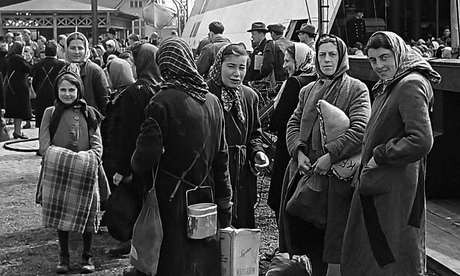
The buses took us to Denmark, which was wonderful. We slept in tents with paper blankets; everybody was so diseased they were going to be destroyed afterwards, but they were very nice to lie on. Then we went on a boat which took us to Malmö, in Sweden. I arrived with my mother (third from right, with her back to the camera) on the morning of 28 April 1945. After what we’d been through, we couldn’t believe we were received with so much warmth. I remember there were photographers.
The first thing to do was shower and get new clothes (ours were full of lice) but there weren’t any in my size. One of the volunteers ran home and brought me her daughter’s summer dresses with puffed sleeves and a white dress with polka dots. I wore them in the middle of winter because they were so beautiful. My schoolmates thought I was crazy.
I first saw this photo a couple of years ago. The Swedish consulate in Jerusalem, where I now live, had a showing of a film called Harbour Of Hope, a documentary about three concentration-camp survivors who were brought to Malmö. This photograph of me came up and I said to my husband: “I think that’s me.” When I look at it I see hope. It never leaves you, knowing the terrible things human beings are capable of doing to each other, but they’re also capable of helping. Now, when I see refugees arriving in boats, it reminds me of those times. They don’t know what tomorrow will bring.
Every Face Has A Name, a documentary inspired by the survivors arriving in Malmö, has its UK premiere as part of the UK Jewish Film Festival on Sunday 15 November. The festival runs until 22 November.
• Are you in a famous photograph? Email thatsme@theguardian.com