Frederick Wiseman makes documentaries about institutions, around 40 since his first, Titicut Follies in 1967, which was about a hospital for the criminally insane. Dozens of other organisations have undergone his rigourous and humane scrutiny since then: Kansas City PD (Law And Order, 1969), the US Marine Corps boot camp at Fort Knox (Basic Training, 1971), the vivisection industry (Primate, 1974), the Racetrack (1985). Wiseman’s catalogue isn’t merely an authorial viewpoint held steady for a half century; it’s a monolith of social-historical material about who we are and who we have been since America went insane in the 60s. And the man who made them has long been an institution unto himself.
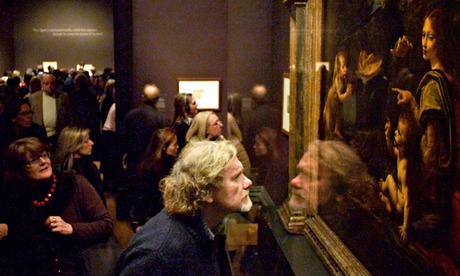
His latest film delves into a beloved British institution, the National Gallery. He goes beyond the public galleries, down into the basement, into its astonishing collections, the restoration and preservation processes and the fundraising activities, among the staff and the docents, and into members-only viewings filled with the great, the good, the fat and the rich. As usual, he poses no questions and largely points no morals; he shows up for his appointed six weeks, shoots everything he sees and spends a year editing the results. But those three hours, like the mesmerising six hours of watching old people fade away in Near Death, just fly by, such is the level of immersion and absorption we experience.
At 84, Wiseman has been making a movie a year for the last decade, with no sign of let-up, and no change in his approach since Titicut Follies. He is the last survivor from the golden age of American documentary film-making, whose leading lights were members of a hair-splitting, ideologically motivated priesthood who came of age in the period of profound self-examination that was the Vietnam-Watergate era, when every hitherto cherished institution up to and including the Pentagon and the President faced vigorous scrutiny and interrogation.
But there’s nothing dry or academic about Wiseman’s oeuvre. Controversial in their day, movies such as High School (threatened with legal action), Law And Order (ditto), and Titicut Follies (instantly banned for nearly 25 years) are now invaluable documents of entirely vanished places, people, subcultures and mindsets. When feature film-makers wish to know what these institutions once looked like, they often consult Wiseman. Basic Training runs right through Full Metal Jacket, and One Flew Over the Cuckoo’s Nest and Frances owe plenty to Titicut.
Wiseman’s movies, unlike Nanook Of The North or Night Mail (for all their virtues) are not stale, aspic-bound museum art. They live the way buildings and paintings live, unchanging and forever.



.jpg?w=600)