
In my last column, I discussed the role of the turnaround in a 12-bar blues. To review, the turnaround occurs in the last two bars of the progression. Its function is to set up the return to the beginning of the form by providing a “wrap up” to the musical ideas of the previous 12-bar section.
Every blues guitar great uses turnarounds masterfully, and many have their own signature turnaround phrases.
Turnarounds can also be used to add tension between the I (one) chord and the IV (four), or when moving from any one of the three chords in a I - IV - V (one-four-five) progression to the next. It’s very useful to learn as many of the “tried and true” turnarounds that exist in blues music, but you should also feel free to invent your own.
Let’s stick with the key of E, which we used for last month’s examples. In the key of E, a I - IV - V progression is made up of the I chord, E, the IV, A and the V, B. Figures 1 and 2 illustrate two of my favorite turnarounds in E.
In Figure 1, bar 1, starting on beat 2, I play a simple melody based on E minor pentatonic (E, G, A, B, D) that ascends and then descends, setting up the change to B7. In Figure 2, the only difference is that I include a trill, a quickly repeating hammer-on/pull-off, between D and E.
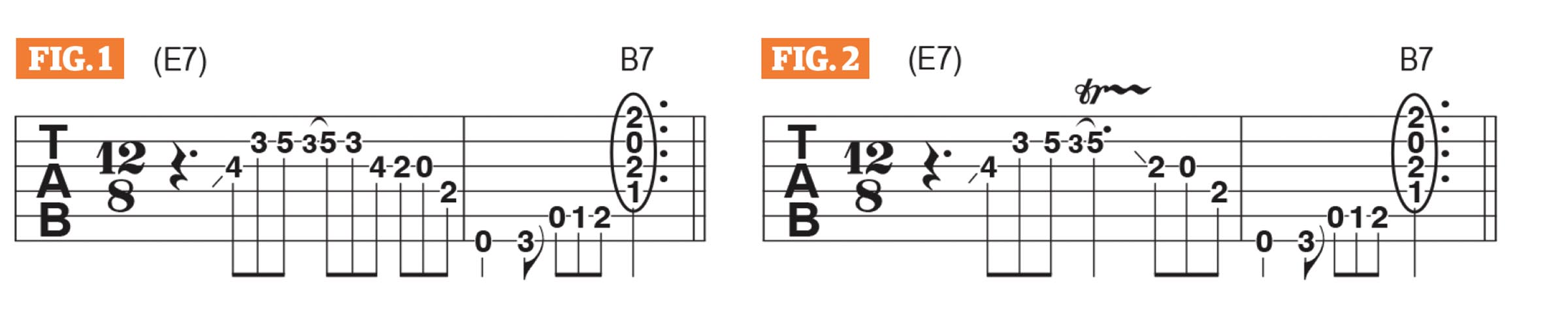
These licks are based around things I’ve heard Eddie Taylor play in his recordings with Jimmy Reed.
The coolest thing about these turnarounds is, once you learn them, you can expand on them and put your own inflections into them.
In Figure 3, I take the basics of Figures 1 and 2 and, in bar 1, change the placement of the trill, and in bar 2, reference the B7 chord with notes on the 5th and 1st strings only, followed by a slide down the low E string.

Single-note “lead”-type turnarounds are also very important; Freddie King and T-Bone Walker both developed exceptional vocabularies of single-note turnarounds that can be heard in many different tunes.
Figure 4 offers a single-note turnaround in E played in Freddie’s style.

T-Bone loved the key of G, so it’s important to work out a bunch of turnarounds in this key, too.

Figures 5 and 6 are played in T-Bone’s style and are based on G Mixolydian (G, A, B, C, D, E, F). You can also look at these licks as being based on G minor pentatonic (G, Bb, C, D, F) with the inclusion of the major 3rd, B, and the 9th, A.

One of Freddie’s most enduringly popular songs is Hideaway, and he plays fantastic turnarounds throughout it. Figure 7 is based on the Hideaway approach. Notice, at the beginning, the “threes on twos” phrasing, which is three quarter notes played within the space of two quarter notes.

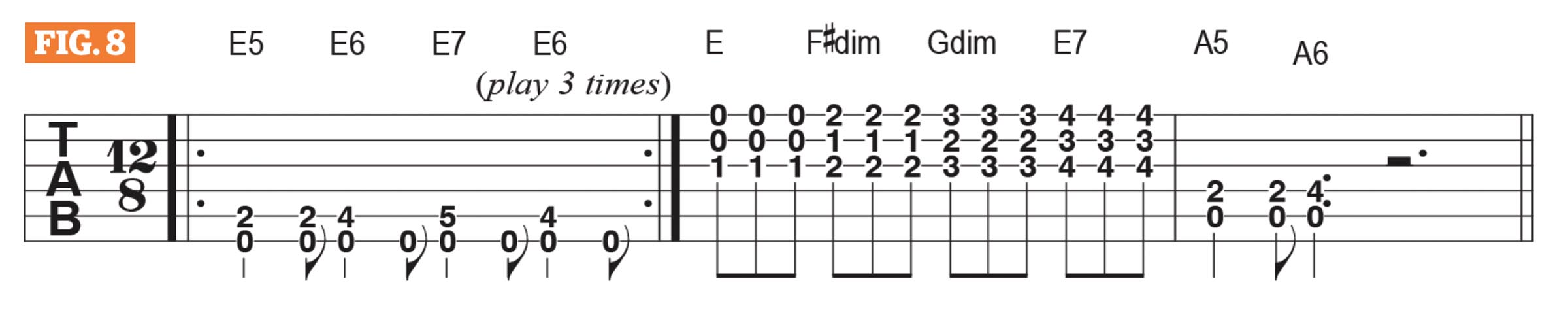
Figure 8 represents the first five bars of a 12-bar blues in E. After three bars of E5 to E6 to E7, I play ascending chords on the top three strings as a means to set up the change to A7.
Listen to and learn as many turnarounds as you can, and use them as elements in your solos. The whole fun of playing blues is finding your own voice inflections.
This is the last installment of One Guitar Woman for now. Thank you for reading! You can check out SueFoley.com for the latest on my tour dates and album releases.






.png?w=600)