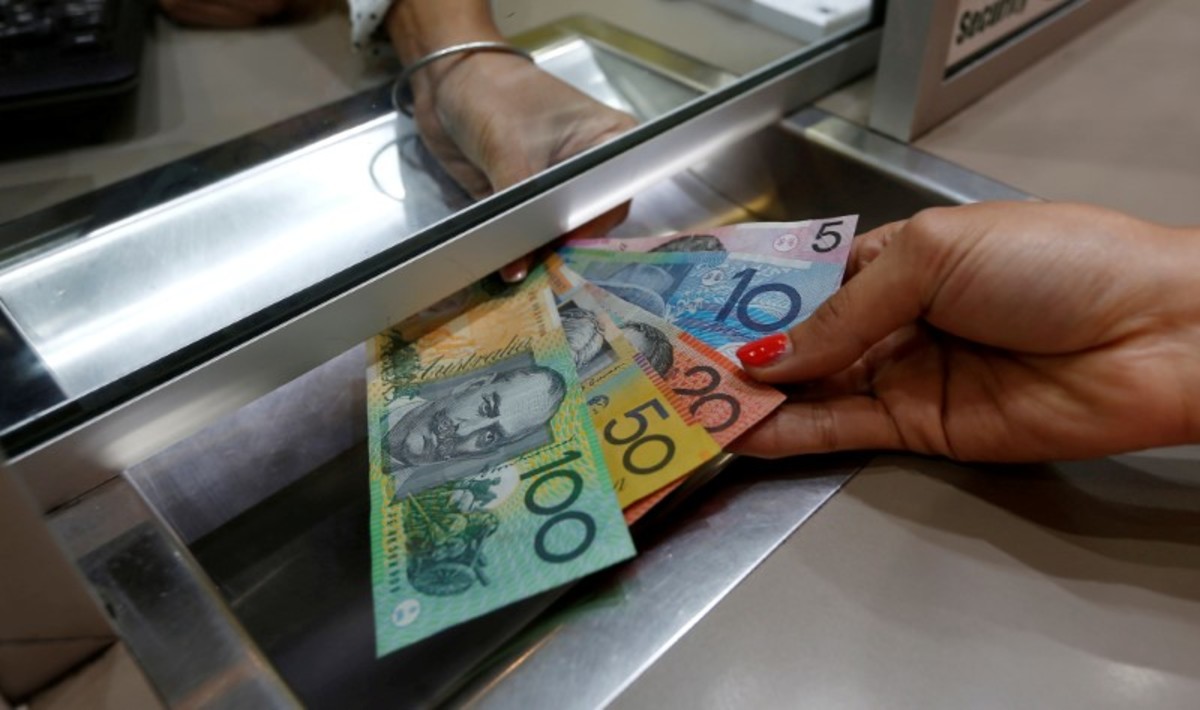
SYDNEY (Reuters) - Australian dollar traders could be set for a very dull year indeed if the median call in a Reuters poll proves prescient, with analysts expecting it to end pretty much where it started against the U.S. dollar.
The survey of 51 analysts predicted the Australian dollar <AUD=D4> would be at $0.7700 in one, three, six and 12 months, an unusually flat glide path for the traditionally volatile currency.
Over 2017, for example, the Aussie went from as low as $0.7165 to as high as $0.8125 before ending the year just above $0.7800.
Yet, the monotonous median hid a wide range of extremes with forecasts as low as $0.6800 and as high as $0.8500 on a one-year horizon. When the median forecast clusters around the middle ground it often reflects acute uncertainty about the outlook.
The bearish case rests mainly on the Aussie's vanishing yield premium with the Federal Reserve widely expected to lift U.S. interest rates above Australia's this year, perhaps as early as March.
That would be a rare event. The last time U.S. rates were higher was in January 2001, when the Aussie was around $0.5600.
Bond markets have already shifted to reflect that outlook with the premium paid by Australian two-year debt over U.S. paper now at zero for the first time since 2000. It had been as high as 60 basis points as recently as September.
"The risk is rates differentials will move further against the AUD at the front end of the curve at least," said Ray Attrill, head of FX strategy at NAB.
"Even on current differentials the AUD is seen moving into a lower $0.70-0.75 trading band in the first half, with downside risks depending on broader USD performance, risk sentiment and commodity prices."
Attrill has $0.7300 pencilled in for end 2018.
Yet rate differentials are clearly not everything in currency markets. While the yield premium has evaporated over the last few months, the Aussie actually rallied from a trough of $0.7501 to hover around $0.7860.
Part of that outperformance is due to surging optimism about global economic growth, which in turn has lifted prices for Australia's major commodity exports.
Chinese demand has helped drive iron ore, Australia's single biggest earner, from a low of $58.62 in November to $74.61 <TIOc1>, a rise of 27 percent.
Copper, a bellwether for industrial growth, climbed 31 percent last year and is at its highest since early 2014.
"Commodity prices will remain supported because the global economy is experiencing its first synchronised upswing for a number of years," said Elias Haddad, a senior currency strategist at CBA.
"This will underpin Australia's terms of trade, while the current account deficit is narrowing and generating a higher fundamental valuation for the currency."
He sees the Aussie at $0.8300 by year end.
The story was much the same for the New Zealand dollar, and for many of the same reasons. The median forecast put the kiwi at $0.7000 for one month, $0.6950 for three, $0.6900 for six and back to $0.7000 for year end.
The kiwi is currently around $0.7150 <NZD=D4> having also rallied in the past few weeks as risk sentiment improved globally and prices for dairy, the country's biggest goods export, turned higher.
(For other stories from the global FX poll:)
(Polling by Shaloo Shrivastava and Khushboo Mittal; Editing Shri Navaratnam)