The credits of television shows end with a copyright line, once in Roman numerals – widely believed to have been a device to stop viewers who were not Latin-literate from realising they were watching a repeat – but now generally using Arabic numbers.
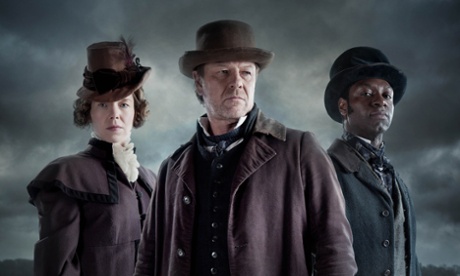
In several current TV shows, though, this ownership note is not the whole story. The Frankenstein Chronicles, which started last night on ITV Encore, is the latest drama that uses out-of-copyright literary characters in a new interpretation or setting, following on from Penny Dreadful and the current ITV Jekyll and Hyde, with the trend about to be extended by BBC1’s Dickensian.
It still feels strange to find new material on ITV Encore, which has the sound and feel of a repeats channel – and the presence of The Frankenstein Chronicles inevitably looks like being dropped to the reserves – but the network is an appropriate home for a show that gives a second hearing and round of applause to Mary Shelley’s 1818 story of a scientist who galvanises life from dead body parts.
Series creator Benjamin Ross has – again fittingly – stitched together a new plot from bits of the original, with Sean Bean, playing one of Sir Robert Peel’s first cops in 1827 London, investigating the origins of a strange human form that washes up from the Thames. This twist keeps the series clear of Penny Dreadful, in which show-runner John Logan employs a recognisably Shelleyesque version of the monster and his begetter Dr Victor Frankenstein among the borrowed characters interacting in Victorian London.
Reanimation of the original narrative is also the technique used in the new Jekyll and Hyde, where writer Charlie Higson advances the action by several decades into a different generation of the split-personality family, which again has the benefit of avoiding bumping into the Dr Henry Jekyll who turns up in Penny Dreadful.
Fans of the various franchises may already be imagining a crossover episode, in which the Penny Dreadful Dr Jekyll meets his grandson from the ITV series and John Logan’s Victor Frankenstein shares a practice with whoever is responsible for the patchwork cadaver in The Frankenstein Chronicles.
One reason that the field of Brit Lit spin-offs is becoming so crowded is that Mary Shelley, Charles Dickens and Robert Louis Stevenson invented archetypes and situations that are familiar even to people who have never read the books. This rapid name-recognition is presumably why Fox originally gave its planned drama about a dead cop who is brought back to life to solve mysteries the title Frankenstein, even though it has no more than a vague metaphorical connection with the Shelley story. After objections of literary grave-robbing, the series is now, more sensibly, called Second Chance.
In tight financial times, it is also financially canny to plunder the vaults of out-of-copyright books. Adapt a classic novel that is still controlled by an estate and the budget is swollen by a rights fee, with the additional risk that the keepers of the author’s flame may also interfere artistically. Some copyright holders have been so acquisitive or restrictive that, for a decade or so, cultural democrats in various countries have celebrated Public Domain Day on 1 January each year, the date on which literary copyrights cease, 70 years after the writer’s death in many territories, but 95 in America. TV producers, you suspect, are among those whooping most exuberantly as another crop of plots and protagonists become free.

Because Sherlock made such a success from the business of rebooting 19th-century literature, it is clearly in one sense the father of this genre, with Elementary its irritating American cousin. But the case of these Holmes entertainments is complicated because there is continuing legal debate over whether the Baker Street detective is free to air for producers: the estate of Sir Arthur Conan Doyle contests that some characters and elements remain protected because they appeared in later stories that are still subject to royalties.
This may be one reason that the more recent literary spinoffs have reached further back into the library. Tony Jordan, writer of Dickensian, doesn’t have to worry about descendants of Charles Dickens heading to the courts to claim ownership of Scrooge, Fagin, Miss Havisham and other characters who are incorporated into new storylines in the series.
Ominously, on 1 January 2016, the next Public Domain Day, the authors whose literary works come out of copyright include Adolf Hitler, but the TV trend for re-animating free literature will hopefully not extend to postmodern mashups of Mein Kampf.