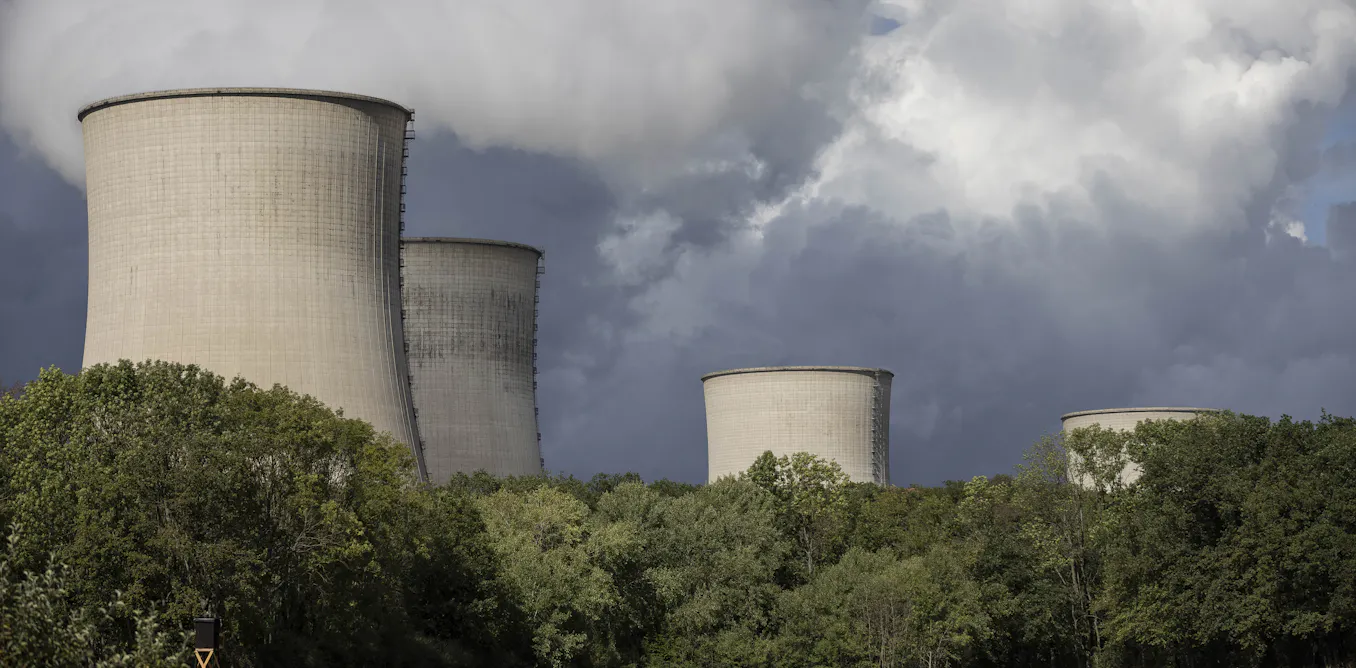
Much of western Europe has endured long stretches of hot weather and heatwaves this summer. France recently experienced the hottest day in its recorded history and placed 54 of its 96 departments under the highest heat alert.
In response, the state-owned utility, EDF, began cutting output at several nuclear plants along the country’s rivers. Some reactors ran at reduced power while others shut down temporarily. For some, the episode appeared to confirm that nuclear power, for all its low-carbon promise, cannot survive the climate crisis.
While that reading may be tempting, it’s mistaken. What the heatwave revealed was not a failure of nuclear technology, but rather a narrow, well-understood constraint in how some riverside plants are allowed to operate during extreme heat.
To dissipate the heat they produce, plants draw water from a body of water and return it a few degrees warmer. French law limits how much warmer that water may be, a rule meant to protect fish and other aquatic life.
During a heatwave, the rivers are already warm, so it’s that legal ceiling, not any technical limit of the reactor itself, that obliges EDF to reduce output. Thus, the cuts here were a deliberate measure to protect river ecosystems — not a reactor failing to generate electricity.
As Canada develops new nuclear power projects, some might worry that hotter weather could undermine nuclear reliability. However, France’s experience this summer suggests otherwise.
Heat and nuclear plants
The recent reductions in nuclear power generation did not undermine France’s electricity supply. The reductions began on June 22 and continued through the week as the heat persisted, reaching about 4.1 gigawatts, or seven per cent of national demand, at their peak. Even then, a large majority of France’s reactors remained in operation.
The grid operator, RTE, said France had “sufficient generation capacity to meet electricity demand,” even with several reactors offline. It is true that prices rose, exports to neighbouring countries fell and the grid relied more heavily on gas as well as oil-fired reserve generation. Yet these were temporary strains, and at no point was France’s supply in any kind of serious jeopardy.
Of course, none of this is really new. Heat has curtailed French reactors before, but set against annual nuclear generation, the losses have been modest. In our recent study, we documented two decades of these cases: France’s heat- and drought-related curtailments remained below one per cent of its annual nuclear output in every year but one, with the worst case reaching about 1.3 per cent.
France’s historical record also shows meaningful adaptation: the country’s heat-related curtailment losses have fallen by roughly 90 per cent since 2003, as utilities upgraded cooling systems, refined operating practices and timed maintenance shutdowns for the hottest parts of the year. While the constraint remains, its practical effect has significantly diminished over time.
It is also worth asking how nuclear’s alternatives would have fared. The same stagnant, high-pressure air that warmed France’s rivers also weakened wind generation across France, leaving the grid to rely more heavily on gas than on additional renewable output. Heatwaves often place simultaneous pressure on several parts of the electricity system, but not on all of them equally.
During periods of severe heat, renewables can weaken just as demand peaks. Wind generation tends to fall in these conditions and high temperatures can trim the efficiency of solar panels, while firm, low-carbon generation remains available when supply is tight. A system more dependent on renewables could have fared worse in late June, while nuclear generation remains far less variable over the course of a full year.
None of this diminishes the danger of heat. But the prospect of further extreme heat in the future is a reason to expand low-carbon power, including nuclear, rather than reduce it.
Canada’s nuclear future
Canada is currently expanding the Darlington nuclear plant in Ontario, and further projects are being considered nationwide. The relevant question is whether a manageable constraint should weigh heavily against further developing a useful, low-carbon source of energy.
We don’t think it should. Extreme heat affects every source of electricity. Nuclear’s exposure is comparatively predictable, rooted largely in environmental operating limits and increasingly manageable.
Back in France, EDF expects to spend around 600 million euros a year over the next 15 years on climate adaptation. That’s a lot of money, yet nuclear alternatives carry substantial costs of their own. Greater reliance on gas would entail higher emissions and significant water use, while heavier dependence on variable renewables could leave electricity supply less secure during heatwaves, which can simultaneously suppress their output.
The recent heatwaves illustrate that nuclear plants can operate under strain while continuing to meet electricity demand on a stressed grid. In a warming climate, such resilience should be treated as an asset, not a liability.
This article was originally published on The Conversation. Read the original article.