France has called on the European Union to pause its plans to sign a long-awaited free-trade agreement with the South American Mercosur bloc, setting the stage for a tense week in Brussels as EU leaders seek to push the landmark deal over the line.
Paris said that the conditions were not yet right for EU member states to approve the agreement, urging the bloc to postpone upcoming deadlines to allow more work on safeguards for European farmers.
In a statement from the French government issued on Sunday, France stressed that "legitimate measures of protection for our European agriculture" still needed to be secured.
The intervention comes as European Commission President Ursula von der Leyen is preparing to travel to Brazil later this week to finalise the accord with Mercosur – a bloc made up of Brazil, Argentina, Uruguay and Paraguay.
The agreement, nearly 20 years in the making, would create a free-trade area covering around 722 million people, the largest of its kind in the world.
Before any signing can take place, however, the commission must win the backing of EU member states.
European nations are expected to consider the deal between Tuesday and Friday, although France argues that timetable is premature, particularly with a Mercosur summit scheduled for 20 December.
French lawmakers unanimously opposed to EU-Mercosur trade deal
Call for safeguards
Finance Minister Roland Lescure underlined France’s opposition in an interview with Germany’s Handelsblatt business newspaper, saying the treaty was "simply not acceptable" in its current form.
He said Paris had set three conditions for its approval – robust safeguard clauses, equal production standards for EU and Mercosur farmers, and tighter import controls. "Until we have obtained assurances on these three points, France will not accept the agreement," he said.
President Emmanuel Macron has also personally appealed to von der Leyen to delay the process.
The European Commission, however, has rejected calls for a postponement and reiterated its determination to see the deal signed by the end of the year.
French farmers petition Macron to block Mercosur trade agreement
"Signing the deal now is a matter of crucial importance – economically, diplomatically and geopolitically," a commission spokesperson said, reflecting concerns about Europe’s competitiveness, as it faces pressure from Chinese exports and US tariffs.
Meanwhile, Berlin – one of the agreement’s strongest backers – has also weighed in, calling for the deal to be signed this week. Germany hopes the pact will help revive its industrial exports and bolster Europe’s position in an increasingly competitive global trade environment.
Supporters of the agreement – including Germany, Spain and several Nordic countries – see it as a timely boost for EU exporters. The deal would make it easier for European firms to sell cars, machinery, wines and spirits in Latin America, while opening the EU market further to South American products such as beef, sugar, rice, honey and soybeans.
Brussels showdown
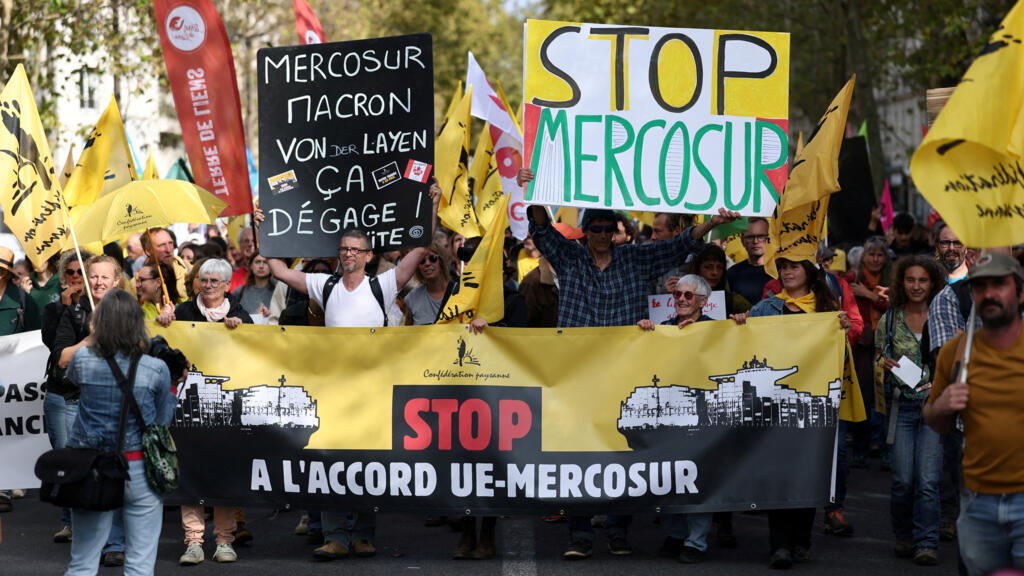
For many farmers in France, Poland and elsewhere, the deal raises fears of unfair competition from imports produced under less stringent environmental and animal welfare standards.
That concern is expected to spill onto the streets of Brussels this week, with up to 10,000 farmers planning protests during an EU leaders’ summit on Thursday and Friday.
In an effort to ease tensions, the European Parliament is due to vote on Tuesday on safeguard measures designed to reassure farmers.
Is France misguided to keep rejecting the EU-Mercosur trade deal?
While EU states have already approved the relevant clause, MEPs could seek to strengthen it further. The commission has also announced tighter checks on agricultural imports and promised to update rules on pesticide residues to prevent banned substances entering the EU via trade.
France still faces an uphill battle to block the treaty outright, as it only requires a weighted majority of member states to pass. Even so, diplomats warn that failure to find a compromise this week could have wider consequences.
Von der Leyen is expected to join Mercosur leaders in Foz do Iguaçu – home to the famous Iguaçu waterfalls – for the signing ceremony if the deal clears its latest hurdles.
Even then, the process will not be finished, as the European Parliament must still give its final approval – likely in early 2026.
(with newswires)