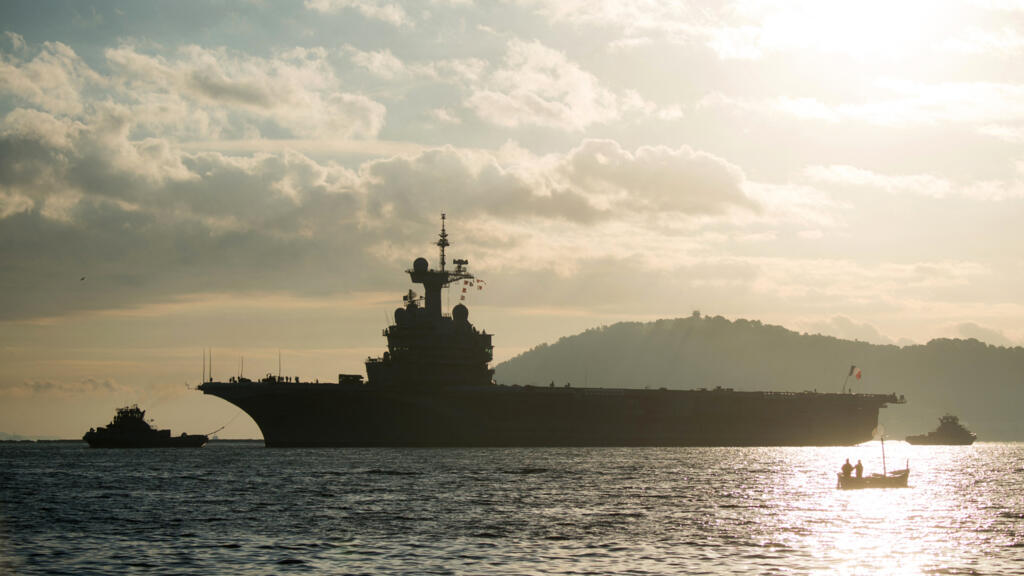
France has dispatched its flagship aircraft carrier into the Atlantic as European leaders close ranks over Greenland, underscoring a renewed push for solidarity – and self-confidence – at a tense moment for the transatlantic alliance.
The Charles de Gaulle – the pride of the French navy – set sail from the Mediterranean port of Toulon this week to take part in a major allied exercise, the defence ministry said Tuesday.
While officials declined to give precise details of its route, sources said the carrier strike group is heading into the North Atlantic – a stretch of ocean that has found itself squarely at the centre of recent geopolitical friction.
The deployment comes as French President Emmanuel Macron prepares to host talks in Paris with the leaders of Denmark and Greenland.
Greenland’s strategic location between the Arctic Ocean and the North Atlantic, coupled with its mineral resources, has made it an increasingly important focus for global powers.
EU seeks stability after Trump steps back on Greenland and tariffs
Transatlantic tensions
Tensions flared earlier this month when US President Donald Trump threatened to seize the semiautonomous Danish territory and to impose tariffs on European countries that opposed him, including France, Germany and Britain.
The remarks rattled European capitals and prompted an unusually firm show of unity in support of Copenhagen. Trump later stepped back from the threat of military action after what was described as a “framework” for a deal was reached, although few details have been made public.
The French-led naval deployment is being presented as measured rather than confrontational. The exercise, known as Orion 26, will bring together French forces with regional allies and partners in what Paris describes as a strategic area for the defence of European interests.
The carrier strike group includes the aircraft carrier and its combat aircraft, alongside escort and support vessels such as an air-defence frigate, a supply ship and an attack submarine.
None of the sources questioned said how far north the group would operate, though the North Atlantic is a familiar transit zone for Russian submarines from the Northern and Baltic fleets.
Can NATO survive the presidency of Donald Trump?
NATO strains and 'autonomy'
The military manoeuvres come amid a broader argument within NATO about Europe’s ability to defend itself.
Speaking to EU lawmakers in Brussels, NATO Secretary-General Mark Rutte insisted that Europe remains dependent on the United States for its security.
Without Washington, he said, Europeans would need to more than double current defence ambitions to fill the gap.
At NATO’s summit last year, European allies – with the exception of Spain – along with Canada agreed to raise defence and security-related spending to a combined five percent of gross domestic product by 2035.
Rutte warned that even this level might fall short if Europe sought full independence, particularly given the cost of developing nuclear capabilities.
France has long argued for greater European “strategic autonomy”, a stance that has gained traction as successive US administrations have signalled that their security focus lies increasingly elsewhere.
Paris maintains that building stronger European capabilities would complement, not replace, the alliance with Washington.
(With newswires)