When General Charles de Gaulle reportedly pondered how one could "govern a country with 258 varieties of cheese", he may have got the number wrong, but chances are La Vache qui rit was not on his list.
Can the creamy, spreadable, processed product in a silver wrapper even be considered cheese at all?
It does contain cheese, and it was invented by a cheese maker, not a panel of marketing experts.
The story first appeared in the Spotlight on France podcast. Listen here:

Modern cheese
It all began 100 years ago on 16 April 1921, when Léon Bel filed the patent for his cheese recipe.
He hit on the idea of making the cheese after the Swiss-born Graf brothers had imported the technique to the Jura region a few years earlier, and realised it could be the solution to his family's struggling cheese business. By the end of World War I, the Bel cheese company found itself saddled with large wheels of local comté cheese it couldn't sell.
In a spirit of "if you can’t move it, improve it", Bel began mixing hard cheeses such as comté and gruyère with milk and butter at high temperatures, rendering a uniform paste that was stable and easy to store without refrigeration.
This cheese caused something of a revolution in France at the time, though Bel was not the only one making it. But he found a way to make his product stand out from the crowd.
A cow is born
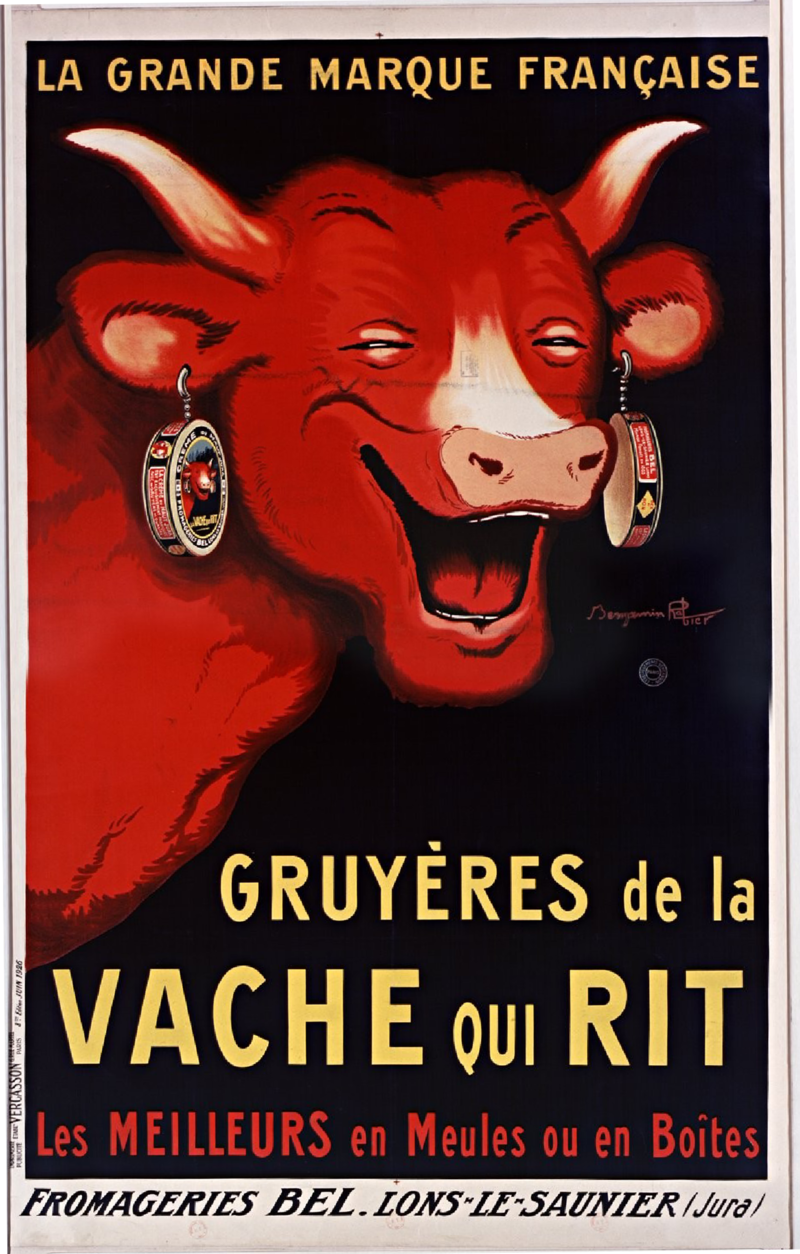
The first Vache qui rit was sold in a round metal tin featuring Bel’s own drawing of a red cow, standing on four legs, behind a sign with the name of the product.
But in 1923 he decided it needed a relook and turned to illustrator Benjamin Rabier who gave the cow a friendlier, more human face.
Bel’s wife is believed to have encouraged him to add on the cheese box earrings to make the cow appear more feminine. The earrings created a kind of never-ending image within an image, which has kept generations of bored kids occupied on car journeys and picnics.
As to why the cow is laughing, legend has it that during WW1 Léon Bel saw a troop meat wagon with a smiling ox on the side. A soldier nicknamed it the Wachkyrie, in reference to the Valkyries, so dear to the Germans, and that morphed into vachequirit.
The making of an icon
In 1924, La Vache qui rit was packaged in its now trademark round cardboard boxes in eight, individually silver-wrapped wedges.
The cheese soon was rolled out in international markets, and thanks to Bel’s marketing skills, the image became something of an icon. By the 1930s, there were laughing cows emblazoned on a range of promotional objects.
The cow even took part in the early days of radio advertising with the song C’est la Vache qui rit (It’s the Laughing Cow), by Jean Rodor, performed by the aptly-named Constantin le Rieur.
An international hit
La Vache qui rit is now sold in 136 countries, under a variety of different names (Die Lachende Kuh in Germany, Con bo cuoi in Vietnam). Only a small part of the production is still made in France, in the Jura.
The biggest consumers of this pasteurised French invention are in Algeria and Morocco, with the French in third place.

In its purest form, top chefs in France are not averse to the Laughing Cow's charms.
Michelin-starred French chef Hélène Darroze has fond memories of her grandmother's pumpkin soup in which crème fraiche was replaced by a triangle of La Vache qui rit.
“I’m continuing the tradition with my daughter,” she’s quoted as saying at La Vache qui rit museum in Lons-le-Saunier where Léon Bel opened his first factory.
This story is part of the Spotlight on France podcast.