There was a letter in Monday’s Midi Olympique, France’s bi-weekly newspaper devoted to rugby union, entitled: “Merci Messieurs”. It was penned by a woman called Véronique and she was eager to express her heartfelt gratitude to the players of England and Scotland. She suggested their game had been union at its finest – adventurous and expansive – unlike that of her France. Frankly, she wrote, “they bore me”.
She has a point. France may still be in with a distant chance of winning the Six Nations championship should they beat England on Saturday, if Wales and Ireland have already lost their games, but they must also score a barrel-load of points in the process. And in their four matches so far in this tournament they have managed only four tries, seven fewer than Stuart Lancaster’s side.
The fact France have drafted the gargantuan Toulouse No8 Louis Picamoles into the squad for Twickenham suggests an expansive game-plan is not the priority for the head coach, Philippe Saint-André. It never has been. His masterplan has always been built around a rock-solid defence and while most of the rugby world recoiled at the poor quality of France’s 29-0 win over Italy on Sunday, Saint-André was delighted at shutting out the Italians, exclaiming: “Today we saw a real team … it was a great win.” For while France may have scored only four tries this championship they have conceded only half that number, and that is the stat Saint-André loves, and the one that the fans deplore.
Whoever Saint-André selects on Thursday to face England the fans do not hold out much hope. For a start it is 10 years since they last tasted Six Nations success at Twickenham but, more pertinently, the French public’s faith in their side has shrivelled in the three-and-a-half years that Saint-André has been in charge.
Once they were famous for Serge Blanco, now it’s Mathieu Bastareaud, the 18-stone centre with the build and, the cynic might say, the pace of a prop forward. Force has replaced flair and the results have suffered as a consequence with France winning just 15 of their 36 Tests under Saint-André.
So why has the former France winger not been sacked? He is criticised by his public, savaged by his press and ridiculed by his peers. After the 20-13 defeat by Wales last month, one of Saint-André’s predecessors as the national coach, Bernard Laporte, cruelly compared him to Raymond Domenech, the hapless coach of the France football team who sparked a mutiny among his players during the 2010 World Cup.
But Domenech wasn’t sacked, despite the disaster which he presided over in South Africa five years ago, and nor will Saint-André be. “It’s not in the habit of the French to sack people,” explains Jérôme Riondet, the only Frenchman to have played in the Varsity match (for Oxford in 1995) and now a rugby commentator for beIN Sports. “I’m not just talking about rugby but sport in general, and also in the workplace. It’s a different culture to the Anglo-Saxon one. In France it’s more a feeling of ‘we chose him so we must back him not sack him’.”
What also keeps Saint-André going is the thought that it will soon all be over. He steps down after the World Cup and one suspects there won’t be a backward glance when he retreats to his family home in the Rhône-Alpes region of France.
It was there he went last August, not long after France had returned from a chastening tour to Australia where they were beaten 3-0 in the Test series. Under the summer sun of this beautiful region Saint-André organised a touch rugby tournament in honour of his late father, a former mayor of the village of La Chapelle-en-Vercors and the son of a Resistance hero executed by the Nazis. According to one of those present, Saint-André addressed players and spectators at the end of the tournament. “At this moment I don’t have too many friends,” he said, smiling, “so I’m happy to see you all here because you know who I really am.”
He also made a couple of jokes at his own expense, which is very much the Saint-André way. One of the reasons he spent so long in England, first as a player with Gloucester and then as coach of Sale Sharks, is that his humour is more Anglo-Saxon than Gallic. That’s another reason why he’s been able to withstand the opprobrium of his own people.
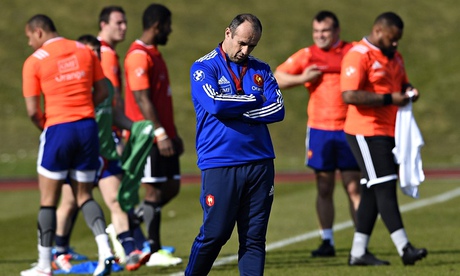
Yet in public, in front of the cameras, he can often appear glum, with a hangdog demeanour that does little to inspire confidence. It exasperates those close to him because they know the real Saint-André. His brother, Raphaël, himself a former professional player and coach, confided to a French newspaper recently: “I’ve said to him: ‘You are a little too sad in press conferences, be more upbeat.’” To his credit, Saint‑André took his brother’s advice when he appeared on a primetime television programme earlier this month, but some viewers didn’t appreciate his good cheer given France’s recent results. “Voila!” he exclaimed afterwards. “When I laugh, they reproach me and when I’m sad they say that I’m crying. What should I do?”
That’s one of the reasons Blanco, the legendary former France full-back and now vice-president of the FFR, has been brought into Les Bleus’ backroom staff. His bonhomie is a counter-balance, not just within the squad but in front of the media when the critics become a little too clamorous.
It would be wrong, however, to lay the blame for France’s plight solely at the feet of Saint-André. He wasn’t responsible for the 19 handling errors committed against Italy nor the indiscipline in Dublin that gifted Ireland six kickable penalties.
“Club rugby in France is now so structured,” explains Riondet. “It started about a decade ago when Bernard Laporte was coach of France and when all the foreign coaches started to arrive [in the Top 14]. They brought with them game-plans and so now we have a generation of French players who have lost the ability to play by instinct. Their natural flair has been suppressed by these rigid game-plans that are alien to the French way of playing rugby.”
The players are uncomfortable with it, and the public despise the conservatism. The game in France is a means of expression and for a great many supporters style is more important than success. In the 2005 Six Nations France began their campaign with sterile but structured victories over Scotland and England. Were the public satisfied? No. The great Pierre Villepreux, France’s gifted full-back in the late 1960s, complained that “the team played in a very organised manner to the detriment of the individual liberty”. So the then coach, Laporte, loosened the shackles when Wales came to Paris and allowed his players to play with more elan and adventure. France lost 24-18 but the fans went home happy. “It’s mad,” said Laporte of the congratulatory messages he received from the public. “I feel like we won rather than lost.”
Ten years on and Riondet says that philosophy hasn’t changed. He’s not confident of success at Twickenham on Saturday, nor at the World Cup in September. “But to be honest, I think it might be best for France in the long run if we go out at the group stage,” he says. “That might be the last chance to save French rugby because we’ll be forced to start from scratch.”
He, like most of his compatriots, wants to see France revert to playing with more ‘individual liberty’. In the meantime perhaps Midi Olympique should think about expanding its letters page.
Gavin Mortimer is a Paris-based writer @gavinmortimer7