French President Emmanuel Macron on Friday called for de-escalation of the three-week conflict in the Middle East, as France and five other countries said they were ready to help ensure safe passage through the Strait of Hormuz.
"I express the hope that the fighting will cease and that a ceasefire can be agreed," Macron said after a European Union summit in Brussels.
“I haven’t heard anyone express a willingness to get involved in this conflict,” he added. "I don’t think an escalation would resolve the international situation."
France, Britain, Germany, Italy, Japan and the Netherlands said in a joint statement on Thursday that they were concerned about the situation.
"We condemn in the strongest terms recent attacks by Iran on unarmed commercial vessels in the Gulf, attacks on civilian infrastructure including oil and gas installations, and the de facto closure of the Strait of Hormuz by Iranian forces," the statement said.
How Iran’s Shahed drones are reshaping the economics of war
Shipping risks rise
"We express our deep concern about the escalating conflict. We call on Iran to cease immediately its threats, laying of mines, drone and missile attacks and other attempts to block the Strait to commercial shipping, and to comply with UN Security Council Resolution 2817.
"We express our readiness to contribute to appropriate efforts to ensure safe passage through the Strait. We welcome the commitment of nations who are engaging in preparatory planning."
Italy, Germany and France later said this did not mean immediate military action, but a possible joint effort after a ceasefire.
On Thursday, Iran continued attacks on energy sites in the Gulf. Drones hit a Saudi refinery and two others in Kuwait, after earlier damage to a major liquefied natural gas facility in Qatar. The strikes followed Israeli attacks on Iran’s South Pars gas field.
Israeli Prime Minister Benjamin Netanyahu confirmed on Thursday night that Israel would suspend further strikes on Iran’s energy infrastructure after a request from US President Donald Trump.
Iran says no one can exclude it from World Cup after Trump warning
Tensions over strategy
The move raised questions about whether Trump and Netanyahu agree on how to conduct the war, which began on 28 February with Israeli and US air strikes on Tehran.
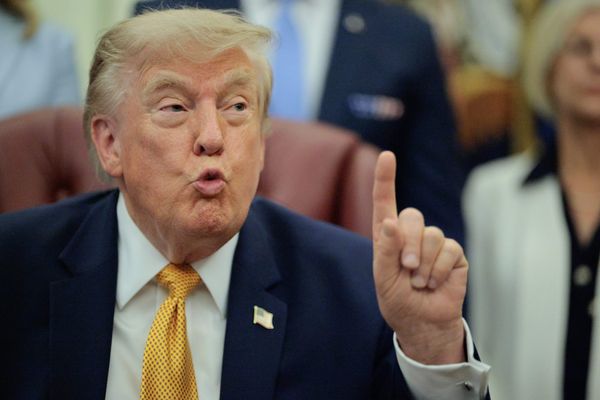
At a meeting in the Oval Office with Japanese Prime Minister Sanae Takaichi, Trump said he did not support Israel’s strike on the South Pars field.
“I told him: 'Don’t do that,’” Trump said. “We get along great. It’s coordinated, but on occasion he’ll do something. And if I don’t like it ... and so we’re not doing that anymore.”
Netanyahu said there was no real divide between the two leaders.
“It’s been said that for 40 years I’ve been saying that Iran is a danger to Israel and a danger to the world. That is true,” Netanyahu said at a news conference in Jerusalem. “You know who else said that? President Trump.”
Macron said France would not take part in any mission to forcibly open the Strait of Hormuz, through which 20 percent of the world’s oil passes.
“France’s position remains defensive,” he said. "France aims to protect our citizens and our interests, to support our regional allies, to preserve our freedom of navigation and maritime sovereignty and to do everything possible to help de-escalation.
"However, we will not participate in any forced opening of the strait in the context of ongoing war operations and bombings."
Spotlight on Africa: Africa faces security worries as Iran conflict spreads
Ukraine focus maintained
Macron also said the Middle East conflict would not shift focus away from Russia’s war in Ukraine.
"We continue to work on robust security guarantees with the coalition of volunteers and to provide financial and military support that meets Ukraine's needs."
He called for a €90 billion loan for Ukraine to be put in place without delay.
EU leaders agreed to the loan in principle in December, but Hungary’s Prime Minister Viktor Orbán blocked its formal adoption last month, citing concerns linked to the closure of the Druzhba pipeline.
"While energy security concerns in the EU must be taken into account, they do not undermine our support and must not be instrumentalised," Macron added.