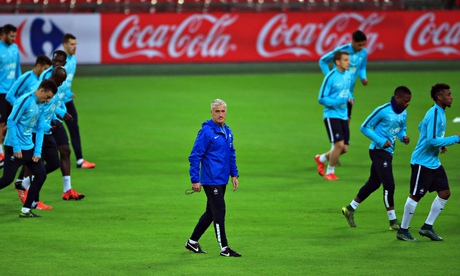
Beneath Wembley’s arch, illuminated in what Didier Deschamps describes as the “very beautiful colours” of the French tricolour, a strange interpretation of normality returned to the footballers of France in these most abnormal circumstances.
On the eve of a friendly whose complexion has changed entirely in the light of the atrocities in Paris, the three heavily armed guards patrolling the tunnel moved out of eyeshot to allow the team to walk out on to a calm stretch of grass for some light training. The outfield players made a circle to stretch their muscles. The goalkeepers handled shots and warmed their gloves. There was a quiet dignity in the way they went about their work before a game that is purely about honouring their flag, their values and their people.
“We will be on the pitch to wear our colours, the red, white and blue, even more proudly,” Deschamps said. In his first public appearance since Friday, the France manager spoke with remarkable composure. There were times, understandably, where he looked strained, paused to find the right words. The overall message he wanted to convey suggested a feeling that the principles of sport are somehow comforting and need to be clung to. “More than ever now, sport knows no colour, no religion,” Deschamps said. “All are welcome in sport. It’s about diversity in every aspect. It’s a way of uniting people and it’s important it continues to do that.”
Les Bleus are readying themselves for an emotional night, with English supporters encouraged to join in La Marseillaise, and Deschamps expressed his gratitude for the messages of solidarity that have come in the midst of national trauma. He also elaborated a little on the experience of the squad since the explosions were heard outside the Stade de France during the match against Germany. “We were focused on playing our game, obviously, and heard two or three explosions without knowing what had happened. You wondered what that was but we were so focused on the game at the time.
“We weren’t really brought up to speed with what had happened until after the match, when it came to light the terrible, disastrous events that had taken place outside the ground and in central Paris. When it became clear Germany wanted to remain in the stadium, independently of what the French state and security forces wanted, we went to them, spoke to them and it was important we stayed with them until it was safe to leave. We got back to Clairefontaine in the early hours, tried to eat and sleep but it was difficult to do either of those things. The night was very short.”
For Deschamps it is hard to imagine how he begins to reconcile what he witnessed at the Stade de France with his experience of winning the 1998 World Cup in that arena as part of a team who were a powerful symbol of the beauty, harmony and possibility of multicultural ideals.
Deschamps was captain of a squad who challenged myriad preconceptions and, like alchemy, turned base ideas into gold. Then aged 29, from Bayonne in the Pyrenees, a tough and fiercely intelligent midfielder, Deschamps lifted the World Cup with his band of brothers around him. The France 98 side crystallised something overwhelming – way beyond the normal perimeters of sport and the standard desire to overcome the doubters who did not think Aimé Jacquet’s side had it in them to conquer all.
This was a team who represented unity in the face of an undercurrent of unease about what it meant to be French. This was a team who represented all the magnificence of multiculturalism at its best.
The far right resented the makeup of the side, which almost made it all the more uplifting. The players who shared their flag had their roots from across the globe – from North Africa, like Zinedine Zidane, the South Caucasus like Youri Djorkaeff, the Caribbean like Thierry Henry, South America like David Trezeguet, West Africa like Patrick Vieira, the Pacific Islands like Christian Karembeu … shoulder to shoulder, the whole stronger than the sum of its parts, victorious.
Out in the streets of Paris that night the general mood swept up that optimism and danced with it. That’s what it felt like, anyway, walking through the elegant streets of central Paris, up the boulevards, past the bars and cafes, towards the quite wondrous sight of Zidane’s face illuminating the Arc de Triomphe. Every element of the melting pot of Paris was out that night, spilling forth with joy. The tricolour took on a black-blanc-beur hue. Black-white-Arab. Without being so naive as to imagine that all the complexities and disenfranchisment felt in the suburbs would disappear, life – in that particular place, at that moment in time – felt so remarkably hopeful.
Stade de France. 13 November 2015. Deschamps was managing from the dugout, older, wiser, focused on another tournament on home soil – and out of the blue came explosions, the soundtrack to an unfolding nightmare.
Deschamps mentioned the bravery of the two members of his squad whose families were directly involved in the horrors. “Two players profoundly touched by terrible incidents, Antoine Griezmann was fortunate to have a feeling of relief and happiness his sister managed to stay alive at Bataclan. Lass [Diarra] was touched by the loss of a relative he was very close to. It’s great he stayed with us. I have conversed with both the players. Lassana’s presence is a reassurance. He has been very strong. We have learned the value of unity and solidarity.
“We are here to represent our country at a particularly poignant moment and are proud to be French. It will be a match full of emotion. That is the role we have to play. Sport is … how can I put it … a representation of unity, of diversity coming together. Look at the words that Lassana Diarra published in his remarkable message – sport has no colour or religion. That has always been the case. It must remain so.”