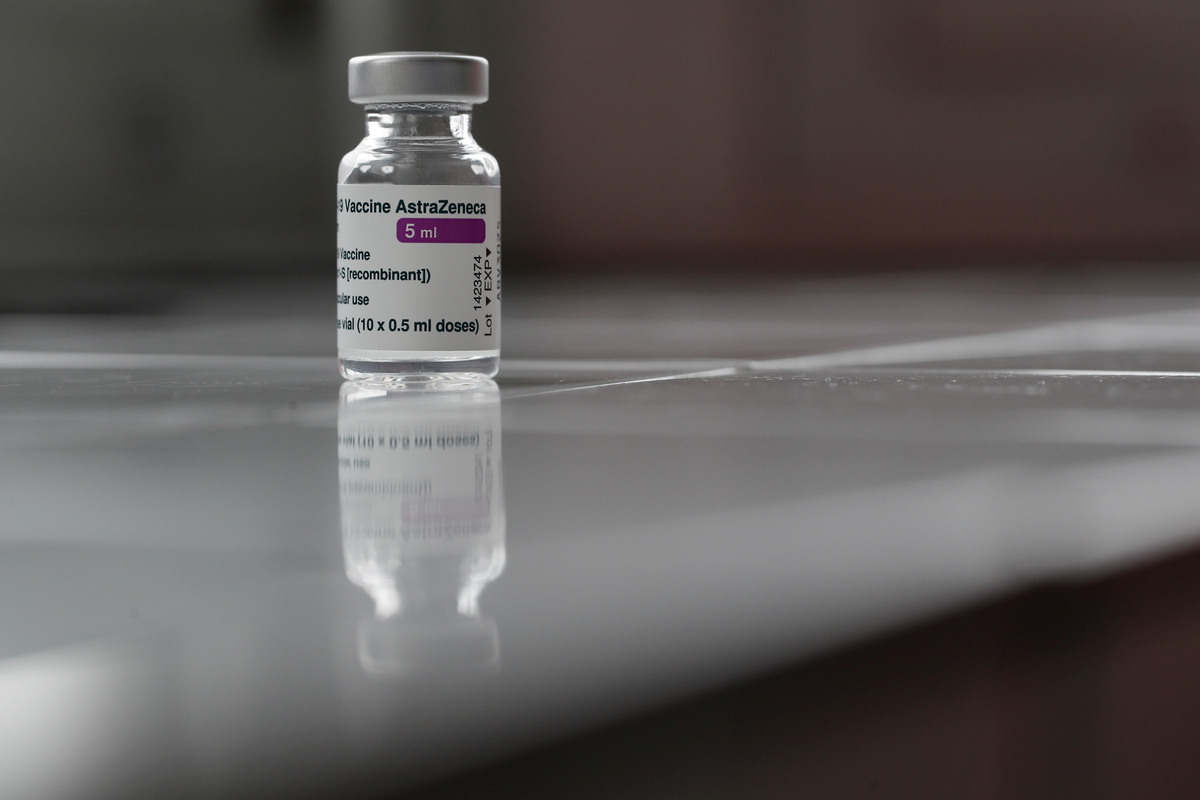
France's top health advisory body in charge of COVID-19 vaccines recommended on Friday that recipients of a first dose of the AstraZeneca shot who are under 55 should receive a second dose with a so-called messenger RNA vaccine.
Reuters reported on Thursday that the Haute Autorite de la Sante (HAS) had opted for the dose-mixing recommendation, which has not yet been evaluated in trials.

The French decision came after European drug regulators said on Wednesday there was a possible link between AstraZeneca's COVID-19 shot and a very small number of cases of rare blood clots.
Some countries had already suspended use of the AstraZeneca vaccine as a precaution, but most have resumed using the shot, although some have done so with age restrictions.
"This is a logical choice and one of security," Dominique Le Guludec, the head of the HAS, told reporters.
"Our approach is absolutely not to engage in a gigantic experimentation on the French population...We actually want to be cautious and not expose people to thromboembolic accidents, even though they are very rare," she said.
Two mRNA vaccines, one from Pfizer and BioNTech and one from Moderna, have been approved for use in France.
mRNA vaccines prompt the human body to make a protein that mimics part of the virus, triggering an immune response, while AstraZeneca's shot uses a harmless, weakened version of a chimpanzee common-cold virus to deliver instructions to generate an immune response and prevent infection.
MORE STUDIES NEEDED
Germany was the first European country to recommend that people under 60 who have had a first AstraZeneca shot should receive a different vaccine as a second dose.
The World Health Organisation on Friday said there was no data to recommend that countries "mix and match" COVID-19 vaccines.
But Thomas Mertens, head of Germany's STIKO vaccine commission, defended the decision, saying mixing two different vaccines may prove more effective than giving two doses of the same shot.
"Firstly, I am sure that there is no safety risk for the vaccinated. Secondly, I am personally convinced that the immunity will be just as good in the end, maybe even better," he told Reuters Television.
Mertens said STIKO expected data from a study in England on mixing vaccines in mid-May.
The HAS also called for real-world studies to assess the immune response triggered by the mixed vaccination scheme.
It said its decision was based on an immunisation strategy known as heterologous prime-boost, in which separate doses of different effective vaccines are used to confer protection.
The HAS said that while there is little data yet available on using different vaccines in a prime-boost strategy for COVID-19, animal studies and evidence from other disease areas is encouraging.
(Reporting by Sudip Kar-Gupta, Benoit Van Overstraeten; Additional reporting by Tilman Blasshofer in Frankfurt; Writing by Matthias Blamont and Caroline Copley; Editing by Kate Kelland, Mark Heinrich and Hugh Lawson)