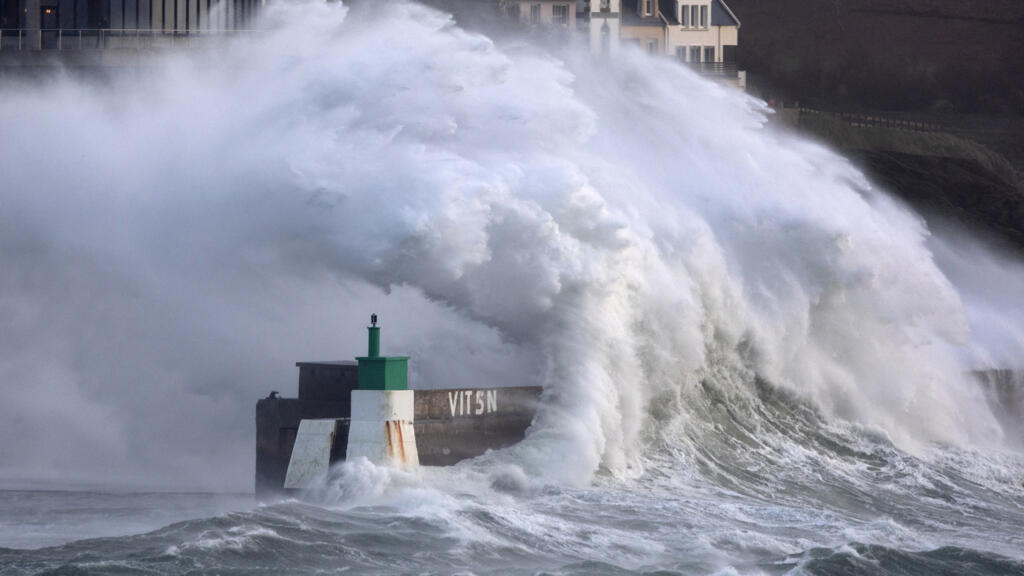
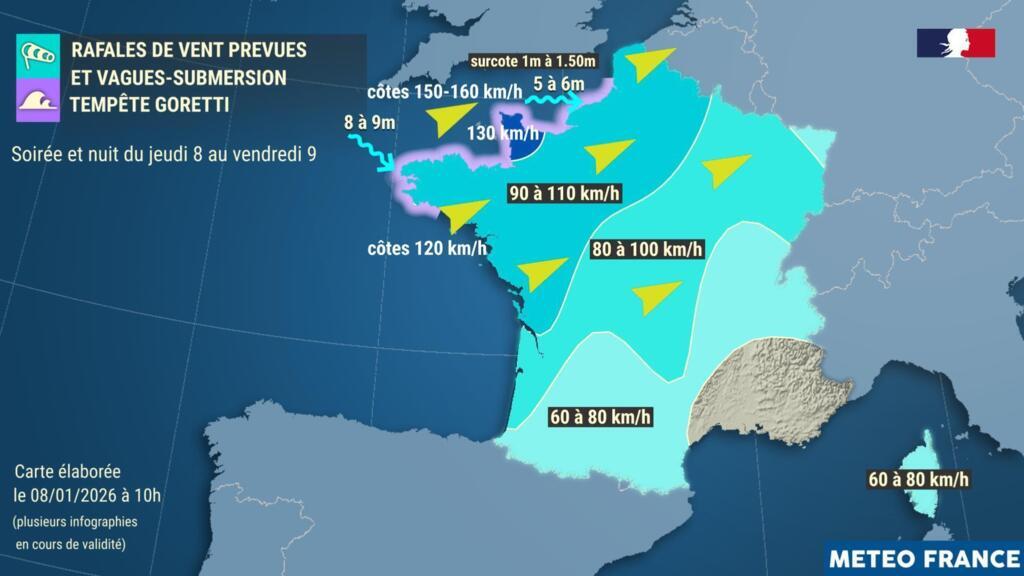
Storm Goretti has hit France and parts of northern Europe with violent winds and sharply colder temperatures, causing power cuts and major travel disruption.
Some 380,000 households were left without electricity on Friday, grid operator Enedis said, as the storm swept across the north of the country.
Most outages were reported in Normandy, especially in the northern part of the region, where conditions were at their worst.
Authorities reported extraordinary wind speeds overnight in the north-western Manche department, with gusts reaching 216 km/h and 213 km/h – among the strongest recorded during the storm.
Across several regions, strong squalls brought down trees, including at least one that fell onto residential buildings in Seine-Maritime. No injuries had been reported so far.
Schools remained closed across northern France as weather alerts covered around 30 regions nationwide.
The Manche department urged residents to stay indoors, warned against unnecessary travel and advised households to prepare emergency lighting and drinking water.
Six people dead in road accidents as France manages heavy snow and ice
UK braces for wind and snow
Across the Channel, the United Kingdom also faces severe conditions. Britain’s Met Office issued a rare red wind warning for the Isles of Scilly and Cornwall in the south-west, urging people to stay inside.
Wind gusts of up to 160 km/h were forecast in parts of the country, while “very large waves” were expected to create dangerous coastal conditions.
An amber snow warning was also in place for Wales and central England, with forecasters predicting snowfall of up to 30 centimetres in some areas.
The disruption quickly reached transport networks, as National Rail warned that train services would be affected over the next two days and called on passengers to avoid travel unless absolutely necessary.
Snowfall to cause major flight cancellations at Paris airports
Extreme weather across Europe
Elsewhere in Europe, Storm Goretti formed part of a wider spell of harsh winter weather affecting several countries.
At least eight deaths across the continent have been linked to recent conditions. In Albania, police in the port city of Durres recovered a man’s body from floodwaters after days of heavy snow and torrential rain in parts of the Balkans.
In Germany, heavy snow and strong winds were forecast to disrupt daily life, particularly in the north. The German Weather Service warned that up to 15 centimetres of snow could fall in northern regions, while icy conditions posed risks further south.
Temperatures were expected to plunge sharply over the weekend, potentially dropping as low as minus 20 degrees Celsius in some areas.
Several cities announced school closures, including Hamburg and Bremen, where public transport had already suffered delays and cancellations on Thursday.
Germany’s national rail operator Deutsche Bahn warned of significant delays in the coming days.
More than 14,000 staff have been mobilised to clear snow from tracks and platforms.
Paris launches winter emergency plan as homeless man dies from cold
A reminder of a warming climate
German forecasters expect the storm to ease by Saturday, with snowfall tapering off by Monday. While the conditions feel particularly harsh, meteorologists caution against seeing them as a contradiction to long-term warming trends.
“This kind of storm is an exception compared with the milder winters of recent years, which are a consequence of climate change,” said German Weather Service meteorologist Andreas Walter.
Cold, snowy months remain possible even as average temperatures rise, he noted – but such events are likely to become rarer in the future.
(with newswires)