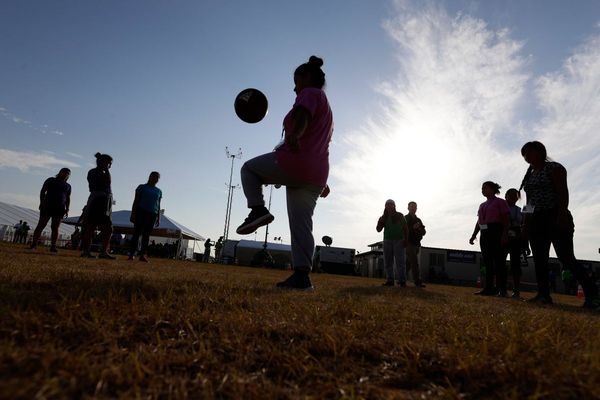
Britain should share responsibility for processing the asylum applications of thousands of migrants at a camp near Calais, according to a French interior ministry report.
The report, which is critical of the lack of cooperation between the French and British border authorities, was presented to French interior minister, Bernard Cazeneuve, before he met his British counterpart, Theresa May, in Paris on Thursday for talks about the migrant crisis.
The scale of the problem was highlighted last week when scores of migrants were seen trying to stow away on queuing lorries bound for Britain during the first wave of a strike by French ferry workers.
The report commissioned by Cazeneuve and published on the website of the French newspaper Libération, says secure parking areas should be set up around the port to stop migrants climbing on to lorries. It also calls for a pilot study to examine whether regulating the flow of freight traffic to Calais would help prevent illegal migration to Britain.
It calls for the UK and France to pool resources to deal with asylum applications at Calais, and suggests that Britain should be prepared to house more migrants.
Both recommendations were thought to have been rejected by May. But after the meeting in Paris, May said Britain and France had agreed to step up efforts to discourage migrants from Africa and the Middle East.
The report by Jean Aribaud, a former prefect of the Nord-Pas-de-Calais region, and Jerome Vignon, head of France’s National Poverty Observatory, examines why the the estimated 3,000 migrants camped at Calais want to get to Britain.
It lists a number of “pull” factors including:
- Asylum applications are dealt with more quickly in Britain. Initial decisions are made within six months of arrival in Britain compared with nine months in France, it says.
- Emergency housing is provided “as soon as reasonably possible” in Britain, whereas in France asylum seekers tend to be housed in reception centres.
- It is easier to find undeclared cash-in-hand jobs on the black economy in the UK, Aribaud and Vignon claim. Their report describes Britain as a “country where illegal immigrants, either adults or children, are likely to be able to immediately earn cash to pay off debts to smugglers and send money back home.”
The report identifies a series of issues fuelling the problem at Calais, including ambiguous border arrangements between France and the UK, poor information-sharing between the two countries, and inadequate border controls that fail to prevent a significant number of illegal immigrants reaching Britain, often with the help of smugglers.
The report contrasts the tight security at the ports with the lax security on the Channel tunnel, described as “random and uncoordinated”. But even at the ports it says the French and British authorities do not share information about the discovery of migrants.
Last week David Cameron said Britain should work more closely with the French, and do more to make the UK a less attractive place for migrants. Speaking in the Commons, the prime minister said: “We’ve got to do more to make sure Britain is a less easy place for illegal migrants to come to and work in. That’s what our immigration bill is all about.”
A joint statement by May and Cazeneuve after their talks said: “Given the worsening migratory crisis in the Mediterranean and its repercussions in Calais … the two ministers decided to boost cooperation, notably by topping up the intervention fund.”
They said the extra resources would allow new security measures aimed at preventing migrants entering the port at Calais and Channel tunnel. The statement added: “Joint information campaigns aimed at explaining to migrants the realities of the British asylum and welfare system, so as to dissuade flows of migrants to the Calais region, will be pursued and stepped up.”