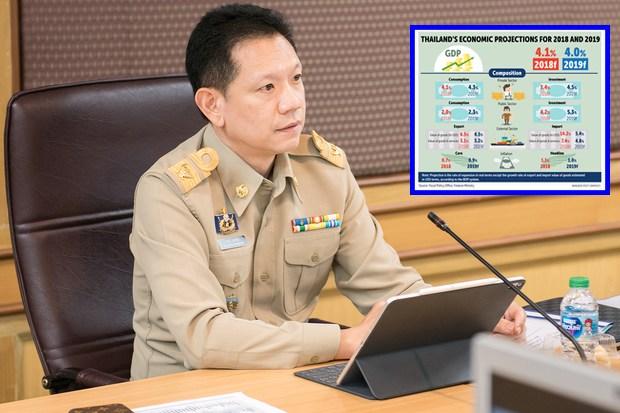
The Fiscal Policy Office (FPO) is bullish on the economic outlook, forecasting growth will meet its potential at 4% this year, despite mounting uncertainties, particularly on the external front.
State and private investment as well as domestic spending are expected to be the main growth engines for the Thai economy in 2019, while exports should cool down to 4.5%, weighed by a dip among trade counterparts and the Sino-US dispute, said Lavaron Sangsnit, director-general of the FPO.
Private investment will accelerate, driven by election clarity and public-private partnerships (PPP) in big-ticket infrastructure projects, he said.
Inflationary pressure is expected to be subdued this year, with the FPO forecasting 1%, marginally down from 1.1% predicted for last year, said Mr Lavaron.
He noted the tame inflation forecast is in line with the decline in the global crude oil price.
"Economic growth in the first half of 2019 is expected to be softer than the second half because there was a high growth base in the first quarter of 2018 at 4.9%, while the second quarter was 4.8%. The FPO believes the election will boost confidence, and the increase in confidence has been given more weight than increased domestic spending from the elections," he said.
"In 2019, the Finance Ministry has to support the economy to grow to its full potential of 4%. As for what measures will be taken, we have to wait."
The Finance Ministry's think tank, however, downgraded its growth forecast for 2018 to 4.1%, Mr Lavaron said.
The 2018 economic growth projection still outpaced 3.9% growth in 2017, he said.
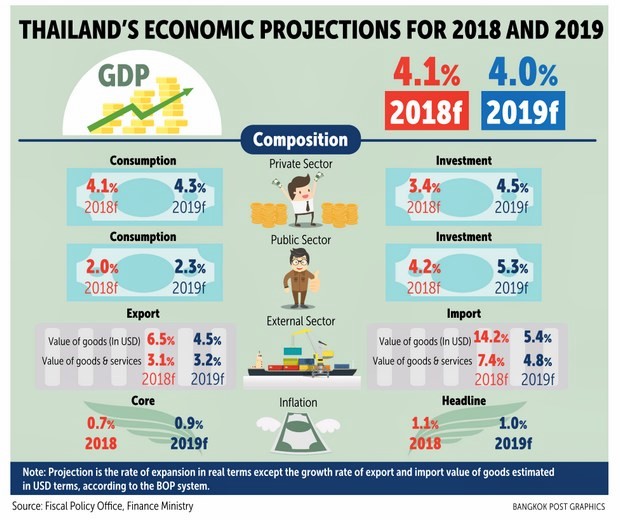
The stronger growth forecast was attributed to increased consumption and investment, said Mr Lavaron.
Measures taken by the state to help those in the low-income bracket, such as the state welfare smartcard, also increased public spending.
Government investment projects encouraged private investment, which increased from the previous year, he said.
The FPO earlier predicted the economy would expand 4.5% last year, but export contraction in the final two months, in part because of the trade war, tempered growth.
In December, the Bank of Thailand trimmed economic growth forecasts for 2018 to 4.2% from 4.4% predicted earlier, and for 2019 to 4% from 4.2%.
"Due to the decline in economic growth of trading partners and US trade barriers, as well as retaliation from various countries, exports of goods in 2018 was 6.7%, lower than the target 8%. The trade war caused a decline in exports of goods, especially for products that Thailand supplies to China," said Mr Lavaron.
"The trade war is estimated to cost US$200-300 million [6.31-9.46 billion baht], which is not so much. The trade war is expected to dwindle this year. However, if it is prolonged, investments in Thailand may benefit."