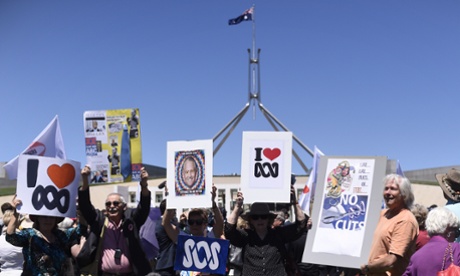
The former Middle East correspondent Greg Wilesmith is one of four senior Foreign Correspondent producers to have been sacked by management in a purge of the ABC’s most experienced journalists.
In what has been described as “an ABC version of Survivor” all the senior reporters and producers on Lateline – and most of those on the national 7.30 – have been put into a redundancy “pool” from which management will choose who to sack after conducting a four-week skills audit.
While the Lateline and 7.30 staff face a harrowing month in which they will be measured against each other, Wilesmith and the other three were made redundant without consultation.
“I’m surprised to be asked to walk the plank given managers acknowledge my extensive international experience and high skill level,” Wilesmith told Guardian Australia on Tuesday.
“They should withdraw their proposals. Foreign Correspondent is being cut disproportionately. I can’t see any rationale for it.”
The four are field producers who fly in to produce, write and edit the feature stories stories alongside the foreign correspondents based around the world.
Foreign Correspondent’s budget has been cut by 10%, sources say. It will go from 30 half-hour episodes a year to 22 half-hour programs and four one-hour shows.
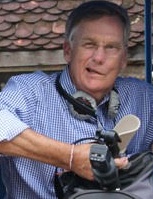
Wilesmith is the most experienced journalist on the program and is admired across the ABC.
It is understood Lateline and the 7.30 hosts Emma Alberici, Leigh Sales and Tony Jones are exempt from the skills matrix. But the co-host of The Drum and Lateline reporter and occasional host Steve Cannane has been placed in the pool, sources said.
Reporters Jamelle Wells, Philippa McDonald, Brigid Glanville, Adrian Raschella, Liv Casben Louise Negline, Deborah Rice, David Spicer and Jayne Margetts are also among those on the list.
According to the leaked “selection pools” document a total of six senior producers from current affairs will lose their jobs before Christmas, as well as six of the 25 senior reporters. Staff from ABC Fact Check, The Business and Landline are also in the pool.
“I think they already know who they want to get rid of,” one reporter said. “They are assessing us against this skills matrix but the thing is they already know our skills. We all have assessments every year.”
He added: “It’s an awful process. We all had to wait outside the meeting room like cattle being shipped to the abattoir.”
The ABC’s head of news, Kate Torney, said in an internal memo that “efficiencies within Foreign Correspondent’s budget” had to be found to “ensure the program’s sustainability”.
It is understood the plan is to shed senior people such as Wilesmith and hire cheaper staff with “digital production and video journalism expertise”.
Torney said the equivalent of 31 full-time positions would be made redundant in current affairs (26 in editorial roles and five news operations).
“Under the proposal, most staff from Lateline, The Business, 7.30, ABC Fact Check and radio current affairs would be placed in selection pools,” Torney said in an internal memo.
“We also propose finding efficiencies within Foreign Correspondent’s budget to ensure the program’s sustainability, without changing the level of output.
“In order to achieve this, we propose making four full-time positions redundant. We also propose creating two new positions and reclassifying one position, to help build digital production and video journalism expertise within the team.
Wilesmith, a former Europe correspondent, won the Donald McDonald ABC scholarship to the Reuters Institute of Oxford in 2011.
At the time the ABC’s managing director, Mark Scott, praised Wilesmith, saying he had “enjoyed a long and distinguished career at ABC News for more than 25 years”.
In the international news division, there will be 18 full-time positions made redundant, most of them staff engaged in foreign countries and four in editorial and support roles.
“Against this we propose creating some positions, including video journalists, multi-platform producers, digital producers and social media specialists, across news and current affairs,” the memo said.