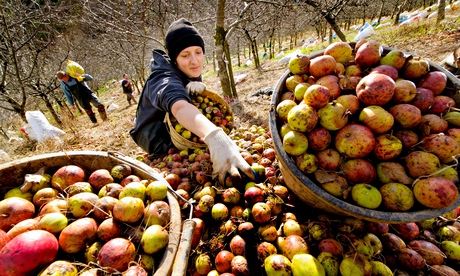
“The day of the oppressor is over,” reported the Gloucester Journal in 1766. “The calamity of the cyder drinker is put away; the deadly excise man shall appear no more in our quarters.”
But the Journal had not reckoned with the European commission when it declared that the attempt by the Earl of Bute’s government to raise a duty on cider producers had been defeated. Last week the commission demanded that the British government do away with a duty exemption worth £2,500 to small-scale producers of cider and perry.
Under the exemption, introduced in 1976, cider-makers who produce fewer than 70 hectolitres a year – about 12,000 pints – do not have to pay duty. The National Association of Cider Makers calculates that this accounts for about 80% of the UK’s 480 cider-makers.
Standing in his cider shed near Gloucester, David Kaspar surveys the array of oak barrels resting on their sides. “Most of the apple trees I’ve planted myself,” he says. “Most of these barrels, I know which orchard the cider came from and which tree it came from.”
Kaspar and his partner, Helen Brent-Smith, run Day’s Cottage, a small apple juice, cider and perry producer. Most of their business is juicing, but they produce just under 70 hectolitres of cider from their 6.5 hectares (16 acres) of orchard, selling it at farmers’ markets, fairs, shops and a pub.
“The exemption is fundamental to keeping craft cider-making going,” said Kaspar. “If we had to pay an extra £2,500 it would probably stop us risking making wooden-barrel cider and perry because it’s too fragile. Quite regularly a barrel isn’t very good, so I have to throw it away. I would also be much less inclined to experiment with some of the varieties we’re bringing back from extinction if we had to pay even before we begin.”
Kaspar, who admits to being a “fruit nerd”, lists some of the 106 varieties of Gloucestershire apple with infectious enthusiasm: Tewkesbury Baron, Arlingham Schoolboys, Hagloe Crab, Bushy French, Taynton Codlin, Foxwhelp. “They’ll be in their prime in the 23rd century,” he says, pointing out some perry pear saplings he planted last year.
“It would be very sad if the tax came in,” Kaspar says. “Not just for financial reasons. It would hasten the demise of traditional orchards and would be another nail in the coffin of traditional cider-making and would be a loss to the natural habitat.”
The role of small producers in the reinvigoration of the rural economy and the stewardship of the environment has led government agencies such as Natural England to encourage the planting of traditional orchards, 75% of which have been lost since the second world war.
Industry groups such as the NACM, which represents both large and small producers, and the Campaign for Real Ale are gearing up for a fight. “I don’t think we’ve got a hope in hell of taking on the EU when they give a reasoned opinion,” says Gareth MacDonald, Camra’s south-west of England regional director. “We do need to think carefully about helping government to find a way around this.”
Some small cider producers believe the intervention by the EU came about because of sour grapes from their counterparts in the wine trade who are not exempt from the duty. Others have blamed “big cider”, the industrial-scale makers who account for the bulk of the 130 million gallons of cider produced in the UK each year.
The Treasury, which has two months to respond to the commission, says it will do its best to support the sector. “While we will study the commission’s arguments carefully, our support for this industry will continue,” it said.
Alex Hill, who has been making Bollhayes cider for 26 years from a smallholding in Devon, says the success of artisan cider-making over the last quarter of a century could be reversed. “The cider industry as a whole trades on this romantic image of the small, local producer,” says Hill, chairman of the South West of England Cider Association.
“There is a far greater variety of ciders produced by smaller makers than by the industrial giants. With the loss of smaller producers, the range of choice and diversity of cider would be sadly diminished, with the market even more dominated by corporate brands.”