Kangaroos in danger of missing out
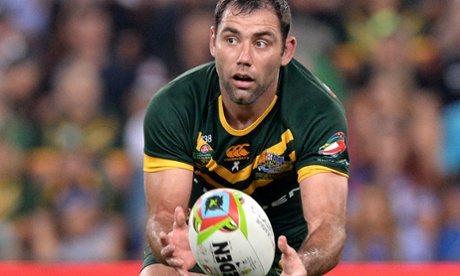
Australia went into the Four Nations tournament missing a fleet of first-choice players — and then lost Daly Cherry-Evans and Greg Inglis along the way— yet for a long time many Australians have floated the opinion that their second- or third-choice teams would be no less effective in getting the job done. At times that arrogant notion has probably had a good basis in reality, such are the traditionally rich orchards of the NRL where the trees swoon with fruit, but it certainly wasn’t borne out on Saturday night. (Could it be that a lot of the rich fruit in the NRL these days is imported?) New Zealand, missing a couple of handy players themselves, out-enthused a sloppy Australia and simply overpowered them in the forwards. This forced Australia into error (they missed 31 tackles to New Zealand’s 19) and it allowed for more offloads and improvisational opportunities for Shaun Johnson, whose joystick manoeuvrings lit up the match. Kieran Foran also reveled in the space carved out by his forwards.
It would be daft to write-off Australia after their first loss in 17 Tests (and it was just the third time in their past 23 encounters that New Zealand has beaten them) but they have a fair bit of improving to do to reach the tournament final, and a win against England next weekend is now a must. Australia’s team selection for the England game will be interesting. Against New Zealand, the Kangaroos, like Willy Wonka’s workshop, looked short of a big man or two, and questions must be asked why. For New Zealand, Jesse Bromwich, Greg Eastwood, Simon Mannering, Jason Taumalolo, Martin Taupau and Tohu Harris all ran more than 100m each (and the excellent Kevin Proctor got close, too). But only Greg Bird and Corey Parker hit the 100m mark for the Australians while Australia’s only genuine prop, a doughy-looking Aaron Woods, made 79m. Josh Papalii, who, like Woods, has been out of action for some time, had little impact. Given the size of the England and Samoan forwards, Tim Sheens may have to reshuffle his deck.
New Zealand are well placed
For someone enduring a suspension, hooker Issac Luke has been a conspicuous presence of late. He made the field for South Sydney’s grand final celebrations and he was in the New Zealand haka on Saturday night showing off those helter skelter eyes of his, not to mention his bare feet. But Luke’s suspension is now served and Stephen Kearney will surely be unable to resist the temptation to change a winning team by putting him straight back to hooker for the Kiwis’ next game against Samoa in Whangarei. Stand-in hooker Thomas Leuluai and interchange player Lewis Brown did an excellent job filling in but the selection of the dynamic and driven Luke is a must and will improve the Kiwis’ chances to control the game — while at the same time taking some responsibility off Johnson and Foran’s shoulders. Given the rest of New Zealand’s games are in New Zealand (where the final will also be played), they are well placed to win silverware.
England should be better for the run
That England twice came from behind to beat Samoa 32-26 on Saturday night should override any worries about the closeness of the score. As was pointed out by coach Steve McNamara after the match, England have had the shortest preparation of any of the four teams, plus the additional strain of having to cross the globe and find that 4pm on spring Saturday in Brisbane can be rather warm. McNamara also drew our attention to England’s new halves combination (St George Illawarra’s Gareth Widdop at five-eighth and Wigan’s Matty Smith at half, who together got England over the line) and new hooker in Hull’s Josh Hodgson. “We’re a brand new team practically,” McNamara said. Of course, that’s the last time McNamara should trot out these caveats. You only get one game to complain of rustiness, and you’d think England will need to improve greatly on this performance given Australia, their next opponent, will be keen to atone for their loss to New Zealand. Perhaps the biggest surprise of the match was that England’s big forward pack failed to gain the upper hand against the Samoans. Mose Masoa, in particular, had the England forwards looking over their shoulder, and in that respect England missed the menace of Sam Burgess. But the bottom line, and the encouraging one, is that England found a way to win.
There’s more to Samoa than their bulk
The size and power of Polynesian players —and spectators, for that matter— is a given, but it was the additional qualities of Samoa’s mobility and ball control that gave England a fright on Saturday night. Indeed, Samoa will be ruing their failure to claim a massive scalp, particularly after leading twice, including late on after Wakefield’s Pita Godinet scored his second try of the match. Statistically, Samoa outperformed England in most departments: they completed an incredible 31 of 34 sets (compared to England’s 28 of 35), they ran 1488 metres to England’s 1217m, they missed seven fewer tackles (21 compared to 28), they made nine more offloads (14 to five) and five fewer errors (five to 10). Their failure to win, then, came to down to a lack of execution on last-tackle options and, possibly, luck (depending on what colours you wear, that is). The Samoans were ahead late on when England were awarded a try to Joel Tomkins after it appeared Michael Shenton had knocked on in the build up. Samoa coach Matt Parish was correct in saying that it would have been deemed a knock-on in the NRL (the knock-back seems to be disappearing from the referee’s lexicon in the NRL), but the decision looked fair, if line-ball. Samoa’s biggest challenge now will be to play as well again and underline captain David Fa’alogo’s opinion that they’re not just in the Four Nations to make up the numbers.
A double-header made for a doubly good start
Sydney may be the birthplace of Australian rugby league but Brisbane (and Queensland) looks increasingly like its current home. For some time now Brisbanites have outshone their southern cousins in terms of their (measurable) enthusiasm for the game and that was again on show on Saturday night for the double-header. Close to 50,000 spectators turned up to Lang Park and with fans of all four teams in the stadium the carnival atmosphere they created added to the occasion, and garlanded what were two entertaining games. Starting the tournament with a double-header was a good move as it gave the Samoans, in particular, a platform —and the subsequent exposure to fans at the ground and on TV— they would otherwise not have had. You only had to watch them take it to England to see yet more evidence that international rugby league is not just a game of pass the parcel between Australia, England and New Zealand. If rugby league wants to grow it needs more international fixtures, and double headers may be one way of giving the smaller league nations the opportunity they need and deserve. Rugby league just needs to find the will, and a way, of fitting more international league into the calendar.