For many people, beetroot inspires horror: soggy, bloody orbs floating in acrid vinegar. But fresh beets that you have cooked yourself are a world away from the dodgy pickled sort, and brighter, firmer, and more full of earthy flavour than those (admittedly convenient) ready-cooked, vacuum-packed numbers. They’re adaptable, too: as happy in wedges as they are grated or whizzed into a puree.
Grappling with fresh beets can leave your kitchen looking a little bit like an episode of CSI. Luckily, baking beetroot in a steamy foil parcel (our favoured method) requires little active cooking or clearing-up time, and produces perfectly tender roots.
Bake a batch at the beginning of the week and store in an airtight container in the fridge once cool. The roots tend to hog all the attention, but we like to make the most of the whole bunch by using the stalks in a salad and saving the leaves to make a thrifty pasta, so do buy the freshest, sprightliest looking bunches you can find.
To roast the beetroot
1kg beetroot (about 2 small bunches)
1 Set the oven to 220C/425F/gas mark 7. Rinse the beetroot. Chop off the stalks and leaves (leaving around 2cm of stalk attached) and dry these thoroughly. Store the stalks and leaves wrapped in damp kitchen paper in the fridge.
2 Line a high-sided roasting dish with a large piece of foil; big enough to fully enclose the beetroot – and turn the sides up to prevent leakage. Add the beetroot and 350ml water, then fold the foil over the top like a parcel. Bake until cooked. This will take around 1 hour – when a knife slides through them easily, they are ready.
3 Remove and leave to cool before peeling – you should be able to just push the skin off. If there are tough areas, use a peeler. You may want to pull on some rubber gloves before getting involved, though we rarely bother.
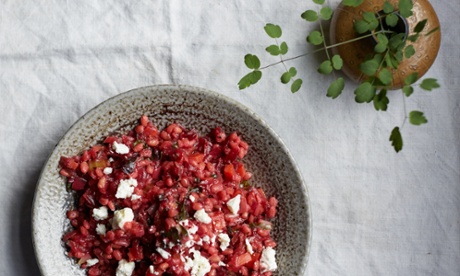
The weeknight comfort dish: Beetroot and pearl barley ‘risotto’ (pictured above)
In spite of the drama of its deep colour, this is a simple vegetarian dish, perfect for weeknights when you need something soothing and comforting.
Serves 4
150g pearl barley
2 tbsp extra virgin olive oil, for frying
1 medium carrot, finely chopped
1 stick of celery, finely chopped
6-8 shallots, finely chopped
2 garlic cloves, finely sliced
300g roasted beetroot, grated
1 tsp dried thyme
250ml white wine
450ml chicken or vegetable stock
Juice of 1 lemon
Crumbled feta, to serve
1 First, cook the pearl barley. Rinse the barley under the tap, then transfer to a saucepan and cover with water. Bring to the boil, then reduce the heat and simmer for 40 minutes. (Do your vegetable prep while the barley is simmering). Prep your veg.
2 Once the barley has been cooking for 25 minutes, fry the chopped carrot, celery and shallots over a low heat until they have softened. Add the garlic and beetroot, then sprinkle over the thyme. Cook for about 3 minutes, stirring with a wooden spoon to prevent the mix from catching. Turn the heat up and add the wine. Cook until the alcohol has reduced by half.
3 Using a slotted spoon, transfer the barley to the casserole dish, and add a few ladles of hot stock to cover. Season, then stir continuously with a wooden spoon, adding more stock as necessary, until the barley is tender and the liquid has been absorbed. (If you have plenty of beetroot leaves, pop a handful into the pot at this point).
4 Squeeze in the juice from half the lemon, then taste to check the seasoning. Add more salt and lemon juice, to taste.
5 Serve in bowls, with a scattering of feta and a final drizzle of olive oil on top.
The summer starter: Beetroot and garlic dip
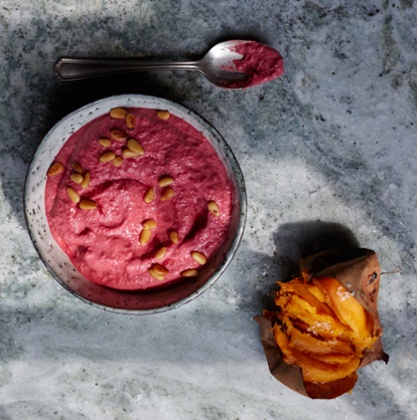
This pretty pink dip is a classic way to make use of leftover cooked beetroot. You could simply serve it with cruditésas a starter, or for a slightly different take, try it as a main course, topped atop a couple of baked sweet potatoes.
Serves 2
For the dip
200g roasted beetroot, chopped
1½ lemons
150ml Greek yoghurt
1 garlic clove, crushed
Salt and black pepper
2 tbsp pine nuts
For the baked sweet potatoes
2 largish sweet potatoes
2 tsp olive oil
Sea salt
To serve
100g white cabbage
1 Preheat the oven to 190C/375F/gas mark 5. Place the sweet potatoes in a baking dish and rub with olive oil. Sprinkle over some sea salt then bake, for 45 minutes to an hour depending on the size of your potato.
2 Put the beetroot in a bowl. Squeeze over the juice from 1 lemon and spoon in the yoghurt. Blend until smooth then add the garlic. extra salt or lemon juice, as necessary.
3 In a small frying pan over a medium heat, dry-toast the pine nuts for a few minutes until golden brown. Stir into the dip.
4 Once the potatoes are cooked, slice in half and dollop the mixture over. Top with some white cabbage, finely sliced for crunch.
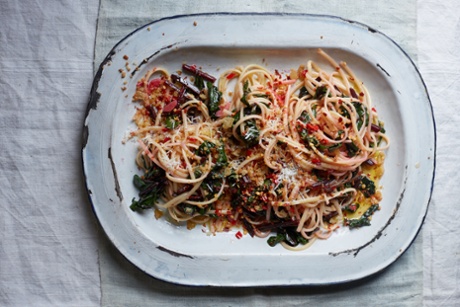
The thrifty meal: Beetroot leaf pasta
If you don’t happen to have a convenient stash of beetroot leaves to hand, then you could also make this with chard or cavolo nero – just cook until tender.
Serves 2
Leaves from 2 bunches of beetroot, washed and roughly chopped
4 tbsp extra virgin olive oil
2 garlic cloves, sliced
½ red chilli, finely chopped
2 tbsp breadcrumbs
Salt and black pepper
Zest of ½ lemon
½ tsp dried chilli flakes
40g parmesan, finely grated
180g pasta (such as linguine)
1 Put a large pot of salted water on to boil. Heat 3 tbsp oil in a large, lidded frying pan. Add the garlic and fresh chilli, then cook for about 2 minutes – don’t let the garlic colour. Add the beet leaves and cook, lid on, over a a low heat heat for 5-7 minutes, until wilted down.
2 Heat 1 tbsp oil in a small frying pan and add the breadcrumbs, seasoning well. Fry to a dark golden colour.
3 Cook the pasta for just under the recommended time. Drain, reserving some of the starchy cooking water. Add the lemon zest, dried chilli and parmesan to the beet leaf pan, then the pasta, and mix together. Add 1-2 tbsp pasta water to help everything amalgamate.
4 Add the breadcrumbs at the last minute, so they stay nice and crisp (not crispy; Elizabeth David, we take note).
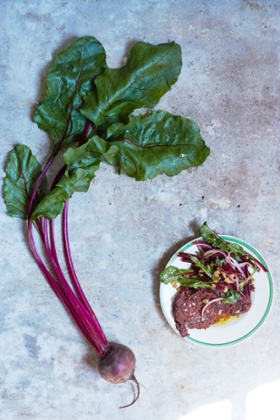
The spicy snack: Beetroot fritters
Balance these unctuous, crispy fritters with a beetroot-stalk salad for a summery lunch or light dinner. Using gram flour makes these a gluten-free meal, but you could substitute for plain if you have trouble finding it.
Makes 8
300g roasted beetroot
Salt and black pepper
1 tsp ground cumin
1 egg, beaten
4 tbsp gram flour
150g goat’s cheese
A large handful dill, leaves and stalks very finely chopped
5 tbsp vegetable oil
For the salad
Stalks from 2 bunches beets, washed
½ small red onion
140g rocket, washed and dried
50g walnuts, roughly chopped
For the dressing
1 tbsp pomegranate molasses
1 tsp honey
A splash of olive oil
A pinch of salt
1 First, make the salad. Cut the beetroot stalks into roughly 3cm pieces. Blanch them for a few minutes, then drain and transfer to a bowl of very cold water.
2 Slice (ideally using a mandoline, if you have one) the onion into very thin, semi-circular pieces.
3 Whisk the dressing ingredients together and add to a bowl along with the drained stalks and red onion. Leave it to sit for 2 hours, or overnight.
4 To make the fritters, coarsely grate the beetroot into a large bowl. Add salt and pepper, cumin, egg and gram flour, and mix well. If the mixture seems too wet, add a bit more flour. Crumble in the cheese, then add the dill, and give it all another good stir.
5 Add oil to a large pan and heat until very hot (throw in a small test piece of mixture; if it sizzles then you’re good to go). Scoop 1 tbsp of the raw fritter mixture from the bowl, form it into a ball-shaped patty in your hands and place in the pan. Repeat. (We find 3 fritters to be the optimal number to fry at a time, but it will depend on the size of your pan).
6 Cook for 30 seconds, before pressing down on each patty with a spatula, so they squish out and become larger and thinner. Fry for around 4 minutes on each side, until crisp and golden. Remove to a plate lined with kitchen paper and keep warm while you cook the rest.
7 Complete the salad by dividing the rocket between plates, topping with the stalk-onion mix and sprinkling over the chopped walnuts.
Caroline Craig and Sophie Missing are the authors of The Little Book of Lunch (Square Peg) and the forthcoming The Cornershop Cookbook (Square Peg)