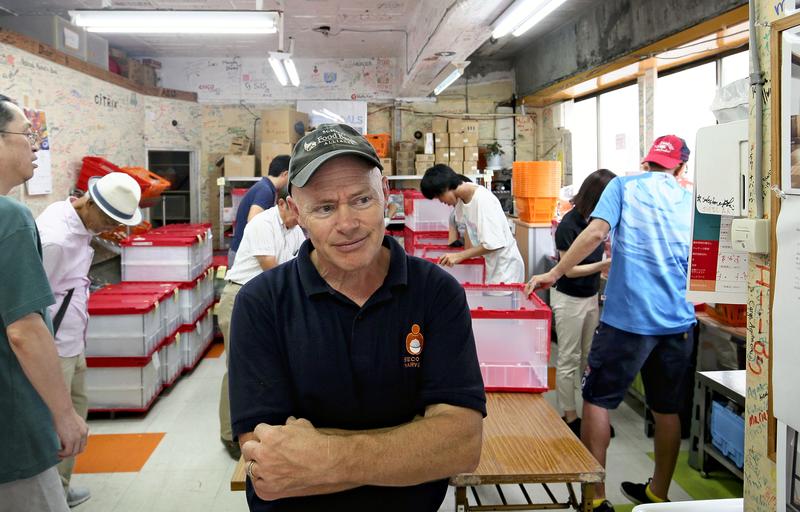
A group of young people visiting from abroad chat excitedly about the chance to try Japanese cooking. Older members call out to friends and revive long-running conversations.
Anyone passing the building on that Saturday morning in Asakusabashi, one of Tokyo's shitamachi neighborhoods, might have thought there was a party going on.
But the several dozen people clustered at the pantry of Second Harvest Japan (SHJ), a food bank founded by American Charles McJilton, were doing serious work, sorting food into boxes. Nearby, hot meals were being prepared at a kitchen to distribute to about 200 people at Ueno Park.
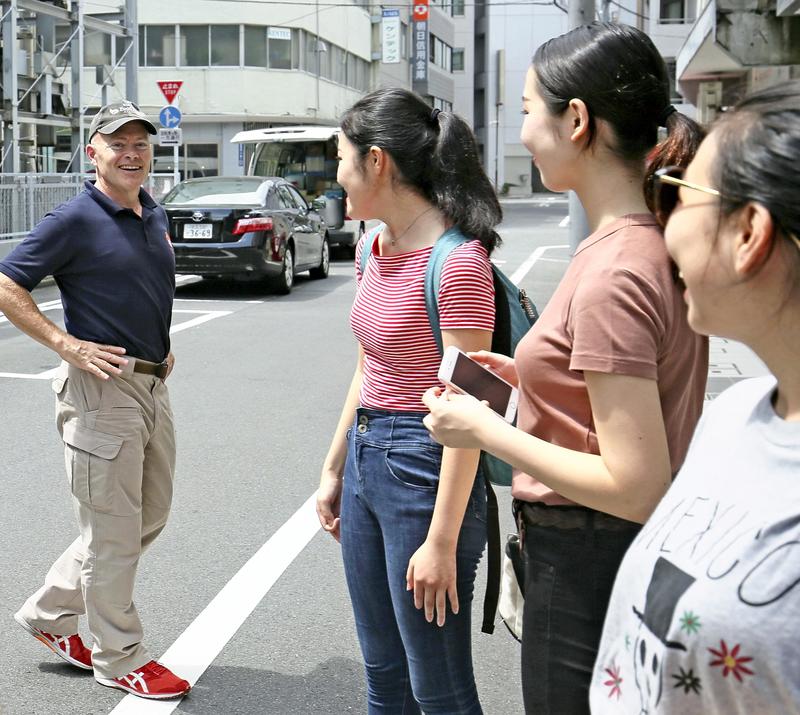
"Food banking starts with having fun, and works outwardly," McJilton said in a recent interview with The Japan News. "If we come here and have fun, and the byproduct of that is people are going to get our food, then that's great."
McJilton, 55, is CEO of the nonprofit. He exudes passion when talking about his organization, breathlessly switching between details on day-to-day operations -- say, the number of Seiyu stores in the Kanto area that currently donate food -- and big-picture issues like the poverty rate and food security.
Growth has been exponential since its founding in 2002 as one of the first food banks in Japan. In 2007, it redistributed food donated by 15 companies. That figure has grown to 1,708 donor companies and organizations. From a one-shop operation in Asakusabashi, it now has warehouses in Yamato, Kanagawa Prefecture, and Yashio, Saitama Prefecture. It has 20 employees and attracts about 100 volunteers per week.
The number of food banks in Japan has also grown, going from only a scant few operating in 2008 to what the ministry of agriculture estimates is about 80 today.
McJilton first came to Japan with the U.S. Navy in 1984, and described it as love at first sight. "When I saw that people here were about the same size as me, I thought, 'This is where I want to live!'" joked McJilton, who stands 163 centimeters.
He returned stateside after his tour ended, but soon came back as an exchange student at Sophia University in Tokyo. Asking a Jesuit priest for advice on places to stay, he was introduced to the Sanya district, an area in Taito Ward known for its large population of day laborers and homeless. McJilton began delivering hot meals and blankets, and considered opening a self-help center, though it ultimately didn't come to pass.
Along the banks of the Sumida
By then, McJilton decided he wanted to work with the homeless community, but encountered a problem. "I had a lot of head knowledge about homelessness … but something was missing from my heart," he said.
To find that missing piece, he made a leap of faith and began living with the homeless alongside the Sumida River in the ward. He constructed a cardboard home with the help of an older resident and stayed for 15 months -- all while holding down a day job teaching English.
It was there that he was struck by what he calls a "profound insight" that would fuel his success with food banking. He had always believed that if you're not part of the solution, you're part of the problem. But one night, as he looked over at the men sprawled only a few meters away, he realized they didn't view how they lived as a problem that needed fixing.
"I had seen people in need and felt a sense of guilt," McJilton said. "[But] the men themselves didn't feel that anybody was responsible for them being on the streets. In that moment I shifted from being responsible for the world to merely responding. I stopped defining what I do as helping people."
That became the guiding philosophy behind SHJ, a simple response to the fact that there are people who are hungry. "It's the same thing as lending someone a pen who doesn't have one -- there's no obligation to take it, and you don't need to thank me or pay me back."
In a country which, according to estimates by the ministry of agriculture, wastes 6.2 million tons of food each year, McJilton said his organization's major challenge is locating nonprofits and individuals to distribute food to. While food donors have grown dramatically over the years, the number of welfare facilities like orphanages, nursing homes and shelters that receive food has remained relatively constant.
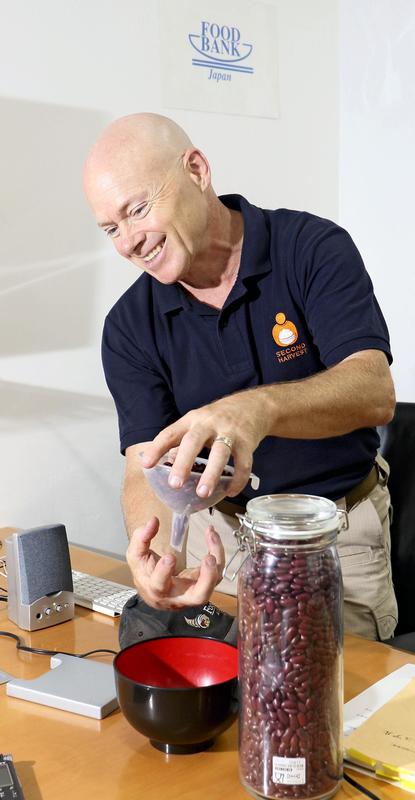
To illustrate his point, he set a massive jug full of coffee beans on the table representing the 3.4 million tons of food discarded by companies alone. Plucking a single bean out, he said, "This is what Second Harvest, the largest food bank in Japan, distributed last year."
McJilton laments that the food loss conversation in Japan is always focused on reducing the supply side rather than getting food into the hands of people that need it most. "We have 20 million people living below the poverty line in Japan ... and yet we only have 20 places [in Tokyo] where they can pick up food ... Something is wrong with that picture," he said.
McJilton attributes the problem to a lack of awareness about and trust in nonprofits in Japan.
The nonprofit sector would stand to benefit from "moving beyond a do-gooder mentality" when seeking to build connections with private companies and the government, he said. "NPOs would be in a better place if they redefined why they are doing what they're doing … and not to accept it when people say, 'It's so good what you're doing.'"
Giving back
SHJ will launch a new project in which the food pantry in Asakusabashi, currently being overhauled, will be made more like a supermarket where people can choose the food they want on their own. The kicker is that for every 5 kilograms of food that a person takes, they have to pledge to do one good thing for society. The concept is aimed at getting people to feel they are repaying society for the food to assuage any feelings of guilt.
"[It] really taps into that ongaeshi, that spirit of giving back and reciprocity that is the best of the culture here … We're going to take the best of Japanese culture and incorporate it into this new style of giving that's never been done anywhere in the world that I know of," said McJilton.
The staff and volunteers at SHJ also seek to give back, but McJilton says that their fundamental inspiration is "just a love of food banking. You've got excess food here that you can provide over here. That's just fun and exciting."
That passion is sure to keep the party going.
-- Quick Questions
Q: What was your first impression of Japan?
A: Finally, a country where everyone is the same size as me.
Q: What is your favorite Japanese word?
A: Ongaeshi -- paying it forward.
Q: What is your favorite food?
A: Whatever food my partner cooks for me.
Q: What do you do in your spare time?
A: Train as a triathlete and go hiking with my kids.
Read more from The Japan News at https://japannews.yomiuri.co.jp/