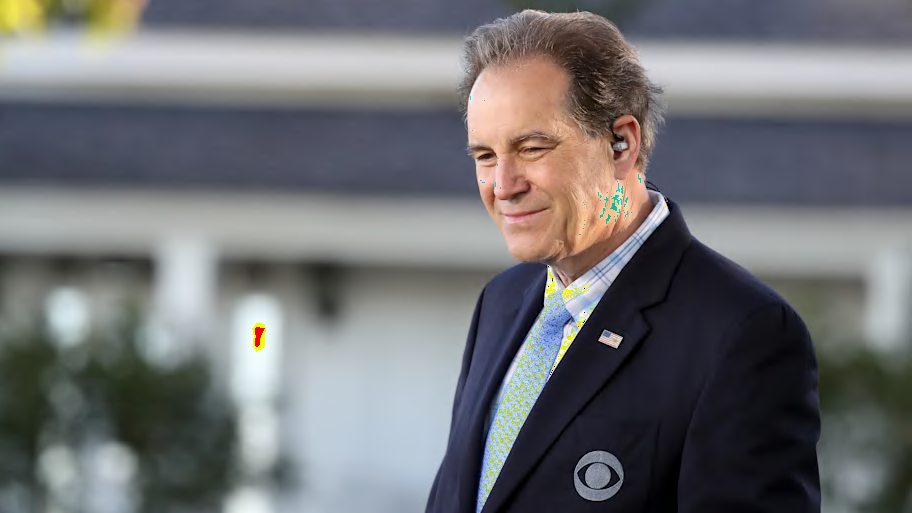
Jim Nantz is a tad perplexed when he reflects on his maiden Masters broadcast.
“I guess I can say it now that I’m 66—what in the world was CBS thinking putting me in the 16th tower?” Nantz said Monday on a CBS Sports conference call. “I was just a kid. My gosh.”
The year was 1986, and Nantz was 26 years old as Jack Nicklaus claimed his fabled sixth victory in Augusta, at age 46. Now, 40 years later, Nantz has been part of every Masters since, assuming the role as lead host in 1989.
In the past four decades, there have been a slew of indelible moments at August National Golf Club. But one stands above the rest for Nantz.
“I just don’t want time to dilute how big that day was,” said Nantz, referring to the final round of the ‘86 Masters. “That’s why I don’t give it up when people ask, ‘What’s the greatest Masters of all-time?’ Is it ’97? Is it 2019? Is it 2025? If I really got pushed into a corner, I would say 1986.”
Why?
“I just don’t want recency bias to change that mix on a leaderboard of great, legendary players [such as Seve Ballesteros, Greg Norman, Tom Watson, Nick Price and Tom Kite].
“And that fact that arguably the greatest of all-time [Nicklaus]—‘washed up’ people said. Given up for almost a ceremonial golfer. Hadn’t won a major in six years. Hadn’t won a tournament of any kind in two years. Just not really even a part of the thought process going into Sunday that he could find a way to present, I think, one of the great encore performances in any sport.”
Nantz’s fantasy becomes reality
Nantz’s foray into the Masters’ broadcast team came as a surprise. The Charlotte, N.C., native had been working with CBS Sports for about a year as a studio host for college football and basketball, while also dabbling as an on-course reporter for the network’s PGA Tour coverage.
Nantz was in Augusta a month before the 1986 Masters, shooting promos that would run during the NCAA basketball tournament. Then, the late Frank Chirkinian, an executive producer at CBS who has been labeled “the father of televised golf,” told Nantz he’d be a welcome addition to the broadcast.
“He wanted to put me on camera on those 10- and 20- and 30-second spots because I was the newcomer and I was going to be a new voice at Augusta and ‘I wanted people to have some idea who you are,’ and that I didn’t just drop out of the sky,” Nantz said. “I was standing in front of the 16th green about to shoot one of the on-cameras with Frank’s direction and he told me I was going to be on that hole.”
Following in the footsteps of Henry Longhurst, Clive Clark and Jim Thacker, Nantz was in awe, getting the chance to live out his dream.
“One of the first things that flashed through my mind was I was still living in a dorm room not even four years before,” Nantz said. “But of course, I took it in stride, like, ‘Sounds good, I’m looking forward to it.’ And I happen to know a lot of the history of the 16th hole. It’s just been a lifetime of work for me.”
For the next few weeks, he was overcome with a wave of emotions, which he hid.
“I had a little bit of imposter syndrome, but I didn’t want them to know that,” Nantz said. “So, I had a month to obsess over it and battle some nerves and anxiety about the fact that I would be so late in the game on the 70th hole come Sunday. And it was a weighty assignment for a young kid. I’m grateful that they gave me the opportunity.”
However, even he couldn’t predict what would occur in his big break.
The Bear has awoken
That Sunday, Nicklaus was making the charge of a lifetime. On the 9th tee he trailed by six, and CBS had barely shown him all afternoon, as he was an afterthought. But after an eagle on No. 15, he was just one back, playing his last five holes at 7 under.
Then, Nicklaus headed to the par-3 16th. And Nantz braced for his moment.
“Jack Nicklaus must continue the charge,” Nantz said on the broadcast. “He has to figure that Ballesteros will make at least birdie back at 15. If anyone has ever owned this hole, it would be Jack Nicklaus [referring to Nicklaus’s birdies in 1963, his first Masters win, and 1975, when he holed a 40-footer].
As Nicklaus re-teed his ball, Nantz asked Tom Weiskopf, CBS’s lead analyst in Butler Cabin, what Nicklaus could be thinking. That led to an exchange that gives Nantz chills to this day.
“If I knew the way he thought, I would have won this tournament,” replied Weiskopf, who finished runner-up in Augusta four times, including 1975, when he fell to Nicklaus by a stroke.
Nicklaus then hit one of the signature shots of his storied career. The ball landed right of the flag before spinning left and nearly dropping in the cup for an ace. He was left with a 3-foot birdie putt and walked to the green behind a thunderous ovation, which CBS didn’t pan away from. And Nantz stayed silent, letting the laudation soak through people’s televisions.
“The moment was so large,” Nantz told SI's Bob Harig for his new book, Tiger v. Jack. “There was so much energy. The place was abuzz. We use that term ‘electric,’ but it really, really was. The air was thick with electricity ... it came spinning off the hill and for a moment there, I thought it was going in.”
Nicklaus would make the putt, yielding one of the most famed, syrupy calls of Nantz’s career.
“The Bear has come out of hibernation,” he exclaimed.
All these years later, those seven words invoke jubilation.
“Jimmy, give us that great line again after Jack made the birdie on 16,” CBS’s lead golf analyst and 2008 Masters champion Trevor Immelman asked Nantz on the conference call. “Come on, let me hear it another time.”
Nantz repeated it.
“That’s it,” Immelman said. “I love it.”
And Nantz is still mystified by the fortuitousness of that call.
“Tried to sound mature beyond my years and wondering where in the world did that thought come into my head?” Nantz said. “Oh, I know, somebody already said it on the broadcast. Totally incapable of coming up with that line on the fly, so I must have plagiarized it. Only to find out later that I hadn’t. It was original and somehow it dropped out of the sky and into my head and I uttered it.”
Although it may not be as revered as Verne Lundquist’s “Yes, sir!” when Nicklaus birdied the 17th to snatch the lead once and for all, Nantz’s exclamation made quite a first impression.
“Hi, I’m Jim Nantz!” pic.twitter.com/PJjSArHvRg
— Ian Ellis Golf Professional (@necky_fade) March 31, 2026
“I was thankful that after the show, Frank Chirkinian gave me a big hug and told me that I would be back the following year,” Nantz said.
And then 39 more years after that.
In the moments following Nicklaus’s heroics, Nantz ran into Ken Venturi, CBS’s lead golf analyst, who told Nantz he would never experience a round like that again at Augusta National.
That’s disputable now. Nantz even admitted after Tiger Woods’s 2019 victory that “as far as pure elation and emotion, the scene around the 18th was the greatest thing I’ve ever been an eyewitness to.” And he puts Rory McIlroy’s career Grand Slam-clinching win last year in that category, too.
“Those three—well, Tiger as a combo—Jack, Rory. I would say those were the three greatest Masters I’ve ever witnessed,” he said.
Nantz remembers something else Venturi, who died in 2013, told him: that he should aim to call 51 Masters, meaning his swan song would come at the tournament’s 100th edition (in 2036). As of now, that’s still the plan.
Perhaps the next decade of Masters will possess more McIlroy, Woods and Nicklaus-esque moments. But even if that’s the case, it’ll always be difficult to emulate the thrill Nantz felt on that Sunday in Augusta, 40 years ago.
“That was one of the greatest days of my life,” he said, “to be able to live a childhood dream to one day grow up and be able to be part of Frank Chirkinian’s broadcast team and specifically be there for the Masters.”
More Golf from Sports Illustrated
- Valero Texas Open Picks, Props, Predictions: Betting Hideki Matsuyama, Russell Henley and Sepp Straka
- Golf Fans Aren’t Thrilled With ESPN Shoving Jason Kelce Down Their Throats
- Valero Texas Open Preview: Field, Course, History, Tee Times, How to Watch
- 2026 Valero Texas Open Betting Models, Picks: Tee-to-Green Play at a Premium
This article was originally published on www.si.com as Forty Years Ago, Jim Nantz Called His First and Favorite Masters.