In World War II, Newcastle was ringed with military installations to protect the city from a Japanese attack.
It was called "Fortress Newcastle" - the same name of a new documentary from the Stories Of Our Town series.
During the war, Newcastle had four forts, five army bases, two naval bases, two RAAF bases and seven anti-aircraft guns.
This included installations in Newcastle, Port Stephens, Stockton, Rathmines, Singleton and the "southern defence line" at Cold T Creek in Belmont.
"This town of less than 100,000 had tens of thousands of troops protecting it, including 40,000 US/UK troops stationed at Port Stephens alone," said the film's director, Chit Chat Von Loopin Stab [aka Glenn Dormand from Waratah].
Chit Chat said Fortress Newcastle was "the military title given to the protection of the industries of Newcastle in WWII".
"Proportionately, Newcastle had far more protection than any other city or town in Australia during this time because everything you needed to make war existed in Newcastle," he said.
Chit Chat said the president of Newcastle Industrial Heritage Association, Bob Cook, was the "the lynchpin for the film".
Bob said in the film that the military "put together a network of artillery, anti-aircraft, searchlights, radar stations and bases and fortresses of people".
"Newcastle had everything that was important in the Second World War - the industries that were making munitions, and all sorts of things like helmets and rifles, everything you needed to run a war," he said.
Industries already in Newcastle were "converted into war factories". The BHP steelworks made iron and steel for the war effort, while the ships ran on Newcastle coal.
Newcastle also made and repaired ships. As well as weapons, it made uniforms, aircraft parts and dried food.
Chit Chat said the film was "built on the research of 10 local historical societies that worked with dozens of volunteers and offered up their archives".
They sourced photos from Greg and Sylvia Ray's Photo Time Tunnel archive, the University of Newcastle and the Facebook pages like Lost Newcastle and Rediscover Newcastle.
The filmmakers interviewed those who served, worked in factories and dug air raid shelters in the war years.
"We lost two of the storytellers making it and three more are really ill. It was important to get it right for them," Chit Chat said.

"They all talked about the fear, they told us about the vast amount of ships sunk by Japanese subs off our coast."
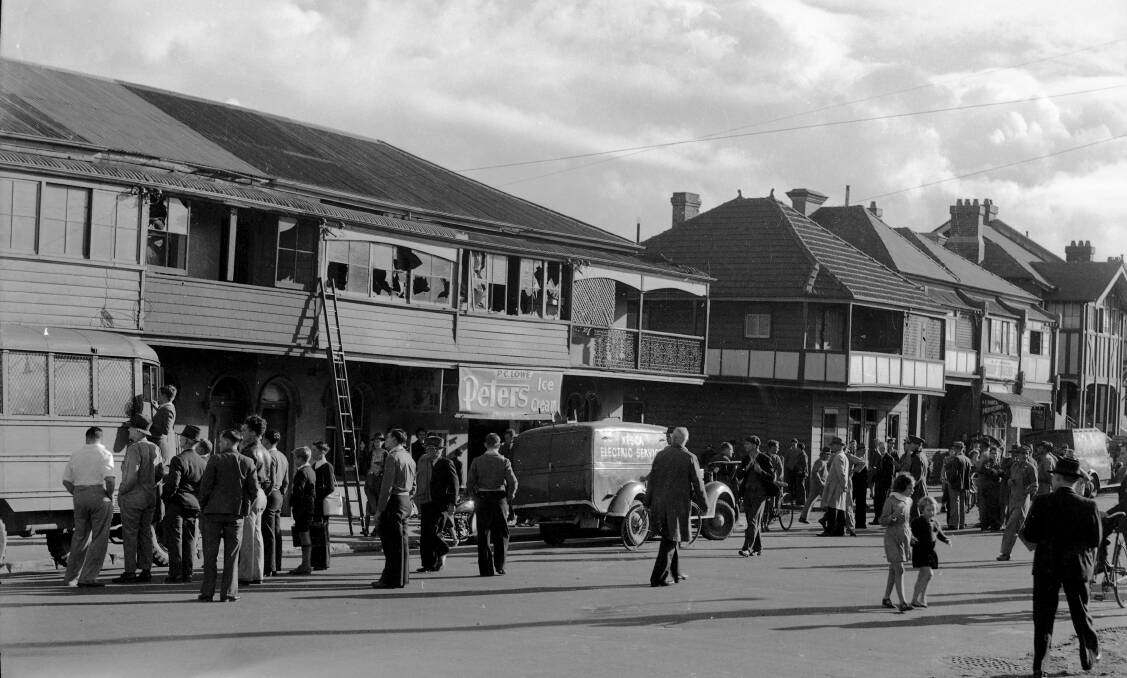
The fear also came to reality when a Japanese submarine shelled Newcastle, damaging a building in Parnell Place.
The Japanese sank 39 ships off the coast, Newcastle University archivist Gionni Di Gravio said in the film.
"For the people of Newcastle that threat was real. We now know that the Japanese never really intended to invade us. Australia was far too big to hold. But because of our industries and coal they did attack us."