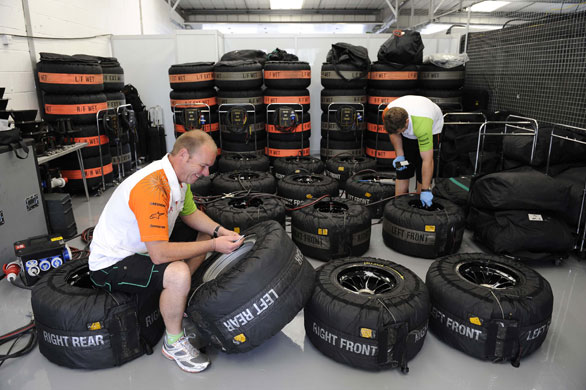
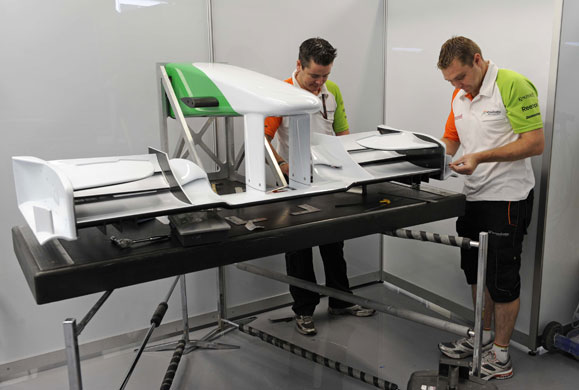
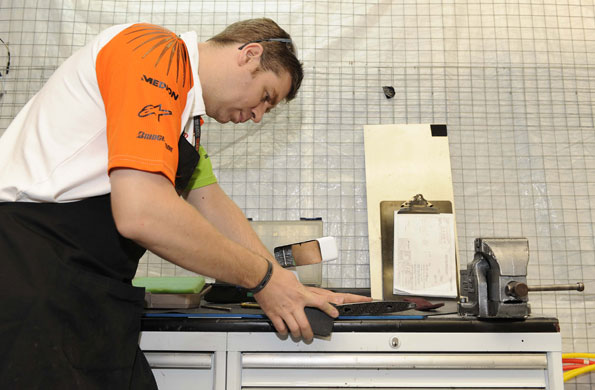
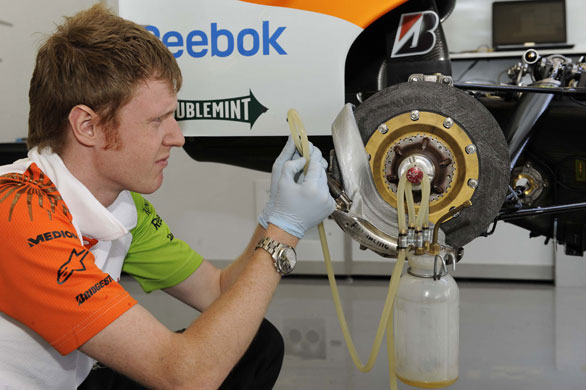
10am: Technician Mick 'Biscuit' Fern glues heat guards to the tyre sensors while his colleague Mark Wilsea purges the inside of the tyres of moisture. Four sets of tyres can be purged at any time and the process can take up to 90 minutes. Kept busy all weekend, the tyre technicians’ workload will increase during the race as the engineers request the tyre pressure to be lowered or increased depending on conditionsPhotograph: Tom Jenkins/Tom Jenkins10.07am: A front wing is propped on a jig in the carbon workshop as Simon 'Pockets' Claridge and Michael dos Santos finish its assemblyPhotograph: Tom Jenkins/Tom Jenkins10.10am: James 'Bubba' Laurence finishes off a wing mirror. Many of the carbon components will have slight imperfections that have to be smoothed out before the part can be installed on the car. Laurence’s weekend will include the repair of many carbon components that will suffer wear and tear during testing and qualificationPhotograph: Tom Jenkins/Tom Jenkins
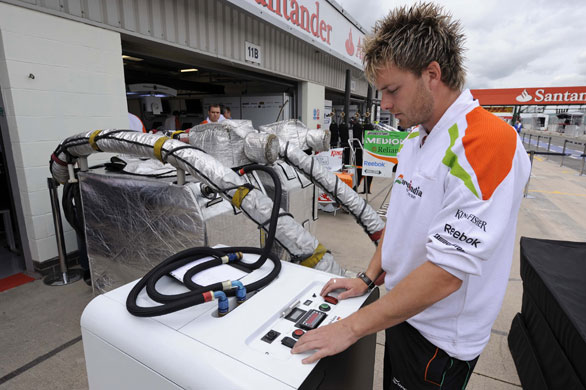
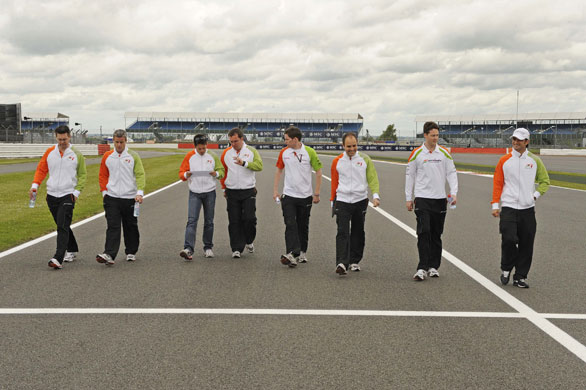
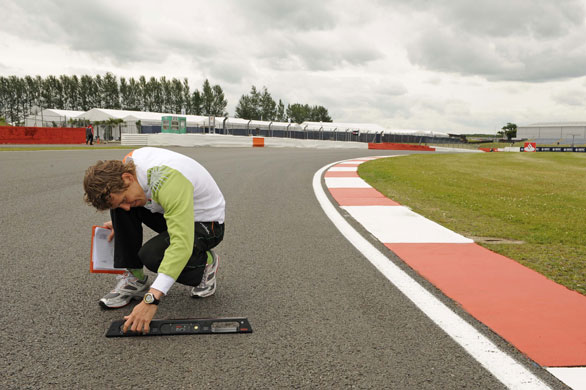
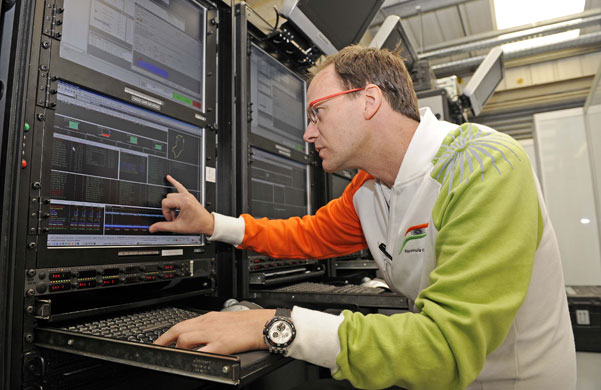
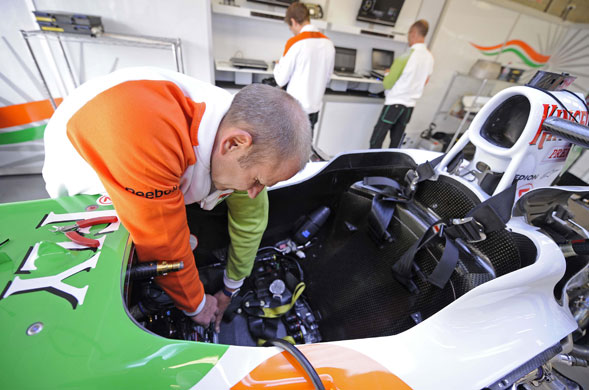
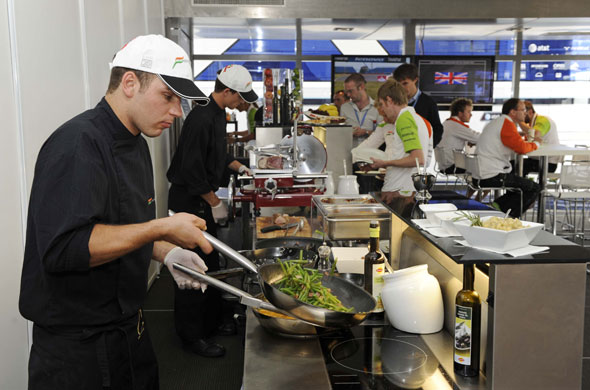
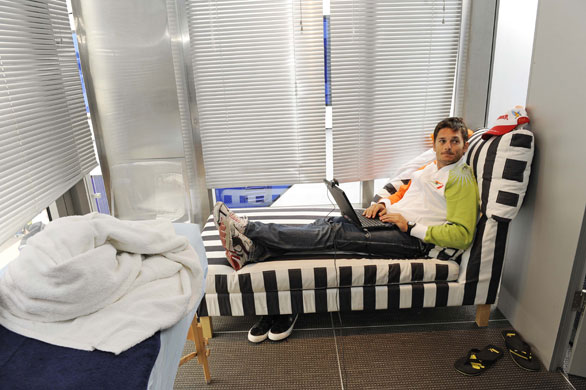
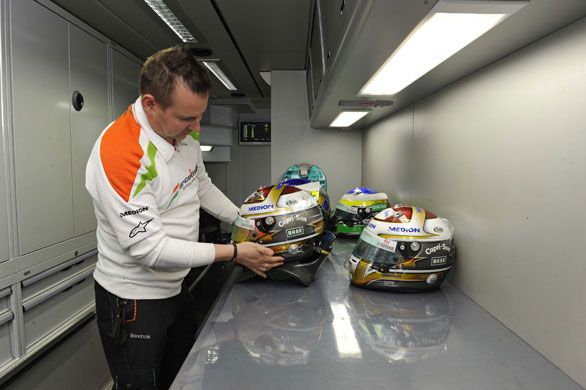
10.45am: Truckie Andy 'Magnet' Ling pumps fuel into the rig. By the time the petrol is pumped into the car it has gone through at least three filters. Teams now have to account for every drop of fuel they use. Ling would not say how much fuel the cars could hold but a few years back, before stricter regulations, the crew used to fill up their own cars with the racing fuelPhotograph: Tom Jenkins/Tom Jenkins11am: Dominic Harlow, second from left, chief race engineer, leads driver Giancarlo Fisichella – conspicuous in jeans rather than the standard issue black cargo pants – and his race team out for a walk of the Silverstone track. The drivers and their teams do this to ensure the camber and gradients of the corners are in keeping with their data. Harlow says it is useful for those in the garage to have a 'mental picture' of each corner. 'It is also just nice to get some time with the driver without, no offence, the media about,' he adds, politelyPhotograph: Tom Jenkins/Tom Jenkins11.30am: The camber of the track at each apex is measured with a digital spirit level by Robert 'Sat Nav' Sattler, Adrian Sutil’s performance engineer. 'Other teams have someone walk both sides of the track with a GPS system, so this really is not that high-tech,' says the BrazilianPhotograph: Tom Jenkins/Tom Jenkins12.30pm: As each car is started for the first time after assembly it is the job of telemetry engineer Andy 'Radar' Laenen to ensure the fire-up data are correct or, as he puts it, 'make sure all the wiggly lines are in the right places'. There are two racks of screens, one for each car, and rows of green type mean the system is functioning correctlyPhotograph: Tom Jenkins/Tom Jenkins12.40pm: Installing the car radio is 'a bit fiddly' says Damien LeBreuilly, the No1 mechanic on Sutil’s car. The radios have to be removed so the frequencies can be changed for each grand prix and then they must be wedged underneath the fire extinguisher, telemetry box, transistors and other equipmentPhotograph: Tom Jenkins/Tom Jenkins1pm: The unfortunately named Andy 'Chesney' McLaren is a 'rear-ender' on Fisichella’s car – meaning he is a mechanic who concentrates on the rear of the vehicle. Here he is bleeding the brakes, a task that must be performed after each run the car completes. This, the first bleeding of the weekend, takes longer than any otherPhotograph: Tom Jenkins/Tom Jenkins1.30pm: Up to 130 people are fed in the Force India motorhome each day – head chef Stephane Lengauer puts the finishing touches to lunch as the team stream in for one of two meals of the day. Friday, Saturday and Sunday Stephane and his seven-strong team serve up breakfast, lunch and dinner – their day starts at 6am and they will not return to their hotel until midnight.Photograph: Tom Jenkins/Tom Jenkins2pm: Giancarlo Fisichella relaxes in his room in the team motorhome. He and Adrian Sutil come to their rooms to relax during the quieter parts of the day. “When I started out in Formula One I would have had a room,” said the Italian. “But it would have been very small, not like this.”Photograph: Tom Jenkins/Tom Jenkins2.20pm: In one of the team’s three 'pop-up' articulated lorries the parts coordinator, Dave Burr, attaches the crash helmets to each driver’s Hans (head and neck) device. The Hans are designed to prevent head and neck injuries, such as whiplash, in the event of a collision. Sutil and Fisichella both have two helmets, one fitted with a visor more suited to wet conditions, but Burr says there are other reasons a driver would opt for one helmet over another. 'There may be psychological reasons,' he said. 'One might smell a bit more than the other, for instance'Photograph: Tom Jenkins/Tom Jenkins
Sign up to read this article
Read news from 100’s of titles, curated specifically for you.