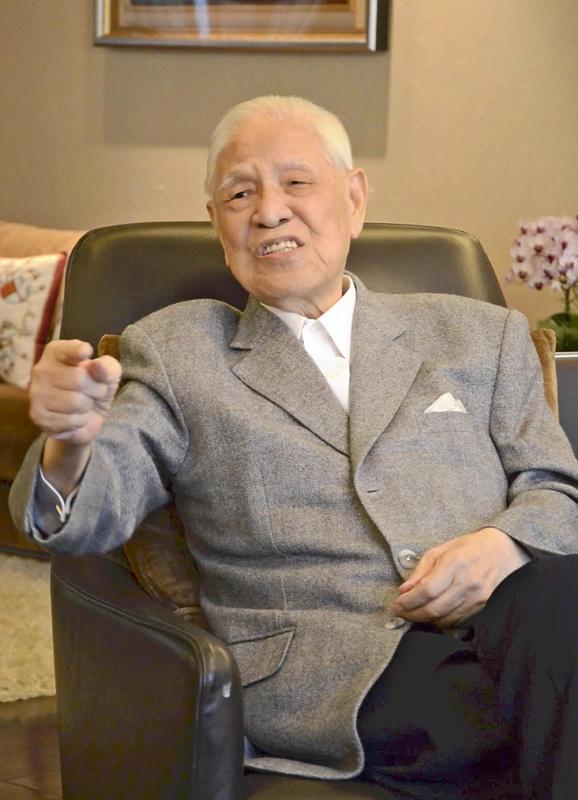
TAIPEI -- Former Taiwan President Lee Teng-hui, who strove for the democratization of Taiwan, died at a Taipei hospital on Thursday, aged 97.
According to the hospital, Lee died from multiple organ failure and other causes.
Lee helped to instill a shared sense of identity in the people of Taiwan through democratization and laid the groundwork for a Taiwan that had an existence distinct from China. He was a leading figure of his Taiwan generation, people who lived as Japanese on the island under the rule of Japan until the end of World War II.
He was born in 1923 in what is now New Taipei City, a suburb of Taipei. While he was studying agriculture at Kyoto Imperial University, the predecessor of Kyoto University, Lee was enlisted in the Imperial Japanese Army under a student mobilization order. He was an officer when the war ended in 1945, and he returned to Taiwan under the one-party dictatorship by the Nationalist Party (Kuomintang, or KMT).
After graduating from the National Taiwan University, he became recognized as an expert in agricultural economy and held a series of important posts, such as mayor of Taipei and governor of Taiwan Province. In 1988, when he was the vice president of Taiwan, incumbent President Chiang Ching-kuo died, and Lee became the first person born in Taiwan to become the president of Taiwan.
The Nationalist Party had fled from the mainland to Taiwan in 1949, having lost a civil war to the Chinese Communist Party. At the time when Lee became president, the KMT was asserting that it ruled the "Republic of China," which claimed the entirety of China as its domain. Lee promoted a more realistic approach of a Taiwanization policy, holding that the party governed only Taiwan and a chain of some surrounding islands. He also pushed through constitutional and parliamentary reforms. At the same time, he also promoted democratic policies, such as implementing direct elections of mayors.
Under his leadership, voters directly voted for the president in the 1996 Taiwan presidential election, in which he ran. Lee won the election and became the first democratically elected Taiwan president amid the circumstances of China threatening Taiwan by conducting missile tests.
In 1999, Lee described the Taiwan-China situation as a "special state-to-state relationship." His two-state concept was severely criticized by China, which rejects the idea of the independence of Taiwan.
Abe lauds Lee
Prime Minister Shinzo Abe praised Lee's life of achievement on Friday.
"He made great contributions to the amity and enhancement of friendship between Japan and Taiwan. Many Japanese people have special affinity toward Taiwan," he told reporters at Prime Minister's Office, adding, "I extend my deepest sympathy. I pray for the repose of his soul."
Read more from The Japan News at https://japannews.yomiuri.co.jp/