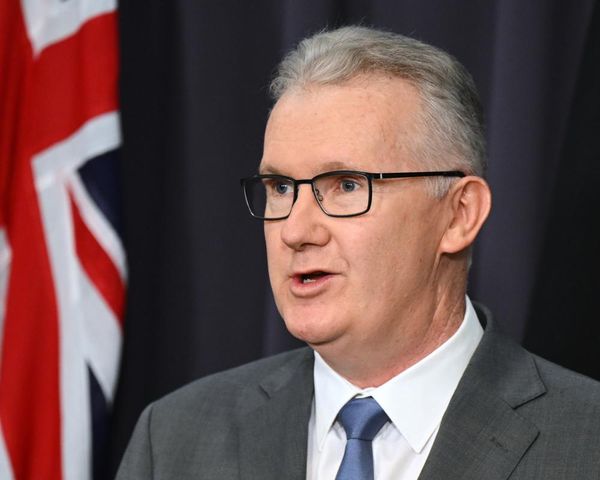
Tony Harris, the former New South Wales auditor general, has blasted the Morrison government for cutting funding to the Australian National Audit Office and for moving too slowly to establish a federal anti-corruption commission.
During an appearance before the Senate committee examining the sports grants saga, Harris said he believed there was “a pattern of behaviour that constitutes a goal” of reducing public scrutiny of government activity.
“There appears to be, by design not by accident, a drift towards reducing the scrutiny of government, especially by government agencies,” Harris told the committee on Monday.
“It’s not only declining to …[establish] an integrity commission, it’s not only the reduction in the budget for the audit office – it is also seen in the difficulty of pursuing freedom of information cases that have been declined.”
Harris said he believed some were declined “unlawfully” but there was little that could be done “unless you want to go to the federal court or wait or hope the appeal body will give you a proper decision”.
“This reduction in scrutiny … is designed, presumably, so that the electorate … doesn’t know those things that the government doesn’t wish it to know.”
Harris characterised the conduct as anti-democratic because the only right Australians had under the constitution was the right to vote “and you can really only use that right to vote in an informed way when you have information”.
The government in October cut $14m from the national audit office’s operating budget, prompting concerns from the opposition and crossbenchers that the watchdog was being whittled away as payback for high-profile and politically damaging investigations, including the probe that uncovered sports rorts and the massive overspend on land at Leppington for the Western Sydney airport.
Before the budget, the auditor general wrote to the prime minister asking for an additional $6.3m in 2020-21 to deliver 48 performance audits a year, rising to an extra $9.1m in 2023-24.
Harris was asked about the ANAO’s funding cut on Monday. The Labor senator Nita Green asked whether the practical effect of the change was that the agency that unearthed the sports grants would have fewer resources to reveal questionable decision-making.
Harris replied: “That’s correct and it has already announced that the number of performance audits it will be able to undertake with its reduced budget will be about 20% less than it had hoped or planned. So it is not a trite matter.”
The attorney general, Christian Porter, released an exposure draft for the government’s integrity commission proposal shortly after Harris gave evidence to the committee on Monday but the government has been blasted for delaying reform it has been working on since 2018.
Harris told the committee there was “an obvious crying need” for an anti-corruption commission at the federal level and that been the case for decades.
He also criticised the Australian Federal Police for appearing reluctant to investigate federal ministers when questions were raised about their conduct. Harris said there was a different attitude among state police forces.
Harris said he wanted to appear before the committee on Monday because he was concerned about a trend where public servants appeared reluctant to advise ministers about the limits of their powers. He said this reticence was a concern when it led to ministers making decisions that were “palpably unlawful” or when ministers used powers they didn’t have to make decisions.
The ANAO raised questions during its probe of the sports grants about whether the then minister, Bridget McKenzie, had proper legal authority to be the decision-maker about the funding as opposed to officials at Sport Australia.
Harris expressed a view that McKenzie lacked legal authority, but he told the committee he wished the ANAO had asked for an opinion from the solicitor general to clarify the questions that have been raised by legal experts since the excoriation of the program in January.