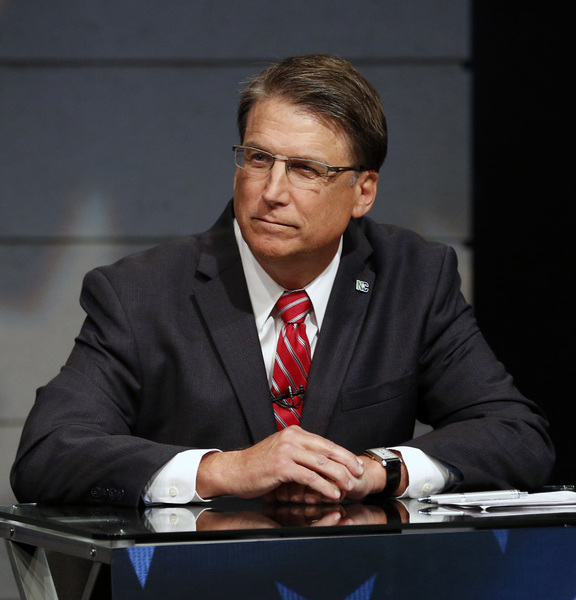
CHARLOTTE, N.C. _ Former Gov. Pat McCrory said Friday that the year of turmoil North Carolina endured over the controversial "bathroom law" House Bill 2 was Charlotte's fault, calling city leaders "misguided" for passing a 2016 law that gave protections to LGBT people.
"Government overreach," he called the nondiscrimination ordinance that included equal rights for transgender people. "That's not the way government should work, to have such mandates at local, state or federal level."
McCrory's comments, made during an interview on radio station WBT, came just a day after state leaders repealed HB2 and replaced it with a widely criticized law that imposes a 2020 moratorium on cities adopting nondiscrimination ordinances. It also added language that says cities are "preempted from regulation of access to multiple occupancy restrooms, showers, or changing facilities, except in accordance with an act of the General Assembly."
"Now, we reset back to what the laws were before the Charlotte ordinance was passed a year ago, when things were working just fine in our state," the former Republican governor said on WBT. "Hopefully, we'll get back to the priorities ... we need to be working on: safety of citizens, good roads, good education."
The North Carolina General Assembly adopted HB2 last year to negate a Charlotte ordinance that offered rights protections to LGBT people, including allowing transgender people to use the restroom of their gender identity. That was singled out by critics, who believed it would allow male sexual predators to prey on women in public restrooms and showers.
McCrory signed HB2 into law, but said he fully supported a repeal. He says he tried three times for a repeal, but was opposed by people on both the political left and the right.
The law drew national criticism of the state, due largely to provisions that negated city ordinances giving rights protections to LGBT people. It prompted an ongoing boycott of North Carolina by entertainers, businesses and some sporting events, including a threat by the NCAA to pull all future events away from the state if the law was not repealed.
The repeal "basically means a city like Charlotte in future will not be able to pass a misguided ordinance, which would threaten to jail for 30 days _ which the Charlotte ordinance did _ someone who disagrees with the gender definition that the current mayor believes it should be," McCrory told WBT.
In the end, McCrory said he believes the U.S. Supreme Court will tackle the "complex and emotional issue" of how gender is defined. "It's not going to be decided by a mayor, or a governor, or a state legislator, or city councilman. Or by a chancellor on the board of directors of the NCAA. It's going to be decided by the Supreme Court, probably within the next year."
HB2 was also blamed in part for McCrory's lost re-election bid last year, something he alluded to in the WBT interview. "There was a lot of money thrown into this issue, especially from the left. Millions upon millions of dollars, which many would say had an impact on my campaign."
The Washington, D.C.-based Family Research Council, which supported HB2, sent out a press release Friday saying McCrory also did a radio interview on Washington Watch with Tony Perkins, a national radio show that airs on more than 240 stations across the country.
In that interview, McCrory is quoted as saying the compromise passed by the state's General Assembly was a defeat for the Human Rights Campaign, which advocates for LGBTQ rights.
"The good news is this: the HRC lost the battle," McCrory is quoted as saying. "With their resources and power and money, and their trying to get some other corporations to help support them in the battle ... (The) fact of the matter is, they did not get a full repeal of HB2."
McCrory went onto say he's hoping the matter of defining gender won't reach the Supreme Court until after a new justice has been picked by President Donald Trump.
"Hopefully, with a new Supreme Court justice that's been nominated by President Trump, there will be a ruling in which we keep the definition of gender as we've been using in the 1964 Civil Rights Act for generations," McCrory is quoted as saying.