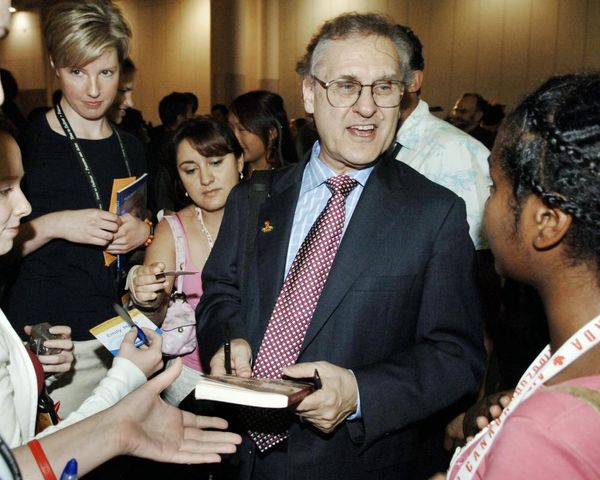
Former Foreign Secretary of Bangladesh Syed Muazzem Ali passed away in a hospital in Dhaka, the High Commission of Bangladesh has confirmed. Mr Ali (75), who is considered to be one of the tallest contemporary diplomats of his country, served as the High Commissioner to India till his return to Dhaka this month.
Mr Ali was admitted in the Combined Military Hospital in Dhaka on December 24 where he was diagnosed with pneumonia. He passed away on Monday morning. A popular diplomat in the Indian capital, his farewell event held on December 10 was attended by External Affairs Minister S. Jaishankar, who described him as an “exceptional envoy”. Mr. Jaishankar noted that it was during Mr. Ali’s stint that Dhaka-Delhi ties underwent “transformation”. “He was a good friend and a strong partner for so many of us,” said Mr. Jaishankar on Monday expressing shock at the sudden passing away of Mr. Ali. Dean of the Diplomatic Corps Frank Hans Dannenberg Castellanos expressed “extreme sadness and grief” at the passing away of the veteran diplomat. The Dean also noted Mr. Ali's contribution for his campaign to declare February 21 as International Mother Language Day.
Mr. Ali was posted in 2014 as the envoy to New Delhi and he coordinated bilateral ties with the Government of India, leading to signing of the Land Boundary Agreement during the Dhaka visit by Prime Minister Narendra Modi in June 2015 with his Bangladeshi counterpart Shiekh Hasina. The pact is considered to be a landmark development in the history of India-Bangladesh ties as it resolved long- pending territorial exchanges between two sides.
Energy cooperation
Known for his ability to convey messages in a frank and forthright manner, Mr. Ali's stint in Delhi is also noted for starting an energy cooperation between New Delhi and Dhaka that helped Bangladesh tide over the crisis of energy shortage. In one of his last press conferences held at the Press Club of India here, he warned against succumbing to emotional issues that could harm bilateral ties and urged for joint battle to uphold secular values in the sub-continent. Pointing at the controversial citizenship law of India and the National Register of Citizens of Assam, he had said, “Politics of influx used by some political parties.”
Apart from the achievements at the bilateral front, his tenure in India was also noted for the eruption of the Rohingya crisis in South Asia after the Myanmar forces began a military campaign against the community forcing them to leave the Rakhine province. Mr. Ali was instrumental in putting together a regional response to the humanitarian crisis.
The Indian election season of 2018-19 drew several unkind references to Bangladesh and allegations of infiltration and he strongly rebutted them at every occasion. At a recent press interaction, he argued that the Bangladesh economy was currently growing fast and nationals there would prefer to go to Europe instead of coming to India. However, he took pride in the fact that his diplomacy had prompted India to open at least two dozen airports for fast facilitation of Bangladesh air passengers helping in dramatic increase of tourists from Dhaka and other parts of the country to India.
From a family of civil servants
Born in 1944 in Karimganj, Assam, Mr. Ali belonged to a family of civil servants and journalists. His father, the late Syed Mustafa Ali, and uncle, Syed Murtaza Ali, were officials of the Assam Civil Service before the Partition of British India in 1947. Famous Bengali author, the late Syed Mujtoba Ali was his youngest uncle. Mr. Ali joined the Pakistan Foreign Service in 1968 while the movement for the formation of Bangladesh was intensifying in Dhaka. He was posted to the Pakistan embassy in Washington DC in 1971 when he declared allegiance to the new government of Bangladesh set up in Mujibnagar by Tajuddin Ahmed. As a result, he became the founder of the diplomatic mission of Bangladesh in Washington DC in 1971.
Following the independence of Bangladesh, he served with distinction as the Permanent Representative of his country at UNESCO, and as envoy to Bhutan, Iran, Syria, Lebanon, Turkmenistan, France and Portugal. He retired as the Foreign Secretary in 2001. He is survived by wife Tuhfa Zaman Ali, two sons and grand-children. In his last big public interaction, which was attended by almost the entire diplomatic community in India, Mr. Ali said he was looking forward to spending time with his family in Dhaka and Washington DC. A strong votary of secular and pluralist South Asia, he will be remembered for urging the region to stay on the course of inclusive public policies. The High Commission of Bangladesh will open a condolence book on Tuesday for those who are willing to pay tributes to the departed soul.