Good night
That’s a wrap.
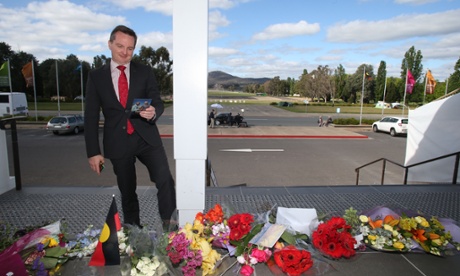
The shadow treasurer Chris Bowen caught a brief moment to himself earlier, before the hoardes descended. Thanks to Mike Bowers, who has done what he does so magnificently: bring you the story.
Today, Tuesday:
Gough Whitlam died, just a couple of years short of his century. Given Whitlam’s tumultous period in Australian political history, given the bitter partisanship that characterised the brief tenure of Australia’s most progressive prime minister, politics could have been bloody awful.
But it wasn’t. Politics was generous. The consensus from across the political divide was Gough Whitlam had done a remarkable thing: he’d changed a country. He’d pursued his beliefs without weasel words. He’d stuck it to the man, without caring whether the man would fell him. He’d shaped modern Australia in profound ways, and Australian politics which once was too small and lacking in imagination to cope with his mad ideas, had now risen to meet him, decades later.
There had been an epic battle, a constitutional crisis, but now the radical program was a matter of near universal acceptance. Gough wasn’t the outlier, he’d journeyed to the centre of things, because we’d finally all caught up with the big dreams.
Politics could forgive him for the mad schemes, because the legacy was so much more good than bad.
Implicitly, politics contrasted its contemporary smallness with Whitlam the enhancer. The smallness jarred against the scale of his ambition. The generosity of spirit in today’s parliamentary farewell was perhaps a small gesture of atonement.
Perhaps it wasn’t atonement but simply manners and form. Unknowable, that. In any case, thanks for reading. See you all tomorrow.
Updated
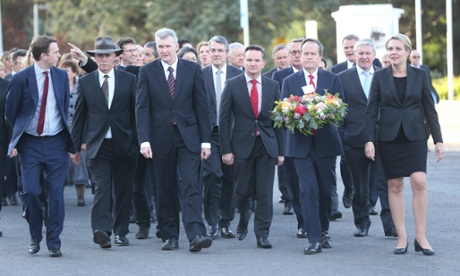
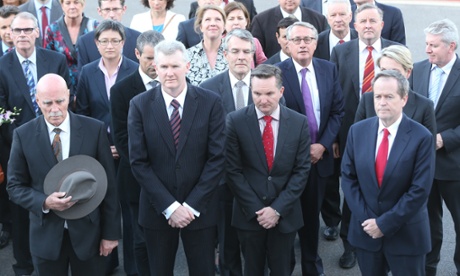
The Labor delegation has completed the pleasant walk from the new house to the old one. Bill Shorten and Tanya Plibersek have contributed some flowers at the steps and have done what the photographers have asked – always a bit awkward when the TV pictures are being broadcast live.
I’ll wait for a picture from Mike – then we’ll say farewell for this evening, wrapping the events of the day.
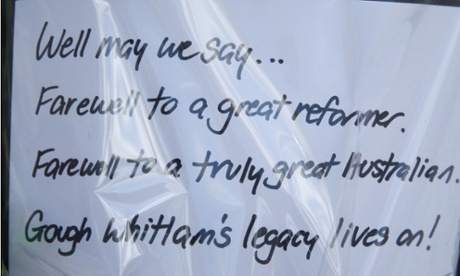
In truth, the piece I’ve been wanting to read today on Gough is from Michelle Grattan. Michelle started her career in Canberra during the Whitlam period. Fortunately now I can stop hassling her. She’s just filed for The Conversation. She promised me lamingtons, and (as always), delivered on her undertakings.
For a young journalist in Canberra, as I was in the early 1970s, Whitlam was a formidable, rather intimidating, but highly engaging figure. It took me years to brave a question at his weekly press conferences. One feared those Whitlam ripostes (though I think they were mainly reserved for the seniors). I recall his suggesting I ride in his car from Launceston to Hobart at the end of the Bass byelection. It had been a dreadful week of campaigning for Whitlam; Labor was headed for a huge drubbing the following day, that would see the election of Kevin Newman (Campbell’s father). Gough’s mood was dark, but practical too, wanting to know from daughter Cathy, who was also in the car, about breakfast next morning in the Lodge (Margaret, his support in almost everything as well as a great figure in her own right, must have been away).
Food was always important to Gough. At a community function, he’d invariably have an eye out for the lamingtons. And who else, having just been sacked as PM, would go to the Lodge for his lunch of steak, rather than back to Parliament House to warn his senators the government had been dismissed? It’s only a bit of a stretch to see that lunch as a metaphor for Whitlam strengths and weaknesses. He would not be blown off course. But he found it hard to change tack when storms hit.
Updated
I did mean to chase up earlier a statement from the Chinese embassy paying tribute to Whitlam. Now, I don’t have to. Here’s China’s official news agency.
To the Honourable Edward Gough Whitlam AC QC, You will always be remembered by many, especially the Chinese people. pic.twitter.com/8b6EI23aqM
— XinhuaNews Australia (@XinhuaAustralia) October 21, 2014
Lovely analysis piece just posted by my colleague, Lenore Taylor.
Australia isn’t just mourning a great politician and it isn’t just mourning a long-gone era of great political change. It’s mourning great politics. The flood of emotion at Gough Whitlam’s death is also a sadness at the passing of a time of brave politics. It seems to have unleashed a deep nostalgia for politics that makes changes that endure, politics that transforms – not by stealth but by fighting and winning the battle of ideas.
Written and floral tributes to Gough on the steps of Old Parly @GuardianAus @murpharoo http://t.co/G0nB1yIhBx pic.twitter.com/dz4ckff7T4
— Mike Bowers (@mpbowers) October 21, 2014
The Labor leader Bill Shorten plans to wander down to the old place this evening with parliamentary colleagues and staff to lay some flowers. Southern highlands resident Claire Yeo is there, paying her respects.
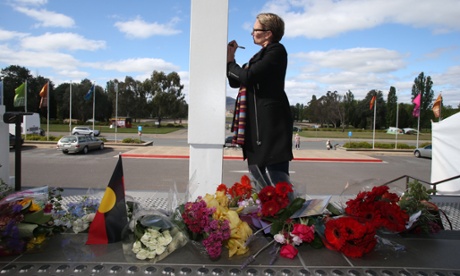
Mike Bowers has been having his own satisfyingly indulgent poke around down at the old building. Members of the public have been contributing floral tributes over the course of the afternoon, decorating the steps of the old parliament house – the site of the famous nothing will save the Governor General declaration.
Hello, Bruce White.
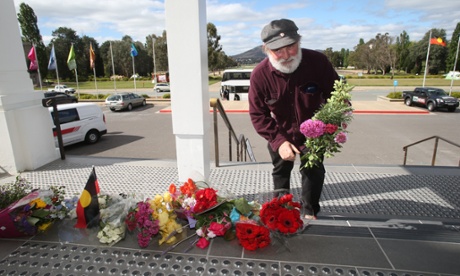
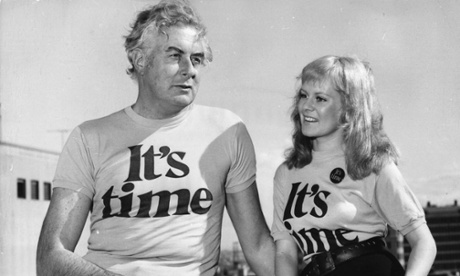
I’ve been having a satisfyingly indulgent poke about in the archive. I’ve just had a read of the 1972 “it’s time” speech – which actually takes some time, given it runs to 37 pages. Fellow nerds can read it in full here.
The striking thing about the speech for the modern reader is it contains .. content. Pages of policies. And of course, some memorable rhetoric.
Gough Whitlam:
Men and women of Australia – the decision we will make on December 2 is a choice between the past and the future, between the habits and fears of the past and the demands and opportunity of the future. There are moments in history when the whole fate and future of nations can be decided by a single decision. For Australia, this is such a time.
Remember when politicians didn’t exist just to meanly chip away at the nation.
I have to say that @firstdogonmoon's tribute to Whitlam pretty much summarises Australia pic.twitter.com/K1suuESyZF
— Blue Lotus (@upulie) October 21, 2014
Keating on rushing to implement your agenda.
If you’ve got the power, go and use it, you know. Why be a mouse? If you’ve got the levers, if you’ve got the naked flame, hang on. I think he and I had that in common.
And also, we like the words and the thoughts. But we’re from different ages and epochs, but we all have – we both had one interest in mind, that is Australia, its people, and most of all, the ordinary men and women of Australia who have nothing to sell but their own time and who need a government to help fashion their future.
I think that’s what he was committed to. And that’s what I’ve always been committed to.
Keating reminds people he handed Whitlam the loud hailer on the steps of the old parliament house in 1975.
We were both indignant about Sir John Kerr’s actions, and knew instantly it had been a coup.
And that we were entitled to, you know, to speak the truth about it.
Paul Keating on Whitlam: he was there at the turning
Former prime minister Paul Keating has now fronted the cameras for the ABC. He notes that Whitlam was unwell before his death, but never, ever complained about his condition, ever.
A magnificent person. But you know, one reflects on his life. He changed the way Australia thought about itself. And in a sense, gave it a new destiny.
Q: Is it possible to put in a nutshell his legacy, the parliament’s just heard hours of politicians from all sides describing their view of it. Can you describe Gough Whitlam’s legacy?
Well, he made the turn. He was there at the turning – you know, breaking a link with the kind of Anglosphere that had formerly dominated Australian public thinking. So it was a great turn and that was the central turn, I think, in the post-war years.
From the campaign to recognise indigenous Australians in the constitution.
Vale Gough Whitlam; a visionary and great supporter of recognising the rights & place of Aboriginal and Torres Strait Islander peoples.
— RECOGNISE (@RecogniseAU) October 21, 2014
A tribute too, from Galarrwuy Yunupingu.
It is with great sadness that we mourn the passing of former prime minister Gough Whitlam. Mr Whitlam was a unique and sincere man, and he is remembered fondly by the Yolngu clans of Northeast Arnhem Land. In his time as Prime Minister Mr Whitlam was a great friend to Indigenous Australians. He always acted in a direct and determined way to resolve the issues. The Bark Petition started the move towards land rights, but Mr Whitlam’s leadership brought it to life and made it real. He was a true friend of the Yolngu people. I send my most sincere condolences to his family on this sad occasion.
#auspol #GoughWhitlam pic.twitter.com/zD0GhtehJI
— Fr Rod Bower (@FrBower) October 21, 2014
The prime minister of PNG, Peter O’Neill, has issued a statement marking Whitlam’s passing.
Chief Whitlam will always hold a unique and special place in the history of Papua New Guinea as the Australian prime minister who worked with our founding fathers to achieve Independence for our nation. Before he became prime minister, Gough Whitlam provided ongoing support for Papua New Guinea’s emergence as an independent nation.
When he became Prime Minister, Gough Whitlam worked closely with our then Chief Minister, Grand Chief Sir Michael Somare, and other founding fathers to deliver self-government in 1973 and independence two years later. Gough Whitlam’s prime ministership was almost synonymous with Papua New Guinea’s transition to independence and the people of our nation express our gratitude. The Whitlam government was elected in the lead-up to self-rule and was in office on the day of Papua New Guinea’s Independence.
I noted before Malcolm Turnbull’s observation about Gough encountering God was the line of the condolence debate. If you are so inclined, you can review the contribution here.
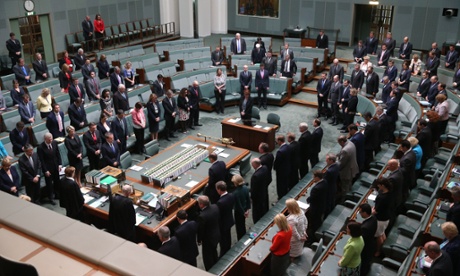
Taking stock of bits and pieces
A couple more shots from the parliamentary debate, which has now wrapped.
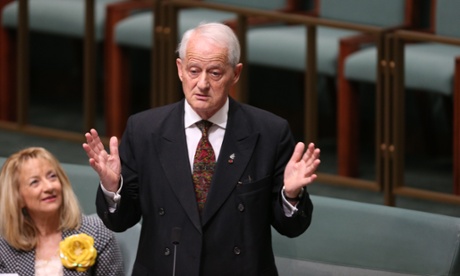
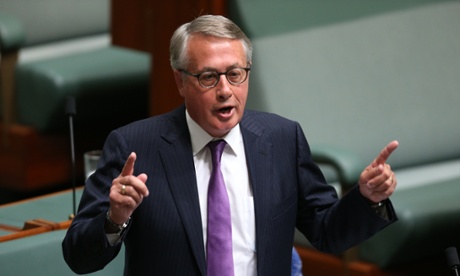
Also I think it sensible at this point to give you some links to interesting offerings from us on Whitlam today.
- If you’d like to catch up with a news wrap, you can find that here.
- If you’d like to read a piece from Race Matthews, Whitlam’s principal private secretary, you can find that here.
- Julia Gillard’s obit is here.
There are more things in the pipeline. I’ll keep you posted.
While still in the domain of former prime ministers, a statement, just now, from John Howard.
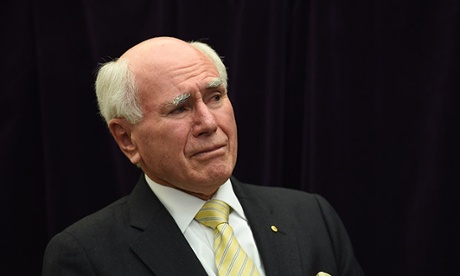
Whitlam’s greatest achievement? Winning power in 1972.
Gough Whitlam brought to public life high intelligence, a commanding presence and a strong belief that government intervention could solve most of society’s problems. He made a lasting impact on Australian politics.
The election victory of 1972 was his greatest achievement. He led the Labor party back into government, after the wasteland of 23 years of Opposition, characterised by a disastrous split and an over long dalliance with attitudes no longer relevant to a rapidly changing Australia. With flair, and notwithstanding considerable resistance, he reformed and modernised the Australian Labor party.
Gough Whitlam was prime minister when I entered parliament in 1974. His ready wit, eloquence and prodigious recall gave him an easy mastery of the parliamentary arena. Fundamental to his policy attitudes was Gough Whitlam’s belief that an activist and interventionist national government was always the appropriate response to Australia’s challenges. Whilst there will always be debate on such a proposition, Whitlam’s commitment to it permeated his actions in government.
His passion for foreign affairs was obvious. His decision – in Opposition – to embrace recognition of the communist administration in Beijing as the legitimate government of the whole of China was ahead of its time and wrong footed the then Coalition government. Through a long life Gough Whitlam was sustained by a strong constitution, as evidenced by his 98 years, and a loving family. His late wife Margaret died just weeks short of their 70th wedding anniversary. Janette and I extend our sympathy to Antony, Nicholas, Stephen and Catherine, and their families.
Q: Mr Hawke, was there anything, I guess, from his leadership that you took away that I guess you instilled as prime minister when you were in power?
Well, I learnt some things positively and negatively from Gough. Gough wouldn’t appreciate it if we were all here in these next few days saying he was a saint without blemish.
So I learnt both from the positives and from some of of the negatives. The positives were of giving active leadership not just imposing your will, but listening and then trying to get people acting together, and, secondly, his vision.
He thought beyond the borders of Australia. He realised that increasingly the welfare of Australia would depend upon the degree of its involvement in Asia in general, and China in particular. And I absorbed very much of that from Gough.
On the negative side, one of the weaknesses of his period was that he allowed argument in Cabinet to go back to caucus. You would have the situation where there could be an argument in the Cabinet, and those who didn’t get their way to go back to caucus and regurgitate the issues.
My first meeting of of the full ministry, I said there will be every opportunity in the Cabinet ministry meetings for you to have your say. You will never leave a meeting feeling that you haven’t had the opportunity to put your point of view, but once the decision is taken, that’s it. So that was another lesson. I learnt, if you like, in the sort of negative sense from Gough.
The other, if you can call it weakness or short coming, was Gough did not basically himself have a great interest or involvement in economics. He left to others, so we had the weakness of of the loans affair.
Former prime minister Bob Hawke has held a brief news conference to mark the passing of Whitlam. I noted earlier the distance Hawke and Paul Keating created quite deliberately between their government and the Whitlam government. That product differentiation is still present today.
Hawke notes Whitlam was a great Labor figure, but he wasn’t much interested in economics.
"I remember Gough with the greatest of respect and immense affection" - Former PM Bob Hawke. #9Newscomau pic.twitter.com/SgD0jjIvTM
— Nine News Australia (@9NewsAUS) October 21, 2014
Updated
It’s always the case in these moments: politics not only pauses to mark a specific passing, it looks in on itself to mourn its own transcience and mortality.
In condolence debates for one of their own – for the big figures, the alphas of the profession – contemporary politicians, through their contributions, hold themselves briefly against ideals that seem impossible to achieve in the moment of active combat.
Politics creates and eulogises an ideal self. The longer you watch these events, the more obvious the ritual becomes. A solemn process, a fascinating one.
Turnbull delivers a homily on disposition in politics.
Whitlam was an enhancer, and enlarger – a person of generous spirit, not a hater.
He wasn’t a mean or negative politician in the way, for example, that another great Labor leader who also lived to a similar age, Jack Lang was.
Jack Lang was a great hater. Gough Whitlam is a great example to us. He obviously never forgave John Kerr but look at the way he was able to be reconciled with Malcolm Fraser. That is a great example to all of us.
I say, Madam Speaker, we can learn from Gough Whitlam about the importance of optimism and the importance of having a big vision for our country. It’s important, obviously to execute that vision with competence I might add, but nonetheless, think about the way he did not allow hatred to eat away at him.
The reality is that hatred as we know destroys the hater. So many people in our business, in politics, find themselves consumed by hatred and retire into a bitter anecdotage gnawing away at the injustices and betrayals they suffered in their life.
Whitlam was able to rise above that. His cooperation and work with Malcolm Fraser on many causes. It is a great example for all of us not to be consumed by hatred.
Tears at the end too, as Turnbull imagines Gough reunited in the afterlife with Margaret.
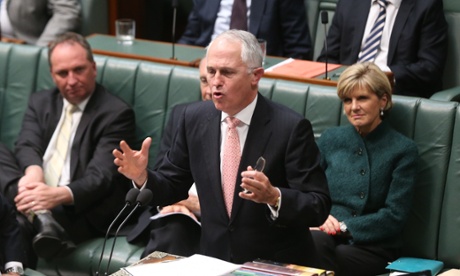
If Gough is in Olympus, I hope, I have no doubt, that he is there with Margaret.
I think that in some respects, one of the things we can be happiest about today is the fact that that old couple are no longer apart.
Updated
Turnbull has rolled seamlessly from republicanism to the Spycatcher case, to the divine. He produces the line of the day.
There has been a lot of discussion about Gough’s regard for the great beyond. Gough’s relationship with - well, Gough is resolving his relationship with God as we speak no doubt.
He was always very entertaining about those issues of the divine. I remember 25 years ago I was in business with his son Nicholas and Nicholas and Judy brought Gough and Margaret up to visit us at the farm in the Hunter Valley I’d inherited from my father some years before.
Unfortunately, a fog had descended on this particular part of the country and you couldn’t see anything. It was just white everywhere you looked. Living in a white cloud. I said to Gough: “I’m really sorry, it is a nice view here, but sorry you can’t see it”. He said: “Don’t be concerned, I’m completely at home. It’s just like Olympus”.
Updated
Communications minister, Malcolm Turnbull.
Gough Whitlam’s government was not, let us say, unmarked by error. It was a controversial time. I will say a little bit about the influence of that on the Labor Party in a moment – but we have to remember that the economic arguments of those days have largely receded into history.
The truth is that nobody on our side or the Labor side would agree with Gough Whitlam’s economic agenda, we wouldn’t agree with Billy McMahon’s economic agenda. Life has moved on.
But what is remembered is the myth of Gough, or as Gough would say, the mythos of Gough. What is that thread, that narrative, that emerges from history out of the hum drum daily grind of political argument? What is it?
What it is, Madam Speaker, is an enormous optimism. All of us admire that.
Whether we voted for him in the 70s or our parents voted for him or whether we approved of what John Kerr did or not – all of that recedes.
What people remember of Gough Whitlam is a bigness, a generosity, an enormous optimism and ambition for Australia.
Labor’s Jenny Macklin, back to 1974.
There weren’t many of us wearing “We want Gough” badges in Wangaratta in 1974 as I lined up to cast my first vote.
Gough had brought the voting age down from 21 to 18 just a year earlier and my friends and I, like many other idealistic young Australians, were swept up in the feeling that finally our time had come.
Change was here.
Reducing the voting age to 18 was just one of those many changes of the Whitlam government which put young people at the centre of the Australian political debate.
It was Gough that made sure that the boys that I went to school with would not be drafted and sent to Vietnam. For our generation, the end of conscription was personal and transformative. Gough’s was a government that spoke to young Australians in a way that governments never had previously.
It was a government that cared about us and he cared about our future.
I mustn’t be unfair to Kevin Andrews, who was more than gracious in that contribution. Meanwhile, what a treasure.
Letter from Spike Milligan to Gough Whitlam, 1977. pic.twitter.com/q2UufyyRNg
— Julia Baird (@bairdjulia) October 21, 2014
Kevin Andrews, family services minister.
In fact, I think it can be fairly said that if Gough Whitlam wasn’t the father of the Australian welfare state, he at least served the role of midwife.
Er.
On the steps where he uttered his immortal 1975 words, flowers and tributes are being left for Gough Whitlam pic.twitter.com/LhO6j88ypk
— Andrew Greene (@AndrewBGreene) October 21, 2014
Albanese, in conclusion.
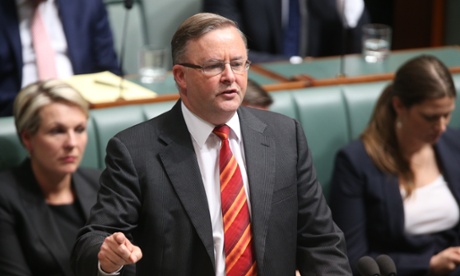
He taught us to be brave, brave about our reform ambition, brave in the face of our critics and unstintingly brave in the pursuit of the greatest ambition any of us could ever pursue – that is justice and opportunity for all.
Updated
Labor’s Anthony Albanese:
Gough Whitlam was a giant of Australians. He was a great parliamentarian but also a great citizen.
At a time where much of political debate is in the weeds, in the details, he soared above the political landscape as a figure in Australian politics. He both anticipated but was able to create a future by his actions. He was someone who, whether in a small room at a dinner, or at a public event, everyone else seemed to fade to black and white while this giant of a man physically, intellectually, appeared there in full colour and dominated wherever he was.
His passing will have a huge impact on so many Australians because he had an impact on them. When Gough was elected, I was living in Camperdown with my mum and my grandparents. I got to hand out in 1972, as you did as part of the faith, in 1972 – and I remember the extraordinary celebration that was there in my local community where people had been thinking that Labor would never quite get across the line and he made a difference.
He made a difference. Changes to social security for my mum who was on an invalid pension. He changed social security from something that was “You weren’t good enough to be a real member of society” to treating people with respect.
He transformed the health system by the introduction of Medibank, torn down when the conservatives came back into office but now essentially an article of faith in this parliament whereby no-one can openly say that they’re opposed to the universality of public healthcare.
He changed education so it was based on merit, not how wealthy your parents were.
Pyne, who has been enormously restrained in this contribution, can’t quite hold it together until the end. He shares his first person account of the day of the dismissal.
I remember my mother was ironing, I was watching ‘Adventure Island’ and my mother started crying. I thought I wonder why?
I have to let you in on a secret, she wasn’t crying out of sadness when she heard the Whitlam Government had been dismissed. She was crying out of joy.
Updated
Manager of government business, Christopher Pyne, starts with Plutarch.
You always got the impression with Gough Whitlam he was a follower of heroes but also wanted to be a hero himself. In fact, to many in the non-Labor side of politics, as is clear by this debate so far and from what I’m sure is to come, he is a hero to many in the non-Labor side of politics.
To me Gough Whitlam conjures up images of a great ancient Greek or Roman statesman. A person of great wit, sophistication, eloquence, privilege but giving his life over to public service, seeing public service as the most important thing that he could do to make his society and his country a greater place.
A nice little anecdote.
When I was a very young man, Madam Speaker, I worked for Amanda Vanstone and she was putting together a book of the great parliamentary speeches since Federation.
She asked me to ring Gough Whitlam, which I did. I spoke to him and said “Senator Vanstone”, (whom he liked, it is hard not to like Amanda Vanstone) – I said “Senator Vanstone for whom I work is putting a book together of the great parliamentary speeches and would like to include one of yours, Mr Whitlam. I said which one would you like me to include?”.
He said: “Any one will do”.
Madam Speaker, Bronwyn Bishop, is enjoying this debate enormously. Lots of chortles. Rather startling, to hear the chortling. But nice, actually.
A little gem from the manager of opposition business, Tony Burke.
The late Cardinal Clancy used to often relate about his conversation with Gough when Gough had inquired as to whether or not St Mary’s Cathedral might be available for a funeral.
This surprised Cardinal Clancy given he was not expecting Gough to convert to Catholicism.
Gough explained “No, it was not for the Catholic funeral, it was because he wanted to be buried in the crypt, claiming he was willing to pay but would only require it for three days”.
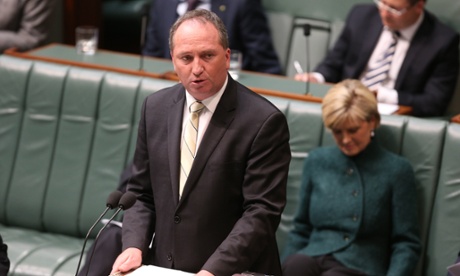
Agriculture minister, Barnaby Joyce.
My parents, when they had a choice between (Billy) McMahon or Whitlam, voted for Whitlam. They didn’t the second time.
But this was how he was seen – he was seen as visionary.
Updated
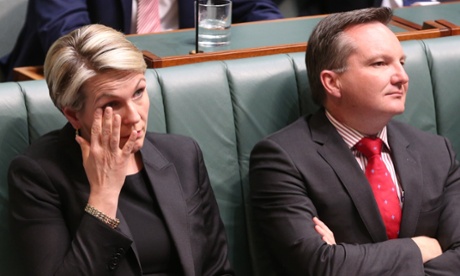
The shadow treasurer Chris Bowen wants to direct the chamber away from the idea of Whitlam as darling of the luvvies, a pinot gris socialist. A progressive, yes, a different sort of Labor leader, yes, but, fundamentally, a man dedicated to improving the life of working Australians.
When he became prime minister, he Margaret and the family lived in Albert Street, Cabramatta in a house that still stands today, perhaps a house Madam Speaker which might one day be acquired by the government.
He celebrated Labor’s historic election win on 2 December 1972 at the El Toro Inn at Warwick Farm. He lived and breathed the aspirations of the people of Western Sydney for a fair go and he applied them to the suburbs and the regions of the nation.
Bowen says a book was published last year which argued that the election of Gough Whitlam was a transition point for the ALP away from a mass working-class party towards an elitist one which prioritised social reform and the environment over economic growth.
I said at the time that to prosecute this argument is to fundamentally misunderstand and underestimate Gough Whitlam.
Yes, he progressed social reforms. Important to a progressive Australia, reforms that were overdue.
He was cut of a different cloth to Calwell or indeed to Curtin and Chifley as the son of a senior public servant who’d received a first-class university education and was an accomplished lawyer.
But his program always had working people at its heart. Almost 40 years after he left office, he is still much beloved on streets of Western Sydney, not because of the social reforms he introduced, but because he brought sewers to Western Sydney.
He wasn’t some elitist agenda driving him to fund the construction of a sewerage system. But it was because of his time living in Arthur Street Cabramatta that he understood that it was simply not right that so many people not have access to such an important and basic service, as late as the 1970s. And the lessons he learnt in Western Sydney, he applied right across the country.
The foreign minister Julie Bishop, lingers a little on Gough’s long and happy marriage to Margaret – a formidable figure.
Like Gough, Margaret was never afraid of voicing her opinions, sometimes to the discomfort of her husband. She said in the 1950s: “I say what I think when I want. I’m not a mouthpiece for my husband or for the ALP and it is very frustrating for me when people assume that I am.”
Adding to Gough’s list of policy ideas Margaret gave a wide-ranging interview shortly after her husband was elected as prime minister in which she advocated for the legalisation of abortions, marijuana, de facto relationshipness and equal pay for women.
Margaret said while she lacked the energy to march in street protests she was a supporter of feminist movement.
In one memorable speech in response to what she perceived as a negative media coverage of her husband she labelled the members of the press as vultures and preying mantises.
The Whitlams were a formidable team.
The rich tapestry of their life together is interwoven into our national history.
The story of Gough and Margaret Whitlam is one of devotion and dedication to each other, to our community, to our nation. I join with our parliamentary leaders in extending my condolences to the Whitlam family.
Tanya Plibersek:
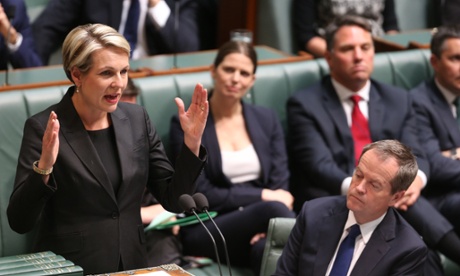
Gough’s legacy both domestically and on the world stage is now so deeply ingrained in our national character that we sometimes take it for granted.
We forget perhaps how fierce the battles were.
All of our prime ministers have served our nation with great loyalty and distinction. But there will always be something special about Gough.
He had an ego. That’s true. And he was the first to make fun of himself for that. He said in the early 2000s, “I feel I am eternal but not immortal.”
As always, as he would say, he was right about that.
I’d say this: that the outpouring of grief that we are witnessing today is not just mourning for a man, but for everything that he represented.
He had a clear vision of the country that he knew Australia could be. He had the ability to project that vision to the world.
More than anything else, Gough’s memory should inspire us to have courage in politics. A reminder that often the most important reforms are the hardest.
But as we’ve seen from today, from this unprecedented public response to his passing, it’s those reforms that Australians cherish.
It’s those reforms that will outlast us all.
Gough, my friend and comrade, rest in peace.
(Pitch perfect, that contribution.)
Updated
Thanks to Mike Bowers, I can pop you in the chamber.
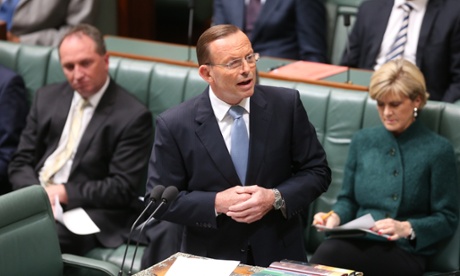
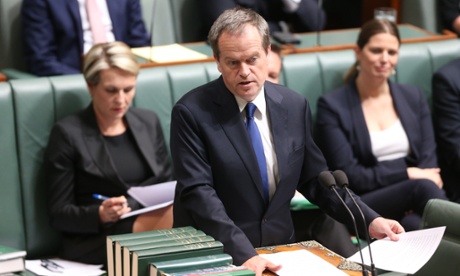
Labor deputy leader, Tanya Plibersek.
I’ve often thought it was fitting that Gough Whitlam was Australia’s 21st prime minister. Because with Gough Whitlam, Australia came of age.
An Australia that once thought small was asked to think big. An Australia once closed and inward-looking opened to the world.
Gough rejected those old ideas of what Australia should be and led us to what Australia could be.
The deputy prime minister, Warren Truss – a chap who approaches politics in orderly fashion.
(Whitlam’s) early days of government were simply cyclonic. A government of only two that set about change and seemingly changing everything.
He was so eager to get things done that he risked leaving the community behind, but I don’t think he cared.
He was determined to get things done. And from that period, the list of Gough’s enduring stamp on our nation is long.
Truss says many Labor figures were inspired by Whitlam’s example to enter politics, and Gough also inspired a number of Coalition figures to take up the fight to progressives.
Truss says he was one of the farmers protesting against Whitlam in the 1970s. He says Whitlam also gave him his first political appointment to the national rural advisory council.
He rounds out with this tribute.
Above all, Gough Whitlam was unambiguously committed to Australia. Australia continues to benefit from much of his legacy today. He recognised China. He went not only to China but playsed a trail which much of the rest of the world followed.
He carved a unique and extraordinary chapter in Australian history. We respect his courage, his conviction, and his contribution. It’s appropriate that the nation recognises his successes and mourns his passing. May he rest in peace. I salute a great Australian.
Strangers in the House.
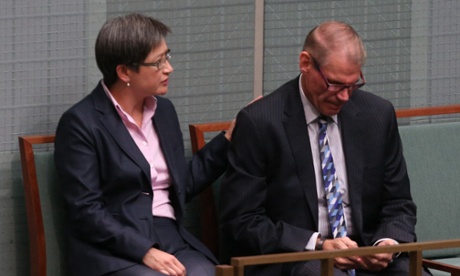
Poor John Faulkner is struggling today.
Shorten on Whitlam, and the inconvenience of dying.
Dying will happen some time, as you know I have a plan for the ages not just for this life.
And you can be sure of one thing, he says of a possible meeting with his maker – I shall treat him as an equal.
Shorten is broadening now.
Gough refashioned our party. He drew it out of its narrow, quarrelsome partisan divisions into an inclusive social democracy, and he stirred with his wit and his capability many brilliant citizens into public service.
Gough presented to the nation and largely delivered a hearty, refreshing, merciful, forgiving exhilarating new order.
He was an unusual figure to be doing such things. He was large and regal. With an accent both broad and aristocratic and a cadence so emphatic it seemed you dare not oppose him. He could appear both prim and episcopal and hugely conservative while changing society forever.
He was judged by his acquaintances and political contestants in very different ways. The former Victorian trade union defence committee swore blind he was a closet Liberal. The Melbourne establishment believed he was a class traitor one who’d sullied his boots and family name by seeking an easier ride in the stupider party.
The DLP saw him as their bridge over troubled waters back to the anti-Communist Chifleyism. To his friend, Jim Killen, he was as obnoxious a by-product of the upper middle classes as was ever grafted itself leech-like on the egalitarian movement.
To Sir John Kerr he was a dangerous megalomaniac, to Gore Vidal the nation’s most intelligent man.
Above all, Gough was an agent for democracy, an agent for tolerance.
It’s Bill Shorten’s turn at the dispatch box. There’s some overlap with the speech to caucus earlier this morning – which is to be expected.
No-one who lived through the Whitlam era will ever forget it. And perhaps nobody born after it can ever imagine it. Gough’s ambition went beyond his desire to serve our nation. He wanted to transform it. Completely. Permanently and he did.
Today I submit that like no other prime minister before or since, Gough Whitlam redefined our country, and in doing so he changed the livings of a generation and generations to come.
It’s a nice speech from Abbott, who it must be said possesses a talent for lionising Labor figures. There are the appropriate caveats – even though we disagree. It’s basically a respectful nod to political history: a conservative instinct, overlayed with some of Abbott’s cultural affinity with Labor figures. Call it the DLP overlap.
Abbott wraps thus.
Madam Speaker, we all have much to learn from the giants of those times.
Abbott tells the chamber he introduced himself to Whitlam in 1978 at Sydney University.
I’ve heard of you, (Whitlam) said. You’re some kind of a Liberal.
I’m actually supposed to be DLP, was my response. “DLP”, he boom the. “That’s even worse.”
Abbott says Whitlam may not have been our greatest prime minister but he was certainly one of the greatest personalities that our country has ever produced. He says no prime minister has been more mythologised.
Whitlam represented more than a new politics. He represented a new way of thinking, about government, about our region, about our place in the world, and about change itself.
1972 was his time. And all subsequent times have been shaped by his time. His government ended conscription. Recognised China. Introduced Medibank. Abolished university fees. Decolonised PNG. Transformed our approach to Indigenous policy. And expanded the role of the Commonwealth, particularly in the field of social services.
These were highly contentious at the time. Some of these measures are still contentious. But one way or another, our country has never been quite the same.
Parliament remembers Gough Whitlam
The prime minister, Tony Abbott, opens the formalities in the House of Representatives.
Madam Speaker, in every sense, Gough Whitlam was a giant figure in this parliament and in our public life. He was only prime minister for three years. Three tumultuous years, but those years changed our nation, and one way or another, set the tone for so much that has followed. Whether you were for him or against him, it was his vision that drove our politics then and which still echoes through our public life four decades on.
Condolence motion for Whitlam in the House of Representatives coming up in a minute or so.
Q: What do you think modern day politicians could take away from what he did?
Malcolm Fraser:
Australia should be Australia. We’re not a play thing for another country. We’re an independent country with our own mind, our own heart and we stand for what we believe, not for what somebody tells us to believe.
Fraser seemed relieved at the end of that press conference. Well, that was very calm, he noted.
Certainly a shed load calmer than a constitutional crisis, yes.
Again, circles of politics and life. The Whitlam and Fraser of today would have more things in common than differences I suspect.
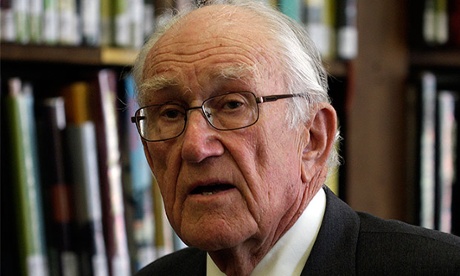
Q: When you first heard that famous speech on the steps of old parliament house occur, what was your first reaction when you heard those words?
I probably flinched a bit. But I had had many darts aimed at my back, if you like, and you develop a thick skin in politics.
Fraser: if he had a fault, it was doing too much, too quickly
Malcolm Fraser is now addressing reporters about the death of his one time political foe.
Q: As a man, how will you remember him?
Larger than life sometimes. Most formidable opponent in political terms but as somebody who was clearly very close to Margaret, somebody who was very close to his family, as somebody who I liked to believe was a good friend.
Q: You did become good friends but your names will always be linked because of what happened in 1975. How were you able to build the bridges after that?
It happened little by little. I don’t think Gough – I never felt he bore me personal animosity. He regarded that as politics.
We met at different times, mostly overseas when I was also out of parliament, not at any length but the ice started to break and then we found ourselves on the back of a semitrailer supporting the independence of the Melbourne Age newspaper.
We found we had a number of issues, domestic and international where we had views in common and that established the basis of a relationship.
Q: In 1975 what was it like between the two of you?
It was a fierce political battle. There were tense times, difficult times.
Q: Do you now look back and have regrets about 1975?
I might regret the larger political argument and the way that did become divisive in Australia. I am not going to talk about regretting particular actions or whatever because I don’t think this is the time to do this.
Q: At the time you couldn’t say it but do you believe he was a good PM?
Let’s say he was a prime minister who did many different things. He had great ambitions for Australia and many of his ideas were good. If he thought he had a grand idea he would want to implement it forthwith and if he had a fault, maybe he tried to do too much, too quickly.
That is not necessarily a fault of his, it is perhaps a fault in part that the Labor party had been out of office for 23 years and he especially had built an agenda for the Labor party which he wanted to see fulfilled as quickly as possible.
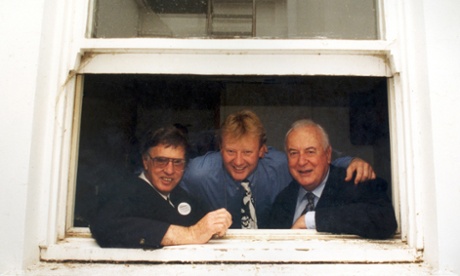
I love this picture, which Mike Bowers has so kindly shared. This is of course Whitlam with Mike and Mike’s legendary father Peter, a great wordsmith of Australian journalism. One to treasure.
Big call from another son of Whitlam, Mark Latham, in a tribute published in The Australian.
Gough Whitlam was the greatest-ever Australian. Great sportsmen such as Don Bradman may have thrilled the crowds and inspired national pride. Great scientists such as Howard Florey may have invented new medicines and added to Australia’s international reputation. But no Australian has enhanced our nation and improved our lives as much as Whitlam.
Greatest ever Australian?
Discuss.
Some nice tributes on Twitter for folks so inclined at #ThankYouGough
Couple more.
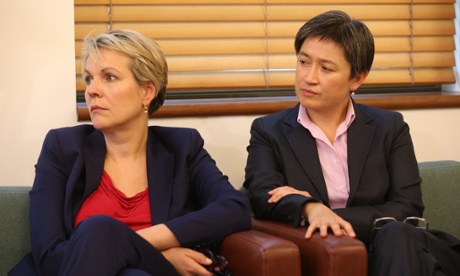
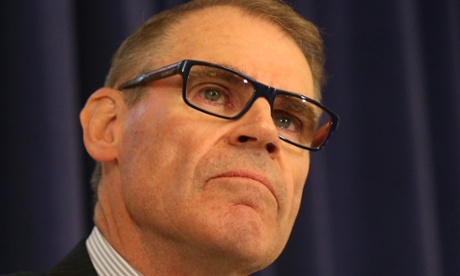
Updated
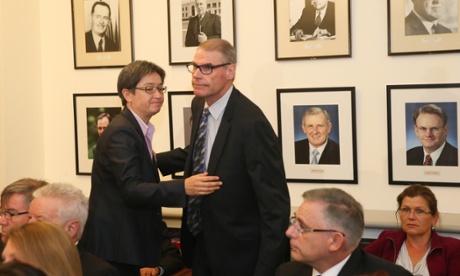
Some lovely shots inside the caucus tribute this morning from Mike Bowers.
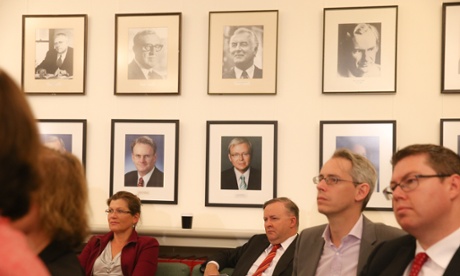
Liberal Philip Ruddock is speaking to Lyndal Curtis on ABC24.
Q: One final question, when you look at (Whitlam), will we see his like again and if not, why not?
I think public life has changed.
I think after the war a lot of people entered public life who might have achieved a great deal in other arenas. I think our parliament is very important. I would hope that many more people of Gough Whitlam’s talent would see it as a role that they should fulfil.
I am not sure there are many Gough Whitlams in the parliament today.
Manager of government business Christopher Pyne updates us on procedure for the day.
The House will meet at noon today and a condolence motion will be moved by the prime minister. As is the precedent, eight speakers from each of the government and the ppposition will speak. Members of the cross bench will of course be accommodated.
The leader of the house will then move that the motion be referred to the Federation Chamber for further debate when that chamber next resumes. The House of Representatives will then be suspended as a mark of respect until its next scheduled sitting at 9.00am on October 22.
This process follows the precedents established following the deaths of former prime ministers Menzies, McMahon and Gorton.
Now, speaking of Paul ..
Paul Keating remembers #Gough Whitlam - "he snapped Australia out of the Menzian torpor". #auspol pic.twitter.com/tXNFz1yOgV
— Alice Workman (@workmanalice) October 20, 2014
Politics is a cyclical business, and Labor has been through a significant cycle with Whitlam. Bob Hawke and Paul Keating were at pains to distance the Labor government of the 1980s and 1990s from the perceptions of chaos of the Whitlam era. Whitlam was unfashionable during the Hawke/Keating period in some respects, not because of sharp differences on policy fundamentals, but because Labor at that time was intent on projecting stability in contrast with the rollercoaster of the 1970s.
Labor came full circle with Whitlam during the Rudd/Gillard period. In many respects, Rudd/Gillard in its assertive progressivity was closer to the essential character of the Whitlam government than the “consensus” Hawke period. Given Rudd and Gillard were true sons and daughters of the Gough era, and did not have to clean up the downside, this is perhaps not surprising.
Faulkner ends thus.
He was a great parliamentarian, he was a Australian and for so many of us, and it’s what makes it so hard – he was a great friend and mentor.
The caucus stands for a minute’s silence.
Faulkner: on fizzy pop and Logies
Labor elder John Faulkner steps up to the podium now.
In the more than twenty five years that I’ve been a member of this caucus, as many of you know I’ve said and done some hard things. Nothing, nothing harder than this. This is the most difficult speech I have made and will ever make in this caucus.
Faulkner speaks of the extraordinary atmosphere in 1972 – the sweep into office: change the Labor party, change the country.
I think his campaign speech in 1972 really summed up his vision for Australia. To promote equality, to involve the people of Australia in the decision making processes of our land and to liberate the tallents and uplift the horizons of the Australian people. And to those ends Gough devoted nearly seven decades of his long life.
The two were close. Close enough to share fizzy pop and in fact the finest fizzy pop of the 1970s and early 1980s.
Gough and I were close for more years than I care to remember. Each week I was in Sydney I would go and have a cuppa, a glass of Passiona with Gough in his office in Sydney that he literally came into his office four days a week until the last week or two of his life.
There was a Logie nominated film. It didn’t win.
Gough was crestfallen for at least five seconds and said to me “Comrade, I suppose an academy award is out of the question?”
Shorten outlines the policy achievements and addresses the flaws.
His speechwriter and confidante once observed there are some who say he did too much too soon, but few can say what he did could have waited any longer.
Gough never lacked the courage for the good fight. It was this courage, this determination that made him the great reformer of the Labor Party, the greatest reformer in the history of our party.
Gough Whitlam loved the Labor Party and Gough Whitlam changed the Labor Party. He shook Labor up. He made our party relevant to the modern multicultural fair and reconciled country of the grand vision.
He says Whtilam was sacked from office, but he did not carry an anvil of hatred. Shorten says the values trumped any rancour.
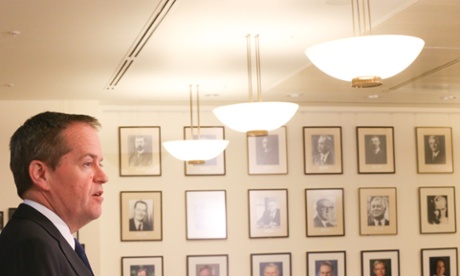
There will be more tears shed today, I believe, for Gough Whitlam than perhaps any other leader in Australian history. And his beloved men and women of Australia will long remember where they were this day.
It’s time, Gough told us, because of him, because of his life and legacy it’s always time. It’s always time for more generous and inclusive Australia. It’s always time to help our fellow Australians rise higher than their current circumstance.
It’s always time for courage and leadership to create and seize opportunity.
It’s always time. Gough’s light shines before him and the memory of his great works will live long in the heart of our nation.
Updated
Shorten, on Whitlam: a certain grandeur to the end
The Labor leader Bill Shorten is addressing the Labor caucus now.
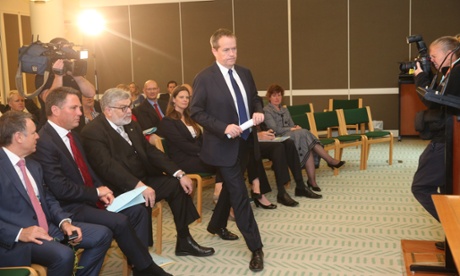
I have some very sad news for all of you, and I think very sad news for all Australians. A giant of our movement, a great leader of our nation, Edward Gough Whitlam has left us.
I rang and offered my condolences to Gough’s son Nicholas this morning. He told me that the great man had passed in peace and comfort.
He kept that certain grandeur to the very end.
Gough’s was a truly Australian life and a life lived truly for Australia. Be it in uniform, or in parliament, in the prime ministership and around the world. Gough did not just want to serve our nation, he wanted to transform it utterly and permanently and he most certainly did.
I believe like no other prime minister before or since Gough Whitlam redefined our country, and in doing so, he changed the lives of a generation and generations to come.
He reimagined Australia, our home, as a prosperous, modern, multicultural nation where opportunity belonged to everyone.
The Whitlam government should not be measured in years but in achievements. Our country is different because of him. By any test our country is better because of him.
Updated
If readers are interested, my colleague Lenore Taylor and I reflect here in a video about the Whitlam legacy.
Life, times, achievements, lapses, recollections – and our own awakening about politics as little kids in the 1970s. Thanks to the lovely Christian Bennett for pulling this together.
At a media conference just a little while ago, the PUP leader Clive Palmer paid tribute to Gough Whitlam for his healthcare and university education reforms. Palmer also claimed to have sent a telegraph to the Queen after the 1975 Whitlam dismissal expressing his opposition to the governor general’s decision.
Palmer:
I know I was a beneficiary of a free education … having an education that I never could have afforded to have.
Greens leader, Christine Milne, unsurprisingly praises the progressive legacy of the Labor man:
Mr Whitlam made us a progressive nation and put us on the global map. After decades of conservative government, in came Gough. His passion for social justice, education and the arts was legendary. He improved Australia’s humanitarian and cultural standing in the world by ratifying the Human Rights Convention and the World Heritage Convention. Whitlam was a champion for the environment, establishing the National Parks and Wildlife Service and protecting the Great Barrier Reef.
In Canberra, the flags are now lowered, and the chambers silent.
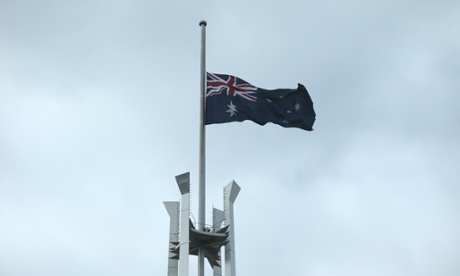
The Labor party room is meeting downstairs. Condolences will begin in a couple of hours.
Australia’s current Governor-General, Peter Cosgrove, has joined the avalanche of tributes. Here is his statement.
On behalf of all Australians I wish to express sincere condolences to the Whitlam family on the passing of former prime minister, the Honourable Gough Whitlam AC QC. Mr Whitlam was a towering leader of his time who made a significant contribution to the life of our nation and his legacy endures today. Lynne and I extend our deepest sympathies to the Whitlam family at this sad time.
Just an interesting little stat – these days political leaders run a mile from putting themselves in a forum where they have to answer questions. Gough Whitlam addressed the National Press Club in Canberra 18 times – the first in November 1964, the last time in July 1995.
Albanese is telling his story about his experience on the day of the dismissal, aged 12.
My history teacher, who is now in a Labor Party branch in my electorate so he won’t mind me naming him, he’s retired, Vince Crowe came into my school. I went to St Mary’s Cathedral in the city and he came in and announced to the class that our prime minister had been dismissed and our government’s been thrown out. People weren’t clear what it was. I got into trouble that day, I was 12 years old. I got home pretty late because there were police horses and there was chaos in the city and we hung about. These were turbulent times and the big demonstration against the dismissal was held in the Domain, and I didn’t go to school.
We all went across and went to the demo.
Q: As a 12-year-old?
And the good old Christian brothers, no-one got into trouble for skipping class either.
Albanese says Whitlam challenged the conservative power structures in the country and the power structures fought back.
He’s referencing the antipathy of News Limited to the aggressively progressive Labor prime minister. Albanese says it was a visceral campaign against Whitlam. It was just like the last federal election campaign, he notes, somewhat pointedly.
Albanese:
We had a campaign whereby the newspapers and the media coverage campaign run against him was the like of which perhaps only the last campaign we’ve seen a comparison in terms of a consistency. At that time, if you go back to 1975, you will see the papers being taken off the backs of trucks and burnt. It was a very controversial time and Gough Whitlam did challenge those existing power structures.
That’s not to say that there weren’t errors committed. Of course there were as all governments do. But I tell you what, in that three years Gough Whitlam left a legacy that is permanent, that is permanent change.
Not for Gough sitting there and just occupying office. For Gough it was about making a difference and he did every single day.
Thanks to Bridie, champion that she is.
Hello all, lovely to be with you here. Anthony Albanese is currently on the ABC paying tribute to Whitlam – an enormously significant figure for him. I’ll bring you some of that shortly, but first, The Whitlams.
As we continue to ride the tidal wave of emotion, grief and tributes to Gough Whitlam, I am going to handover to my colleague Katharine Murphy. Her steady hand will guide you through the rest of the day as Australians and the rest of the world react to Whitlam’s death.
Former prime minister Julia Gillard on Gough Whitlam
Julia Gillard has written about Gough Whitlam and his legacy here.
The last time I saw Gough he was both changed and unchanged. He sat, not strode. The love of his life, Margaret, was gone. He would focus on a world unseen to me.
Gillard says every Labor leader and prime minister has wrestled with the legacy of Whitlam and recalls seeing him speak when she was a teenager, and although she can’t recall the words, she remembers the atmosphere “vividly”.
I remember Gough as one of the great Australian characters. His wit literally filling books. I honour Gough as a man of the highest political courage. A giant of his era. He was truly prepared to “commit and see what happens”. He transformed Australia and we are in his debt.
Updated
Not only are Senate Estimates suspended but so is all other business at parliament house, which is scheduled to sit today. My colleague, Shalailah Medhora, reports:
Attorney-General George Brandis has fronted a Legal and Constitutional Affairs committee to say that the House of Reps will meet for condolence speeches at midday, then all other business, including estimate committees, will be suspended.
Senate Estimates hearings have been suspended for the day as a mark of respect for Gough Whitlam.
Journalist for The Australian, Troy Bramston, has posted this brilliant photo of Gough Whitlam.
#OnThisDay Gough #Whitlam turns 98. Born Melbourne 11 July 1916. PM 1972-75. Longest serving ALP leader, 1967-77. pic.twitter.com/FLcpWkSpgA
— Troy Bramston (@TroyBramston) July 10, 2014
Now for some words from the good burghers of Australia. Social media has been filling with mournful tweets and tribute Facebook posts to the former Labor prime minister:
Vale Gough #Whitlam - he did plenty right (and made plenty of mistakes too) in such a short time. This image - iconic pic.twitter.com/mPLY44LjhH
— Chris8875 (@chris8875) October 20, 2014
Archives from #1975: Australia in turmoil as #Whitlam is fired http://t.co/l1TcDhxuuF via @guardianaus
— Jane Nicholls (@janey64) October 20, 2014
Maintain the rage. Vale Gough Whitlam.
— Baroness Barbara (@barbwodecki) October 20, 2014
Rest in Peace, Edward Gough Whitlam. Always maintain the rage. pic.twitter.com/13L2e5vvlX
— Alex (@xx_Alexandra) October 20, 2014
RIP Gough Whitlam. Can't imagine I'll ever witness anything like his 3 years in office in my lifetime. The founder of modern Australia.
— Andrew Thorpe (@AndrewThorpe) October 20, 2014
Malcolm Fraser speaks about Gough Whitlam's death
The man who controversially succeeded Whitlam as prime minister in 1975, Malcolm Fraser, has spoken about Whitlam’s death, my colleague Michael Safi reports:
Fraser said Whitlam’s death was “a shock but not unexpected” while speaking on ABC television.
He was a great Australian and he’ll be remembered as such. He was a formidable opponent, that covers it all.
He highlighted Whitlam’s inquiry into Aboriginal land rights, his “sense of identity for Australia” and giving voice to “an idea of social justice that was really deep in the whole of parliament”, as the former prime minister’s greatest achievements.
Gough was as famous for the way he left parliament - dismissed by the governor-general - as he was for his reforms. Here is how the Guardian reported the dismissal in 1975, under the headline “Australia in turmoil as Whitlam fired”.
The Sydney Morning Herald’s obituary for Gough Whitlam begins with the former prime minister’s musings on life and death. It contains one of his immortal lines, this one on what he would do when he eventually meets his maker:
You can be sure of one thing. I shall treat Him as an equal.
Tony Abbott pays tribute to Gough Whitlam
Flags at Australian parliament house will fly at half mast today, and on the day of Gough Whitlam’s memorial service, the prime minister Tony Abbott has announced.
Abbott has called Whitlam “a giant of his time” in his tribute to him.
He united the Australian Labor Party, won two elections and seemed, in so many ways, larger than life. In his own party, he inspired a legion of young people to get involved in public life.
Abbott has also paid tribute to Whitlam’s late wife Margaret, who died in 2012.
Gough Whitlam’s life was inseparable from that of Margaret Whitlam. Margaret Whitlam was a leading light for women of her generation. Together they made a difference to our country.
Details of a public memorial will be announced in the coming days after the government has consulted the Whitlam family.
Updated
We have a lovely photo gallery charting Gough Whitlam’s life here. Below is one of the most famous pictures of him, on old parliament house steps after the infamous dismissal.
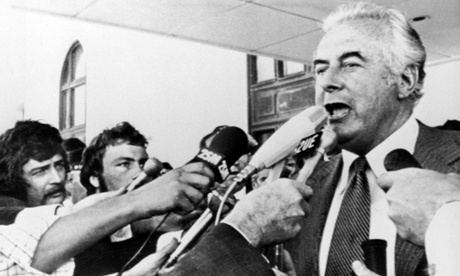
Gough Whitlam was only prime minister for three years but in that time his government implemented a rapid program of reform called “the program”, Guardian Australia political editor Lenore Taylor has written.
Those reforms include:
- Australia’s national health insurance scheme, Medibank
- abolishing university fees
- introducing state aid to independent schools and needs-based school funding
- returning traditional lands in the Northern Territory to the Gurindji people
- establishing diplomatic relations with China
- withdrawing the remaining Australian troops from Vietnam
- introducing no-fault divorce laws
- passing the Racial Discrimination Act;
- blocking moves to allow oil drilling on the Great Barrier Reef
- removing God Save the Queen as the national anthem
Updated
Gough Whitlam’s children released a statement early this morning announcing the death of their father overnight.
Antony, Nicholas, Stephen Whitlam and Catherine Dovey said:
A loving and generous father, he was a source of inspiration to us and our families and for millions of Australians.
The brief statement said there will be a private cremation and public memorial.
Updated