I’ve been practicing Pilates for the past 15 years, and credit the practice with getting me to the start line of five marathons injury-free, and helping me rebuild my core following the birth of my son. If you’re new to Pilates, you don’t need a fancy reformer studio to get in shape — you can get all of the benefits from your exercise mat with bodyweight alternatives. Read on to find my go-to move for strengthening the muscles in my lower back, glutes, and hamstrings, as well as my core.
As a reminder, what works for me might not be right for you and your body. If you’re a complete beginner, you’re pregnant or postpartum, or you’re returning to exercise following an extended break or injury, it’s always best to seek advice from a qualified professional.
What is the exercise?
The exercise I often use to strengthen my posterior chain, spine, and core is the Pilates swimmers. It might look like you’re just fluttering your arms and legs, but this is actually a sophisticated coordination exercise. You only need your bodyweight for this exercise, but lying on a yoga mat can make things more comfortable.
Here’s how to do it:
- Start by lying on your stomach with your arms and legs extended out away from your body.
- Engage your core, scooping your belly button away from the mat, and squeeze your glutes.
- Inhale, and hover your head, neck, and chest off the mat.
- Begin to paddle or flatter your arms and legs in opposition, lifting your right arm and left leg, then left arm and right leg.
- Think about your breath: inhale for five beats, exhale for five beats, as you would during the Pilates Hundreds.
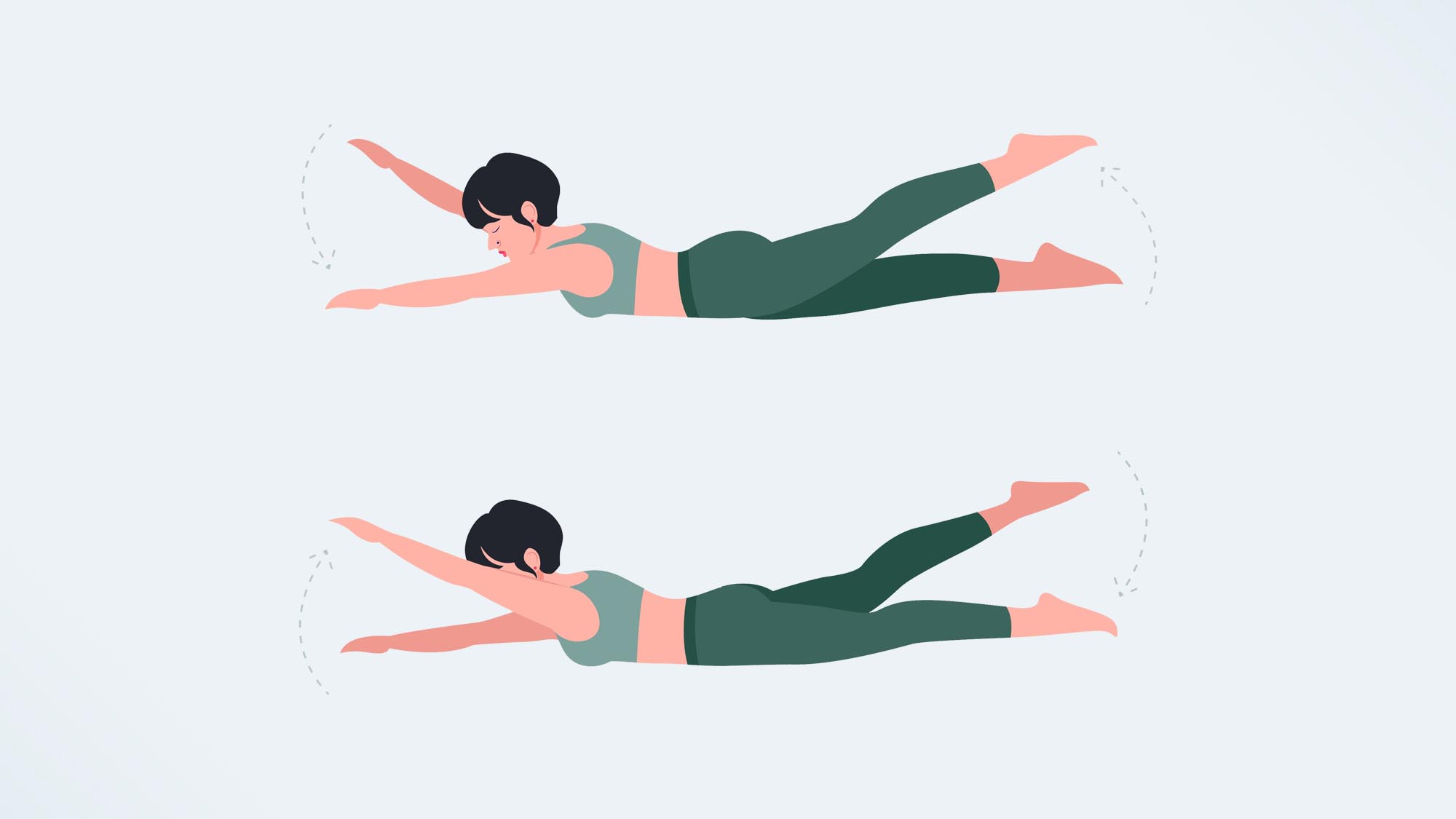
Good form is essential here. Keep your core and glutes engaged to anchor your pubic bone and prevent you from arching your lower back during this exercise. Keep your eyegaze forward just in front of you to avoid arching your neck.
What are the benefits?
Strengthens the posterior chain
During this exercise, you’ll work the muscles running along your spine, the erector spinae, the glutes, and the hamstrings. If you spend a lot of time sitting down, you’ll probably find a lot of these muscles are pretty lazy, so this simple bodyweight exercise is a great way to counteract that slump.
Reduces lower back stiffness
Again, if you spend a lot of time sitting, you might find you struggle with stiffness in your lower back. This exercise forces the spine into a controlled, supported extension. This can help strengthen the small stabilizing muscles between the vertebrae, plus, the active extension is one of the best ways to reduce lower back stiffness.
Builds core stability
Despite lying on your stomach, you’ll still be working the deep core in this exercise, which will prevent your lower back from over-arching. By working the transverse abdominis in this way, you’re teaching your core to stabilize even when the rest of the body is moving — essential for runners and cyclists.
Works on shoulder and hip mobility
Finally, you’ll be working on your hip and shoulder mobility in this move, as it requires a significant range of motion in the sockets while the torso remains stationary.
What are the progressions?
Once you’ve mastered the bodyweight exercise, why not try these progressions to increase the intensity:
- Add a sprint: One of the easiest ways to make this exercise harder is to move faster! The faster you ‘swim’ your arms and legs up and down, the harder your core has to work to stabilize your body. You’ll also get more of a cardio workout the faster you move.
- Move slower: With that in mind, the slower you move, the harder your spine has to work, so mix up the tempo. Pause for a second or two at the top of the reach, focusing on really stretching your limbs as far away from your body as possible.
- Add weight: For a real challenge, add a set of light dumbbells or ankle weights to increase the resistance on the glutes and shoulders.
Pilates essentials we love
More from Tom's Guide
- Not sit-ups, planks, or crunches: I do this simple Pilates exercise every single day to build a strong and stable core and work on my hip flexor mobility
- Not sit-ups or lunges — I use this simple Pilates exercise to sculpt strong obliques, inner thighs and hip stabilizers
- 'I’m a Pilates instructor, and I recommend these 5 core exercises to help older clients build strength and improve posture'