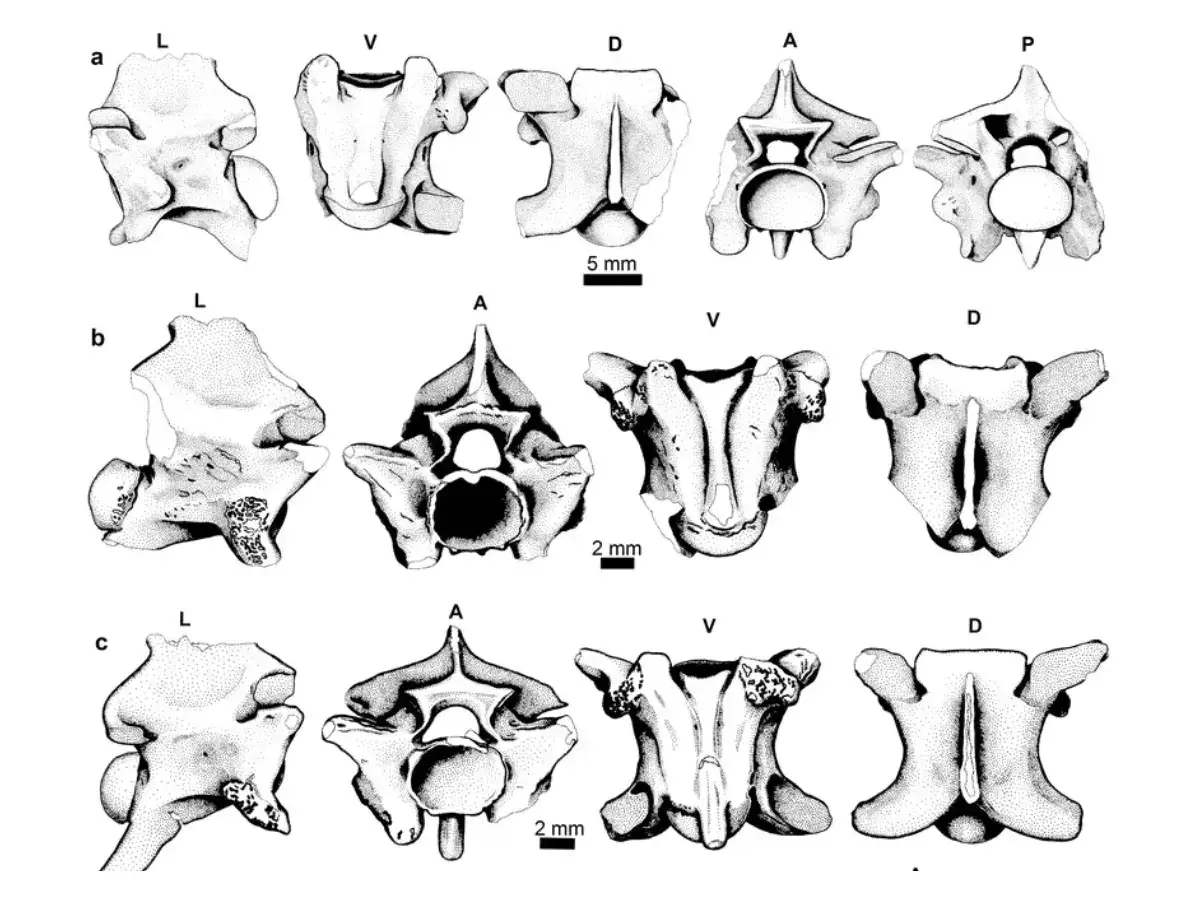
The fossilized remains of a snake found in Greece are being studied due to their incredible dimensions. Experts at the Swiss Journal of Geosciences estimate that this species of extinct snakes, known as Laophis crotaloides, was much bigger than any contemporary species of vipers and might weigh up to 26 kilograms.
These estimates mean that the extinct snake was definitely much larger than most modern species. Nevertheless, there is one aspect that needs to be taken into consideration. As noted by researchers, the evidence consists of a single vertebra that does not belong to a complete skeleton. This means that there is not only the story about an incredibly big snake. There is also the tale about paleontology research and methods used by scientists to restore ancient species.
A fossil once thought lost is re-discovered
Laophis crotaloides has been studied for the first time back in the 19th century. However, at some point, all of the fossils were lost, which did not allow scientists to properly analyze this species. This has changed recently – in 2016. Then, after studying additional material found in northern Greece, specialists made conclusions regarding the nature of the remains.
In the study published by the Swiss Journal of Geosciences, it is stated that the fossil was probably of an exceptionally large extinct species of viper. Notably, caution prevailed throughout the research. It is noted that the size of the snake needed to be assessed because only the vertebra of the animal survived. At the moment, there are no complete skeletons discovered.
At the same time, the size of the vertebra was impressive enough to conclude that the animal in question represented an extremely large snake for a viper.
How one vertebra can indicate a giant snake
For those unfamiliar with the subject matter, it is quite confusing how scientists can make assumptions about the size of the snake from a single bone. However, the vertebra of the snake carries important information about the organism. Studies on modern morphological characteristics demonstrate that vertebra anatomy and proportionality are related to the size of the snake's body and evolution.
Thus, through a comparison between the fossil and modern specimens of snakes, scientists are able to approximate the dimensions of the animal. Such conclusions do not provide exact figures but a scientifically founded assumption. It is argued that such methodology is typical in paleontology because many fossils survive incomplete.
In addition, a larger scientific review published in PubMed Central about gigantism states that the size of an extinct animal can have some uncertainty when fossils are fragmentary. Consequently, one could say that the giant Greek viper must have been huge in size, but the specific number attributed to it should not be taken literally.
What makes king cobras relevant to Laophis
King cobras usually come into play when talking about the giant viper since it is well known around the world as one of the largest venomous reptiles on Earth. They are often described as exceptional and biologically significant animals, which makes them popular venomous reptiles.
However, such an example is given to help readers understand better the scale of the Greek snake. In no way, this does not mean that the fossil was actually compared to live king cobras.
Rather, the vertebral scaling helped determine the size of the giant Greek viper, but it would be wrong to take a sensational fossil story and share it on the Internet.
Why an exceptionally large extinct viper makes scientific sense
Even if Laophis crotaloides seems outlandish, studies show that giant vipers are not scientifically improbable in snake evolution. Studies on viper diversification reveal the existence of various sizes and habitat adaptability among the Viperidae family.
This suggests the potential evolution of a large-size extinct species in response to the right environmental factors. Another fact that contributes to the plausibility of the finding is the existence of a diverse Mediterranean fauna in that area.
Neogene fossil vertebrates in Greece testify to the presence of various reptiles and terrestrial fauna in those ecosystems. Scientists suggest that such data confirm the existence of large-size reptile species in northern Greece during the relevant time period.
What makes Laophis crotaloides important even today
While the creature itself can be disputed, the paleontology method used by scientists makes the case particularly noteworthy. Paleontologists conducted research using the available information, made a comparative analysis, and did not exceed themselves beyond the scope of evidence.
Such methods are especially valuable due to the nature of fossils as incomplete artifacts.
When considering Laophis crotaloides, just one vertebra was required to make the researchers believe that there existed a particularly large viper in ancient Greece. On the other hand, the limitations of the findings were not overlooked by the researchers either.
This combination of hopefulness and conservatism in the research contributes to making the story interesting. The bone could be a specimen belonging to one of the largest vipers discovered to date, but still, no exaggerations took place.
For more news like this visit The Economic Times.