Foreign trainees switch to other industries as virus causes internships to end
A measure to help maintain foreign residents' employment is being hailed by some as a way to improve the conditions of the government's foreign technical intern training program.
Trainees who have been dismissed from their place of work are increasingly switching to jobs in different industries, a previously forbidden move that is now being allowed by the government due to the economic downturn caused by the novel coronavirus crisis.
The fact that the government has recognized them as part of the labor force, however, possibly undermines the basis of the training system.
-- From auto parts to nursing
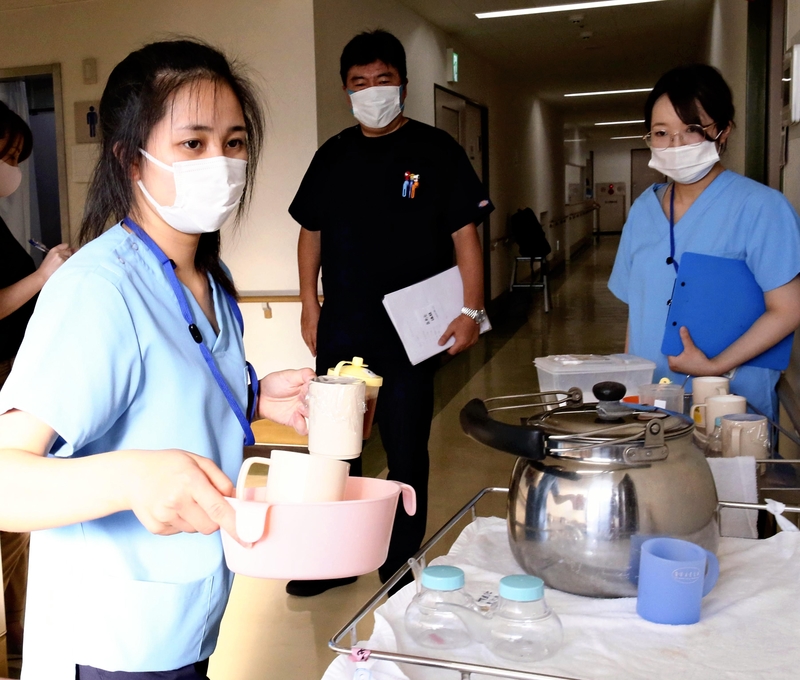
"It's hot, so be careful!" said Do Thi Thu Huong, 24, a Vietnamese woman who works as a nursing assistant. Huong was serving tea to a patient at Kokubunji Hospital in Kokubunji, Tokyo. She also thickens the tea to prevent patients accidentally breathing it in, depending on each person's condition.
In February, Huong was suddenly dismissed from her job at an auto parts factory in Gifu Prefecture, where she had worked for a year and three months as a plastic molding intern. As a result of the pandemic, orders at the factory had fallen and she was forced to move out of the company dormitory.
She was left with a debt of about 500,000, yen which she had taken on before coming to Japan to pay for her trip. Her family in her home country is also dependent on her income.
"I can't just go home," she said.
She sought out new internships while staying at places such as a temple that supports foreign nationals, but all of the businesses in the same industry were suffering due to the virus-caused recession.
At the same time, however, the entry of foreign nationals into Japan has been restricted due to the pandemic, and industries that depend on foreign nationals for their workforce are experiencing a serious labor shortage. Kokubunji Hospital was supposed to have accepted 18 trainees from April onward, but even now there is no prospect of them coming to Japan.
Huong began working at the hospital in July, based on a support program started by the Immigration Services Agency in April. Recently, she has also been responsible for changing diapers.
"At the factory, private conversation was forbidden and all I did was inspect parts all day long," she said. "But here, I can talk to patients and they are happy to see me taking care of them."
-- Improving conditions
According to the agency, 3,248 trainees had been dismissed from their jobs as of Aug. 28 due to the pandemic affecting their training company's circumstances. Of the 2,174 people who wish to continue their training in Japan, only 945 have found another job in the same industry.
The support measures target foreigners who were laid off due to the virus and were unable to find a job in the same industry. As an exception, they will be allowed to work in different industries, change their status of residence to "designated activities" and be allowed to extend their stay for up to one year.
As of Sept. 7, 692 of the 991 foreign nationals who were reemployed under the support program were trainees. This month, the same option is being granted to former trainees who have completed their internship but are having difficulty returning to their home country.
While there have been sluggish results for the new "specified skilled worker" system, which is meant to expand the acceptance of foreign workers, the number of trainees residing in Japan had been increasing every year. Last year, the number rose to about 410,000. Many of them work on a minimum wage, and in addition to human rights violations such as non-payment of wages and violence, there have been a number of disappearances.
"The support measures have led to relief for the trainees who have lost their jobs due to the novel coronavirus," said Jiho Yoshimizu, 51, president of the Tokyo-based Nichietsu Tomoiki Support Group, a nonprofit organization that has provided support to Huong and others, and calls for trainees to be allowed to move to different industries even after the end of the pandemic in order to improve poor working conditions.
The Yomiuri Shimbun
Do Thi Thu Huong, left, a Vietnamese trainee who was dismissed by an auto parts company, works as a nursing assistant in Kokubunji, Tokyo, on Aug. 5.
Read more from The Japan News at https://japannews.yomiuri.co.jp/