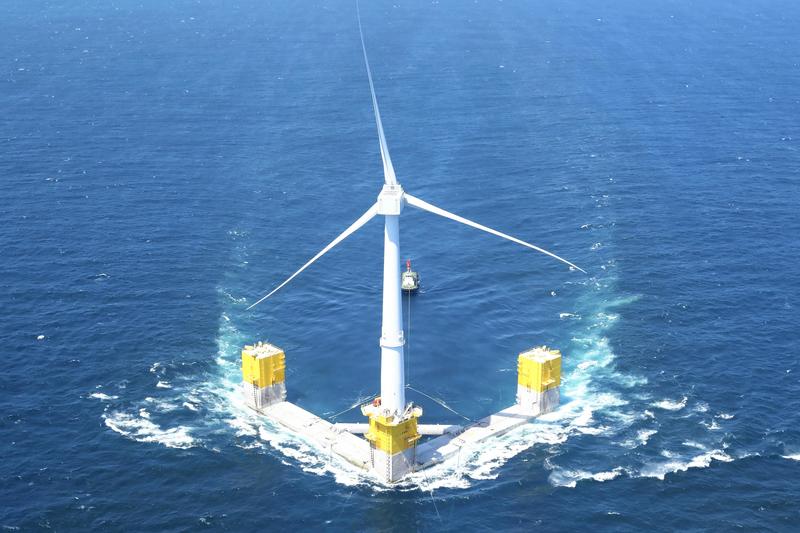
Operators of offshore wind power generation in Japan must be domestic corporations, the Japanese government has decided, as it moves to prevent information about its territorial waters from leaking out to other countries.
Furthermore, if the operators use foreign vessels for offshore research, they must receive the government's consent in advance.
While offshore wind power business is expected to expand in the future, the government aims to effectively exclude Chinese companies from them, considering the economic security perspective.
The Economy, Trade and Industry Ministry and the Land, Infrastructure, Transport and Tourism Ministry began the first public application process for Japan's offshore wind power project off Goto, Nagasaki Prefecture, on June 24. Among the eligibility criteria specified for participating in the operation is to be a "domestic corporation" with headquarters or principal offices in Japan. The same criteria will be applied to future projects.
Power producers selected through the public application process will be allowed to occupy the waters for up to 30 years. There are fears that if the data on seabed topography, geology and ocean currents collected by the operators are leaked to foreign countries, they could be used for military purposes, such as submarine navigation or special forces landing operations.
The government explains that limiting the businesses to domestic corporations will make it easier to keep track of their activities and lower the security risk.
Regarding marine research, 10 ministries and agencies, including the National Security Secretariat of the Cabinet Secretariat, the Foreign Ministry, the Internal Affairs and Communications Ministry and the Natural Resources and Energy Agency, have agreed on the policy to require prior consent for all marine research for economic purposes using foreign vessels.
Until the government gives its consent, permission for other activities related to the project will be withheld, even if marine research is conducted before a public application for power generation projects.
Under the Law on Navigation of Foreign Ships through the Territorial Sea and Internal Waters, which prohibits foreign ships from loitering or moving irregularly in Japanese territorial waters, the Japan Coast Guard will force such ships to leave the area. The government plans to take stern measures, such as preventing such companies from receiving project orders.
In 2019, there were three cases in which Chinese research vessels tried to conduct marine research for economic purposes in Japanese territorial waters. Two of these cases were for offshore wind power and the other was for laying submarine cables.
On the other hand, in the field of offshore wind power generation, cooperating with European companies with proven track records is expected. Such companies can enter the domestic market by establishing Japanese corporations or investing in special-purpose companies in Japan. However, entities such as the National Security Secretariat and the National Police Agency will closely examine the security risks of such corporations and take prudent measures.
Japan is promoting offshore wind power as part of its efforts to expand renewable energy. Following the project off Goto, the government started procedures in June to designate areas off the coast of Choshi, Chiba Prefecture, and Yurihonjo, Akita Prefecture, as new promotion areas.
Read more from The Japan News at https://japannews.yomiuri.co.jp/